Moderna seeks Health Canada approval for COVID-19 vaccine for kids under six
Advertisement
Read this article for free:
or
Already have an account? Log in here »
To continue reading, please subscribe:

Digital Subscription
One year of digital access for only $205*
- Enjoy unlimited reading on winnipegfreepress.com
- Read the E-Edition, our digital replica newspaper
- Access News Break, our award-winning app
- Play interactive puzzles
*First annual payment billed as $205.00 + GST for one year. This annual subscription will automatically renew at $233.00 + GST every 52 weeks (10% off the regular annual price of $259.35). Offer available to new and qualified returning subscribers only. Cancel any time.
To continue reading, please subscribe:
Add Free Press access to your Brandon Sun subscription for only an additional
$1 for the first 4 weeks*
- Enjoy unlimited reading on winnipegfreepress.com
- Read the E-Edition, our digital replica newspaper
- Access News Break, our award-winning app
- Play interactive puzzles
*Your next Brandon Sun subscription payment will increase by $1.00 and you will be charged $17.95 plus GST for four weeks. After four weeks, your payment will increase to $24.95 plus GST every four weeks.
Read unlimited articles for free today:
or
Already have an account? Log in here »
Hey there, time traveller!
This article was published 29/04/2022 (1624 days ago), so information in it may no longer be current.
OTTAWA – The first COVID-19 vaccine for infants and very young children is now under review by Health Canada.
Moderna Canada President Patricia Gauthier said Friday the company sent an application to the Canadian vaccine regulator late Thursday for a vaccine to protect children between six months and five years old.
“It’s now in the hands of Health Canada,” she said at an event in Montreal where the company announced plans to build a vaccine production plant.

Health Canada authorized Moderna’s Spikevax vaccine for adults in December 2020, for teenagers in August 2021 and for children ages six to 11 in March.
There is no vaccine authorized for children younger than five. Pfizer-BioNTech’s Comirnaty vaccine can be used on children as young as five but its version for younger children was delayed because two doses didn’t produce a strong enough immune response.
Data from adding a third dose is expected in May.
Moderna applied for approval of the vaccine for young children in the United States Thursday. The U.S. Food and Drug Administration Friday said it would consider applications from both Moderna and Pfizer together possibly as early as June 8 and as late as June 22.
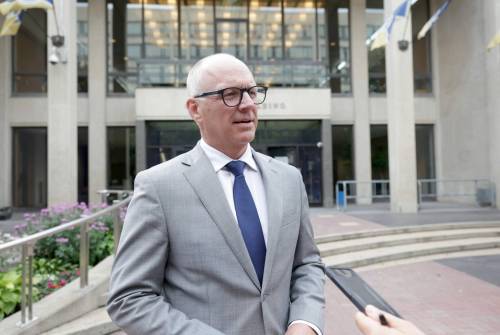
Dr. Supriya Sharma, the chief medical adviser at Health Canada who oversees the vaccine authorization file, said in an interview that she can’t put a timeline on the Moderna review because they’ve only had the submission since late Thursday night.
She said the application will be analyzed using the same risk-benefit approach applied to vaccines authorized for older age groups.
“We’re still looking at the same components,” she said. “So it’s safety, efficacy and quality. It’s the same types of components that we get for the submission, and we’re really looking at benefits outweighing the risks.”
It took Health Canada almost three months to authorize the Moderna vaccine for adolescents, and almost four months for children ages six to 11.
Moderna said a trial of 6,700 children determined the vaccine was safe and produced a similar antibody response to the one that is seen in adults.
A single dose for children under six is 25 micrograms — one-quarter of the size given to adults and teenagers and half the size used for children ages six to 11.
The application is for the vaccine to be given in two doses, four weeks apart.
The trial took place mainly during the wave of the Omicron variant and the vaccine was less effective at preventing infection in kids than previous trials in adults.
The effectiveness of the vaccine against infection in adults also dropped during the Omicron wave, though the shot maintained excellent protection against serious illness, hospitalization and death.
The company said the vaccine was 51 per cent effective at preventing symptoms in children six months to two years old and 37 per cent effective against symptoms in children two to five years old. It said those are similar results to what was seen in effectiveness against Omicron for adults.

Because children have very low rates of serious illness due to COVID-19, the trial could not determine the impact on preventing serious illness.
Sharma said it’s true the risk of serious illness for young kids is low but “it’s not nothing,” which plays into the risk-benefit analysis. About two per cent of the Canadians hospitalized with COVID-19 are under the age of 11 and some 25 children under 11 have died.
Fourteen of those deaths have taken place since Omicron became dominant and infection rates soared.
Officially, more than 385,000 kids under 11 have tested positive for COVID-19, and almost half of those are since Omicron arrived in Canada at the end of November.
However, most provinces stopped testing children widely for COVID-19 after the December holidays. Infection rates in recent months are believed to be 10 to 25 times higher than recorded since then.
A study by the Centers for Disease Control in the United States recently reported an estimated 75 per cent of American children had been infected with COVID-19 by the end of February.
Yukon pediatrician Dr. Katharine Smart, the president of the Canadian Medical Association, also said you can’t look at the risk for kids by comparing it to the risk for adults.
She said COVID-19 poses different risks to many age groups, and you have to look specifically at what is happening with young children. On that front, she said COVID-19 is one of the biggest disease risks facing kids right now.
“The message that’s important for parents to understand is given right now how infectious Omicron is and how rapidly it’s spreading, your child will encounter Omicron,” she said. “It’s just a matter of when. So the decision, I think, for a parent is: Do you want them to encounter Omicron vaccinated or unvaccinated? Because they are going to encounter it.”
Nationally, 40 per cent of children between five and 11 are fully vaccinated, as are 84 per cent of kids and teens between 12 and 17 and 88 per cent of everyone over the age of 18.
This report by The Canadian Press was first published April 29, 2022.
Related Articles
Moderna announces Montreal-area vaccine facility
Advertisement Advertise With Us
Advertisement Advertise With Us