Shanghai starts China’s biggest COVID-19 lockdown in 2 years

Advertisement

Advertise with us

BEIJING (AP) — China began its most extensive coronavirus lockdown in two years Monday to conduct mass testing and control a growing outbreak in Shanghai as questions are raised about the economic toll of the nation's “zero-COVID” strategy.

Read this article for free:


or

Already have an account? Log in here »

To continue reading, please subscribe:

Subscribe and receive a limited-edition Free Press branded hat or tote.

Digital Subscription

One year of digital access for only $205*

  • Enjoy unlimited reading on winnipegfreepress.com
  • Read the E-Edition, our digital replica newspaper
  • Access News Break, our award-winning app
  • Play interactive puzzles

*First annual payment billed as $205.00 + GST for one year. This annual subscription will automatically renew at $233.00 + GST every 52 weeks (10% off the regular annual price of $259.35). Offer available to new and qualified returning subscribers only. Cancel any time.

To continue reading, please subscribe:

Add Free Press access to your Brandon Sun subscription for only an additional

$1 for the first 4 weeks*

  • Enjoy unlimited reading on winnipegfreepress.com
  • Read the E-Edition, our digital replica newspaper
  • Access News Break, our award-winning app
  • Play interactive puzzles
Start now

*Your next Brandon Sun subscription payment will increase by $1.00 and you will be charged $17.95 plus GST for four weeks. After four weeks, your payment will increase to $24.95 plus GST every four weeks.

Hey there, time traveller!
This article was published 27/03/2022 (1602 days ago), so information in it may no longer be current.

BEIJING (AP) — China began its most extensive coronavirus lockdown in two years Monday to conduct mass testing and control a growing outbreak in Shanghai as questions are raised about the economic toll of the nation’s “zero-COVID” strategy.

Shanghai, China’s financial capital and largest city with 26 million people, had managed its smaller previous outbreaks with limited lockdowns of housing compounds and workplaces where the virus was spreading.

But the citywide lockdown that will be conducted in two phases will be China’s most extensive since the central city of Wuhan, where the virus was first detected in late 2019, confined its 11 million people to their homes for 76 days in early 2020. Millions more have been kept in lockdown since then.
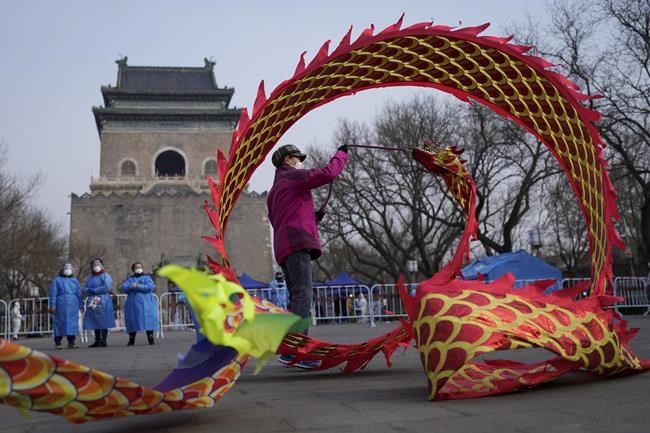
Community workers wearing protective suits watch over a masked resident twirling a dragon shaped ribbon near a barricaded coronavirus testing site setup outside the Drum Tower, Wednesday, March 23, 2022, in Beijing, China. A fast-spreading variant known as
Community workers wearing protective suits watch over a masked resident twirling a dragon shaped ribbon near a barricaded coronavirus testing site setup outside the Drum Tower, Wednesday, March 23, 2022, in Beijing, China. A fast-spreading variant known as "stealth omicron" is testing China's zero-tolerance strategy, which had kept the virus at bay since the deadly initial outbreak in the city of Wuhan in early 2020. (AP Photo/Andy Wong)

Shanghai’s Pudong financial district and nearby areas will be locked down from Monday to Friday as mass testing gets underway, the local government said. In the second phase of the lockdown, the vast downtown area west of the Huangpu River that divides the city will start its own five-day lockdown Friday.

Residents will be required to stay home and deliveries will be left at checkpoints to ensure there is no contact with the outside world. Offices and all businesses not considered essential will be closed and public transport suspended.

Already, many communities within Shanghai have been locked down for the past week, with their housing compounds blocked off with blue and yellow plastic barriers and residents required to submit to multiple tests for COVID-19. Shanghai’s Disneyland theme park is among the businesses that closed earlier. Automaker Tesla is also suspending production at its Shanghai plant, according to media reports.

Panic-buying was reported on Sunday, with supermarket shelves cleared of food, beverages and household items. Additional barriers were being erected in neighborhoods Monday, with workers in hazmat suits staffing checkpoints.

In-person observations of the April 5 Tomb Sweeping Festival have been canceled and memorials will instead be held online.

Some workers, including traders at the city’s stock market, were preparing to stay within a COVID-19 “bubble” for the duration of the lockdown.

Li Jiamin, 31, who works in the finance industry, said she had packed several days of clothing and supplies, and her company was sorting out sleeping and eating arrangements.

“The overall impact is still great,” Li told The Associated Press, pointing especially to losses suffered by workers in the informal sector who have no such support.

Huang Qi, 35, who works at a local university, said he had undergone a lockdown at home before and prepared for the new round by stocking up.
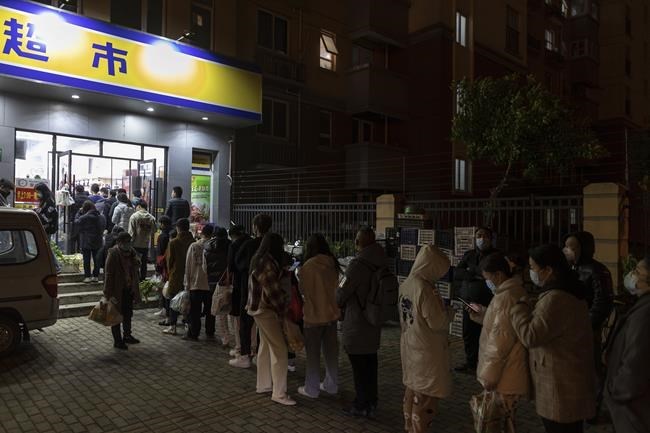
Residents wearing face masks to help protect from the coronavirus line up outside a supermarket at night to buy groceries on Sunday, March 27, 2022, in Shanghai, China. China began locking down most of its largest city of Shanghai on Monday as part of its strict COVID-19 strategy, amid questions over the policy's economic toll on the country. (AP Photo)

“I think if the closure continues like this, our school workers will not be affected much, but what about those who work in the real economy? How can their business be maintained?” Huang said.

“I still hope that our society can find a better balance between ensuring normal life and epidemic prevention and control,” Huang added.

Shanghai detected another 3,500 cases of infection on Sunday, though all but 50 were people who tested positive for the coronavirus but were not showing symptoms of COVID-19. While people who are asymptomatic can still infect others, China categorizes such cases separately from “confirmed cases” — those in people who are sick — leading to much lower totals in daily reports.

Nationwide, 1,219 new confirmed cases of domestic infection were detected on Sunday, more than 1,000 of them in the northeastern province of Jilin, along with 4,996 asymptomatic cases, the National Health Commission reported on Monday.

Two deaths were reported March 20 in Jilin. Before that, mainland China’s official death toll had stood at 4,636 for a year.

China has reported more than 56,000 confirmed cases nationwide this month, with the surge in Jilin accounting for most of them.

Jilin province is enforcing travel bans and partial lockdowns in several cities, including Changchun, one of the centers of the Chinese auto industry. Although the province has seen more than 1,000 new confirmed cases per day, prevention and control measures taken there do not appear to have been as extreme as in other places.

As has become customary, Jilin has been building pre-fabricated temporary wards to house COVID-19 patients and those under observation as suspected cases. The city of Suzhou, about an hour from Shanghai, as well as Changsha in the country’s center and Shenyang in the northeast are also erecting such structures capable of housing more than 6,000 people.

Shanghai itself has converted two gymnasiums, an exhibition hall and other facilities to house potential infected patients.
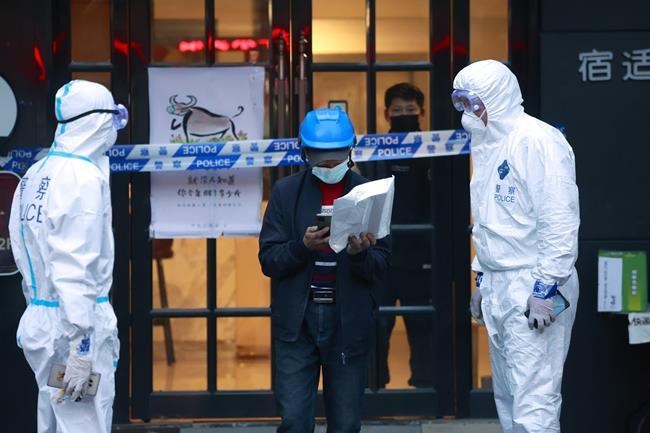
FILE - A delivery man walks by police officers with protective suit outside of a hotel in Shanghai, China, on March 15, 2022. China began locking down most of its largest city of Shanghai on Monday, March 28, as part of its strict COVID-19 strategy, amid questions over the policy's economic toll on the country.(AP Photo, File)

China has called its long-standing “zero-tolerance” approach the most economical and effective prevention strategy against COVID-19.

The new measures being enforced in Shanghai aim to “curb the virus spread, protect people’s life and health, and achieve the dynamic zero-COVID target as soon as possible,” the city’s COVID-19 prevention and control office stated in an announcement Sunday evening.

That requires lockdowns and mass testing, with close contacts often being quarantined at home or in a central government facility. The strategy focuses on eradicating community transmission of the virus as quickly as possible.

While officials, including Communist Party leader Xi Jinping have encouraged more targeted measures, local officials tend to take a more extreme approach, concerned with being fired or otherwise punished over accusations of failing to prevent outbreaks.

Most recently, Hunan province, which has seen relatively few cases, ordered punishments against 19 officials for “failure to vigorously consolidate anti-pandemic policies,” state broadcaster CCTV reported Monday.

With China’s economic growth already slowing, the extreme measures are seen as worsening difficulties hitting employment, consumption and even global supply chains. With a 21-day curfew in place for all foreigners arriving from abroad, travel between China and other countries has fallen dramatically.

On Friday, the International Air Transport Association announced it was moving its annual general meeting from Shanghai to Doha, citing “continuing COVID-19 related restrictions on travel to China.”

“It is deeply disappointing that we are not able to meet in Shanghai as planned,” IATA Director General Willie Walsh said in a news release.

Still, Shanghai’s announcement of the dates when the two lockdowns would be lifted appeared to show a further refinement in China’s approach. Previous citywide lockdowns had been open-ended.
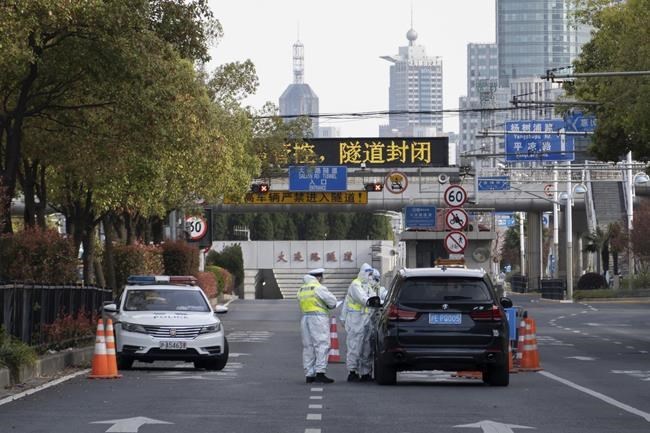
Traffic police wearing protective suits check on a vehicle before an underpass tunnel which has closed following the coronavirus outbreak in Shanghai, China, Monday, March 28, 2022. China began its largest lockdown in two years Monday to conduct mass testing and control a growing outbreak in its largest city of Shanghai as questions are raised about the economic toll of the nation's
Traffic police wearing protective suits check on a vehicle before an underpass tunnel which has closed following the coronavirus outbreak in Shanghai, China, Monday, March 28, 2022. China began its largest lockdown in two years Monday to conduct mass testing and control a growing outbreak in its largest city of Shanghai as questions are raised about the economic toll of the nation's "zero-COVID" strategy. (Chinatopix Via AP)

Although China’s vaccination rate is around 87%, it is considerably lower among older people who are more likely to become seriously ill if they contract the virus.

In Hong Kong, Chief Executive Carrie Lam said the government was still considering next steps in what has been criticized as a halting response to a recent fifth wave of COVID-19 infections that has led to tens of thousands of cases and more than 7,000 deaths.

Lam said no decision has been made on whether or when to test all 7.4 million residents of the southern Chinese semi-autonomous region.

“I don’t have a timetable yet. It’s not easy to predetermine a timetable, in the same way that I don’t know how quickly the cases will come down,” Lam told reporters at a daily briefing.

___

Associated Press researcher Chen Si contributed to this story from Shanghai, China.

Report Error Submit a Tip

More Stories

Safety upgrades at Whiteshell park to begin soon

Free Press staff 2 minute read Preview

Safety upgrades at Whiteshell park to begin soon

Free Press staff 2 minute read 7:06 PM CDT

Construction on safety improvements at a site where two boys drowned in Whiteshell Provincial Park will soon get underway.

The improvements, which include new barriers and fenced lookouts, signage and a new portage for kayakers and canoeists at Sturgeon Falls, was promised by the province after the deaths of brothers Maximo Au Ramirez, 10, and Aaron Au Ramirez, 13, who went missing in Nutimik Lake on July 18.

The province said in a news release Friday the upgrades would begin shortly.

“We have a responsibility to do everything we can to make this site safer and to prevent another family from going through this kind of heartbreak,” said Environment Minister Mike Moyes in the release. “These measures will make the Sturgeon Falls area safer and ensure that Manitobans and visitors are protected when the area reopens.”

Read
7:06 PM CDT

Proposed Transcona development — which could add 20,000 people — gets thumbs down from residents

Joyanne Pursaga 5 minute read Preview

Proposed Transcona development — which could add 20,000 people — gets thumbs down from residents

Joyanne Pursaga 5 minute read 6:15 PM CDT

Dozens of Winnipeggers fear plans to make way for up to 20,000 more people to live in south Transcona would dramatically alter their neighbourhood and tie hefty fees for new services to their property titles.

If city council adopts the proposed South Transcona secondary plan, all future development applications would need to conform to its goals. The affected area is located south of Dugald Road, north of St. Boniface Road, east of Plessis Road and west of Murdock Road.

Homeowner Virginia Page Jähne fears the plan could add a massive tab to the title of her 4.3-acre property to cover services required for the development.

“My main concern is that they are wanting to put $1.4 million onto my title to pay for this. Now, they say that I will not have to pay it unless I subdivide. But if a person comes by and wants to buy from me … and they see that $1.4 million … what’s the first thing (they’re) going to do?” said Page Jähne, in an interview.

Read
6:15 PM CDT

Manitoba prepares project pitches for investment summit

Gabrielle Piché 6 minute read Preview

Manitoba prepares project pitches for investment summit

Gabrielle Piché 6 minute read 6:17 PM CDT

Powerhouse investors may hear pitches on Manitoba mines, silica sand projects and a massive greenhouse during Canada’s first major investors summit.

The Manitoba government is finalizing its list of projects to pitch at the Canada Investment Summit next month.

“The conversations that’ll be had… will be about investments in the billions of dollars,” Premier Wab Kinew said Friday.

“It’ll be one step among many that we take to build a bright future in Manitoba.”

Read
6:17 PM CDT

‘Disrespectful’: residents frustrated after Wyatt arrives hour late to committee meeting

Joyanne Pursaga 3 minute read Preview

‘Disrespectful’: residents frustrated after Wyatt arrives hour late to committee meeting

Joyanne Pursaga 3 minute read Updated: 1:00 PM CDT

Several Winnipeggers attending a city development hearing on Thursday expressed frustration that one councillor arrived about an hour late, delaying the matter from being heard.

Coun. Russ Wyatt, who continues to attend city hall while facing criminal charges, began participating in the 9:30 a.m. East Kildonan-Transcona community committee meeting at 10:35 a.m.

A resident who hoped to speak at the meeting about a development plan in south Transcona noted the tardiness led the committee to bump the topic down on its agenda, while dozens waited to speak on it.

Christina Pyra eventually opted to leave city hall instead of waiting for her turn to make a presentation, to avoid missing a work commitment.

Read
Updated: 1:00 PM CDT

Rainbow Stage’s Legally Blonde a lovely legal musical

Holly Harris 6 minute read Preview

Rainbow Stage’s Legally Blonde a lovely legal musical

Holly Harris 6 minute read 5:44 PM CDT

Omigod, you guys! Rainbow Stage kicked off its penultimate summer production Thursday with a high-octane joy machine bathed in a sea of pink.

Inspired by the 2001 Hollywood film starring Reese Witherspoon, and Amanda Brown’s same-titled novel, the award-winning Legally Blonde: The Musical — featuring a book by Heather Hach, with music/lyrics by Laurence O’Keefe and Nell Benjamin — opened on Broadway in April 2007, followed by a subsequent West End run.

The tale — equal parts cheesy rom-com and potent siren call for female autonomy and empowerment — focuses on quintessential Cali-girl Elle Woods (a pitch-perfect Claire Mac Master). A proud daughter and president of Delta Nu sorority house, she enrols at Harvard Law School to win back her upwardly mobile ex-boyfriend, Warner Huntington III (Duncan Cox).

Laser-focused on marrying a “Jackie, not a Marilyn,” Warner dreams of becoming an American senator, latching onto uber-preppy fellow pupil Vivienne Kensington (Julie Davis), who becomes Elle’s arch nemesis.

Read
5:44 PM CDT

Manitoba supports MAID delay: Asagwara

Carol Sanders 5 minute read Preview

Manitoba supports MAID delay: Asagwara

Carol Sanders 5 minute read 2:00 AM CDT

The number of Manitobans receiving medical assistance in dying in 2026 is on track with previous years while the plan to extend it to those suffering from mental illness is delayed indefinitely by the federal government — a move Manitoba’s health minister supports.

“There’s so much more work that needs to be done,” Uzoma Asagwara said.

The parliamentary committee that issued its recommendation in June was the third special committee of Parliament struck to assess the eligibility of people with mental illness since 2021, when MAID eligibility was expanded to include people who were not at the end of their lives.

A key condition for MAID eligibility is that a patient must be suffering from a grievous and irremediable medical condition.

Read
2:00 AM CDT