NEAT way to lose weight
Increasing your non-exercise activity thermogenesis will set you on the right path

Advertisement
Read this article for free:
or
Already have an account? Log in here »
To continue reading, please subscribe:

Digital Subscription
One year of digital access for only $205*
- Enjoy unlimited reading on winnipegfreepress.com
- Read the E-Edition, our digital replica newspaper
- Access News Break, our award-winning app
- Play interactive puzzles
*First annual payment billed as $205.00 + GST for one year. This annual subscription will automatically renew at $233.00 + GST every 52 weeks (10% off the regular annual price of $259.35). Offer available to new and qualified returning subscribers only. Cancel any time.
To continue reading, please subscribe:
Add Free Press access to your Brandon Sun subscription for only an additional
$1 for the first 4 weeks*
- Enjoy unlimited reading on winnipegfreepress.com
- Read the E-Edition, our digital replica newspaper
- Access News Break, our award-winning app
- Play interactive puzzles
*Your next Brandon Sun subscription payment will increase by $1.00 and you will be charged $17.95 plus GST for four weeks. After four weeks, your payment will increase to $24.95 plus GST every four weeks.
Read unlimited articles for free today:
or
Already have an account? Log in here »
Hey there, time traveller!
This article was published 28/09/2019 (2544 days ago), so information in it may no longer be current.
If you can’t lose weight no matter what you do, you’re not alone.
I receive dozens of emails every week that voice a lot of the same frustrations.
“I used to always be able to follow this diet for a while and drop 10 pounds, but it doesn’t work anymore…”
“I can’t seem to get the scale to move, and my spare tire isn’t going anywhere, either, no matter what fad diet I try next.”
You see, your body is programmed to keep you alive. It does a good job of that, but it can be a big pain in the arse when dieting.
But I’m here to tell you there’s hope.
It’s easy to think your circumstances are unique and there’s too much on your plate or your metabolism sucks or whatever.
But I guarantee there’s someone with your same obstacles who has already reached their goal and then some — I probably have a former client who is exactly like you.
I’ve seen single moms with two young kids and a career absolutely crush it. I’ve seen CEOs and business owners who travel 300 days a year absolutely crush it. I’ve seen dads who work nights and care for kids on off days absolutely crush it.
Frankly, fitness makes you more resilient to the big stressors and challenges in your life. It’s the ingredient to success for a lot of high performers.
Without it to cope, you turn to quick fixes such as alcohol and crappy food, which make matters worse in the long run, and that does you no favours.
Whether it’s building a business, building a body or building a family, all of them take work. But working smarter, not necessarily harder, is the name of the game, and I’ll show you how to avoid one deadly mistake that slows weight loss in its tracks.
Metabolism 101
First, let’s break down what the metabolism is.
Your metabolism is largely driven by three things: resting metabolic rate (RMR), thermic effect of food (TEF) and activity (think exercise — but not just the gym kind, as I’ll explain.)
RMR is the number of calories you burn each day at rest — just to breathe, think and live — which accounts for a whopping 70 per cent of calories burned.
The bigger you are, the higher your RMR. If you’re obese, you actually have a high metabolism, because body fat requires calories to sustain it. (To avoid any hate mail, this article is aimed at otherwise healthy individuals with high body fat. There are certain conditions that can cause a slowed metabolic rate, but they are beyond the scope of this article and typically addressed by a doctor if you get regular bloodwork.)
Fat-free mass is also a factor in your total RMR. The more muscle you have, the higher your calorie needs. But this category includes your organs as well. Your organs burn more calories than your muscles at rest to serve their roles in keeping you alive and well.
Gender and age play a small role. A woman’s resting metabolic rate is three per cent lower than that of a man of the same height and weight. This is mostly due to men having more lean body mass and less fat at any given body weight, not some major hormonal advantage.
Your metabolism also slows subtly as you age, but this is as much due to a decrease in muscle and activity as it is hormonal changes.
What The TEF?
The second big factor in metabolism is the thermic effect of the foods you eat, or TEF for short. This is the energy expended through digesting and storing food. Carbs, fat and protein each have different thermic effects, with protein the clear winner, with as much as 30 per cent of the calories you eat from protein burned off in the digestive process.
For example, if you eat 100 calories of protein, you’ll only use and absorb about 70-80 calories of it (remember that embarrassing episode of “meat sweats” at the Brazilian BBQ joint? Yeah, this explains it.)
Do You Like to Move It, Move It?
The last factor is your activity levels. You may be thinking of intense gym workouts here, but a bigger factor in the calories you burn each day is your non-exercise activity thermogenesis (NEAT), which accounts for movement that isn’t conventional exercise.
While the other components of your metabolism are pretty much set and you can’t do much to change them, especially in the short term, activity and particularly NEAT is the one component you do have control over.
If you take one thing away from this article, to increase your metabolism, it’s wise to make a concerted effort to move more.
The biggest difference on paper between that friend with a “fast metabolism” and yourself is differences in NEAT, which can vary by up to 2,000 calories per day. No, that’s not a misprint.
The Mayo Clinic designed a study to look at the mechanisms that hinder fat gain. They studied 16 subjects (12 males and four females), ranging in age from 25 to 36 years.
The subjects volunteered to eat 1,000 excess calories a day (above what they needed to maintain weight) for eight weeks.
The researchers used highly accurate methods to measure changes in body fat (DEXA scan). Some of the subjects gained 10 times more fat than others, ranging from 0.8 to nine pounds. The overall weight gain ranged from three to 12 pounds, some of which was additional muscle.
NEAT explained the big variation in weight gain. The subjects who rated high in daily expenditure from NEAT were among those who gained the least.
One participant burned an additional 690 calories more than baseline through NEAT alone.
To put this in the simplest terms possible, let’s take a hypothetical scenario with two men of similar stature who both weigh 220 pounds.
One guy works in construction, goes to the gym three times a week, and still finds time to walk his golden retriever every night. The other guy works in accounting sitting at a computer all day, hits the gym three times a week and his favourite nighttime activity is watching football.
In both individuals, the energy expended from the resting metabolic rate, thermic effect of food and the gym sessions is basically the same. But the guy with the active job needs 2,800 calories to maintain his weight while the sedentary guy needs only 2,200. The 600-calorie difference in their energy expenditure comes from the gap in NEAT.
Yes, you may think this is bad news because you have a sedentary job. You sit in a car, at a computer and on a couch for big chunks of the day. But that doesn’t mean you can’t increase your NEAT in other ways.
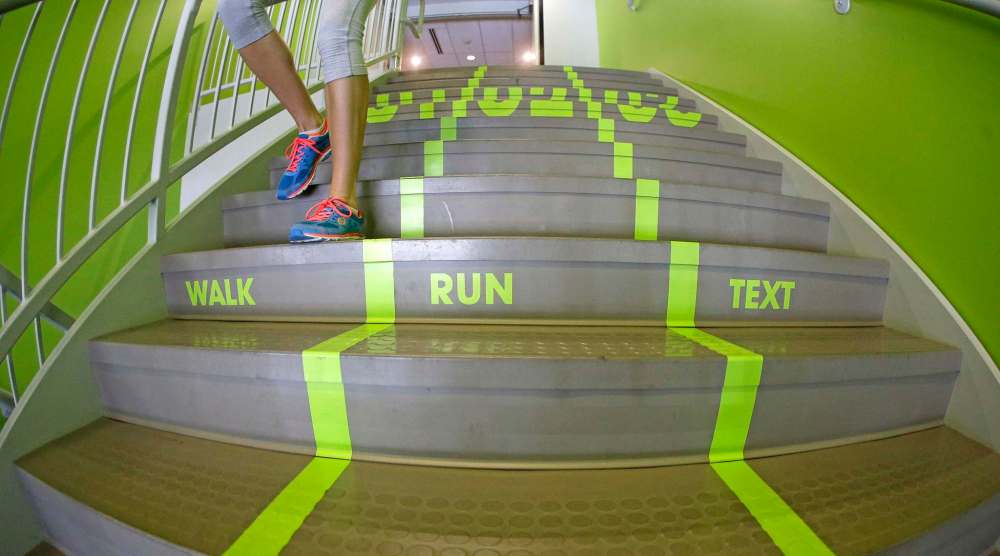
Your boss may not like me, but taking frequent breaks to walk and move will do wonders. Try to take the stairs or park farther away. Maybe pump out a few squats or push-ups in your office every couple hours.
The take-home point is this and it’s good news. Your metabolism isn’t slow. You’re simply eating more than you think you are, overestimating calories burned through workouts at the gym and not doing enough NEAT.
While lifting weights and conventional cardio should be part of your routine, it doesn’t increase calorie burn as much as people think and only accounts for two to three per cent of your week. However, increasing your NEAT alongside your weekly exercise can be the one-two punch to help drive weight loss.
So here are four steps to bump up your NEAT:
• Use the activity tracker on your smartphone or FitBit and aim to hit a certain number of steps per day. Sure, 10,000 is ideal, but aim for the 5,000-7,000 range if you’re starting from ground zero. But please don’t eat back those calories. The calories burned on those devices is a best guess and often wildly inaccurate.
• Get up from your desk and move a few minutes every few hours. You can email me for a 30-day challenge to put up on your bulletin board in the office.
• Plan extracurricular activities that involve movement during your evenings and weekends.
• Make a morning or nightly walk part of your routine (on a treadmill while watching TV this winter is fine, too).
Mitch Calvert is a Winnipeg-based weight-loss coach for men and women like his former self. For a free 30-day NEAT challenge that only requires your body and four feet of floor space, email him with the subject “NEAT” at mitch@mitchcalvert.com. To apply for his next BYOB (Burn Your Own Belly) program, email him with the subject “Interested” or go to mitchcalvert.com to download his free diet secrets cheat sheet.
Our newsroom depends on a growing audience of readers to power our journalism. If you are not a paid reader, please consider becoming a subscriber.
Our newsroom depends on its audience of readers to power our journalism. Thank you for your support.
Our newsroom depends on a growing audience of readers to power our journalism. If you are not a paid reader, please consider becoming a subscriber.
Our newsroom depends on its audience of readers to power our journalism. Thank you for your support.
Advertisement Advertise With Us
Advertisement Advertise With Us