New school allergy guidelines recommend against banning specific foods

Advertisement

Advertise with us

New guidelines aimed at helping schools and daycares protect children with allergies say there's no evidence that blanket bans on specific foods protect children.

Read this article for free:


or

Already have an account? Log in here »

To continue reading, please subscribe:

Subscribe and receive a limited-edition Free Press branded hat or tote.

Digital Subscription

One year of digital access for only $205*

  • Enjoy unlimited reading on winnipegfreepress.com
  • Read the E-Edition, our digital replica newspaper
  • Access News Break, our award-winning app
  • Play interactive puzzles

*First annual payment billed as $205.00 + GST for one year. This annual subscription will automatically renew at $233.00 + GST every 52 weeks (10% off the regular annual price of $259.35). Offer available to new and qualified returning subscribers only. Cancel any time.

To continue reading, please subscribe:

Add Free Press access to your Brandon Sun subscription for only an additional

$1 for the first 4 weeks*

  • Enjoy unlimited reading on winnipegfreepress.com
  • Read the E-Edition, our digital replica newspaper
  • Access News Break, our award-winning app
  • Play interactive puzzles
Start now

*Your next Brandon Sun subscription payment will increase by $1.00 and you will be charged $17.95 plus GST for four weeks. After four weeks, your payment will increase to $24.95 plus GST every four weeks.

Hey there, time traveller!
This article was published 05/05/2021 (1961 days ago), so information in it may no longer be current.

New guidelines aimed at helping schools and daycares protect children with allergies say there’s no evidence that blanket bans on specific foods protect children.

The guidelines, created by an international panel of stakeholders including health-care experts, school principals, parents and professional allergy organizations, also recommend that schools keep a supply of epinephrine auto-injectors.

The guidelines, based on a review of the scientific evidence and published in the Journal of Allergy and Clinical Immunology on Wednesday, are the first of their kind, said Dr. Susan Waserman, the chair of the guidelines panel and a professor of medicine at McMaster University in Hamilton, Ont.
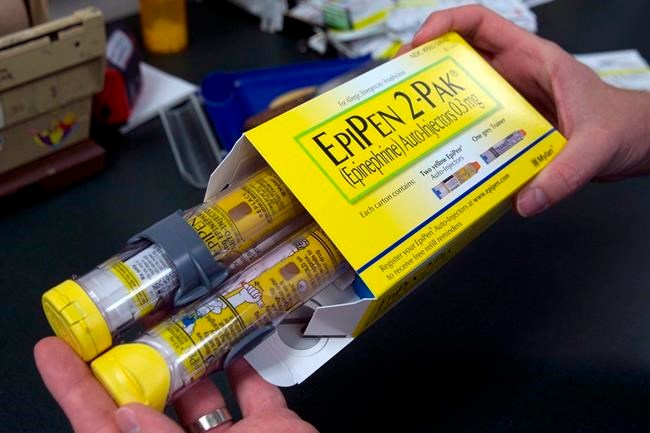
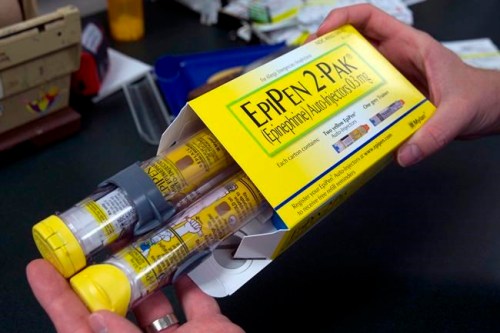
In this July 8, 2016, file photo, a pharmacist holds a package of EpiPens epinephrine auto-injector, a Mylan product, in Sacramento, Calif.  THE CANADIAN PRESS/AP-Rich Pedroncelli

“In many ways, these guidelines support a lot of the practices that have been going on in schools for a long time: identifying children at risk, providing them with an anaphylaxis action plan, teaching teachers and all school personnel to recognize allergic reactions and to act appropriately, good hygienic practices such as hand washing,” Waserman said in an interview Tuesday.

However, the recommendations around food bans and epinephrine auto-injectors, often known by the brand name EpiPen, are different from current practice, she said.

“We did not find evidence to support the practice of site-wide food banning, meaning that things such as peanut-free schools, peanut-free classrooms, or milk-free classrooms, or milk-free schools, or your food of choice, was not supported in the literature that we found as a consistent way of cutting down on allergic reactions in the school situation,” Waserman said.

Bans on specific foods don’t teach children how to manage their allergies, and if children with allergies are always required to sit at a specific table, that can lead to stigma, she said.

“We just see this as better safety management within the school situation and better quality of life for those children who are not mandated to always eat in a peanut-free area or other food-related area,” Waserman said.

However, teachers, parents and, in some cases, older students have a role to play. “School-aged children are not expected to do this on their own,” she said. The guidelines should also be adapted to the specific situation in a school or daycare, she said, adding that in some cases, such as with very young children, a classroom ban on specific foods might make sense.

As for epinephrine auto-injectors, Waserman said schools typically require students with allergies to bring their own, which are generally stored in a single place.

A switch to schools having their own supply of auto-injectors would help ensure that students who have not yet been identified as having a serious food allergy are protected, the guidelines say.

Waserman said it would also be more equitable for students whose families can’t afford auto-injectors — or can’t afford multiple injectors — and it would allow students who have their own auto-injectors to carry the device with them when they leave school.

While the guidelines are based on the “best available evidence” more research is also needed on allergenic reactions and the use of epinephrine in schools, Waserman said.

The guidelines are endorsed by the Allergy and Asthma Network, the American Academy of Allergy, Asthma and Immunology, the American College of Allergy, Asthma and Immunology, the Canadian Society of Allergy and Clinical Immunology and the World Allergy Organization.

This report by The Canadian Press was first published May 5, 2021.

———

This story was produced with the financial assistance of the Facebook and Canadian Press News Fellowship.

Report Error Submit a Tip

More Stories

Online fundraiser for ‘polite, modest farmer’ facing firearms charges sending message, neighbour says

Nicole Buffie 4 minute read Preview

Online fundraiser for ‘polite, modest farmer’ facing firearms charges sending message, neighbour says

Nicole Buffie 4 minute read Yesterday at 5:45 PM CDT

Thousands of dollars have been raised to help cover the legal fees of a Manitoba man charged after he allegedly fired a gun at thieves during a theft on his farm in August.

Read
Yesterday at 5:45 PM CDT

We’re not falling back, springing forward anymore; Manitoba staying on daylight time

Carol Sanders 3 minute read Preview

We’re not falling back, springing forward anymore; Manitoba staying on daylight time

Carol Sanders 3 minute read Updated: 9:55 AM CDT

Time’s up for the time change in Manitoba.

Manitobans won’t be setting their clocks back an hour when daylight time comes to an end elsewhere on Nov. 1.

After surveying residents on the twice annual clock adjustment, the province announced Thursday that it will no longer spring forward and fall back, as has been the case for the majority of the past 110 or so years.

“We heard from Manitobans loud and clear — no more changing the clocks in Manitoba,” Premier Wab Kinew said in a news release Thursday. “Permanent daylight saving time is good for our health, good for business and good for parents… This change means one less adjustment families have to deal with each spring and fall. That’s why this November, your clocks won’t be changing.”

Read
Updated: 9:55 AM CDT

Sweeney’s sexist U.S. gambling-site ad isn’t the real problem

Dan Lett 5 minute read Preview

Sweeney’s sexist U.S. gambling-site ad isn’t the real problem

Dan Lett 5 minute read Yesterday at 1:33 PM CDT

Until very recently, there was no reason to connect actress and model Sydney Sweeney with online sports betting. But the degrees separating these two culture trends evaporated in short order this week.

Read
Yesterday at 1:33 PM CDT

New school allergy guidelines say no food bans

Jacob Serebrin, The Canadian Press 3 minute read Preview

New school allergy guidelines say no food bans

Jacob Serebrin, The Canadian Press 3 minute read Wednesday, May. 5, 2021

New guidelines aimed at helping schools and daycares protect children with allergies say there's no evidence that blanket bans on specific foods protect children.

The guidelines, created by an international panel of stakeholders including health-care experts, school principals, parents and professional allergy organizations, also recommend that schools keep a supply of epinephrine auto-injectors.

The guidelines, based on a review of the scientific evidence and published in the Journal of Allergy and Clinical Immunology on Wednesday, are the first of their kind, said Dr. Susan Waserman, the chair of the guidelines panel and a professor of medicine at McMaster University in Hamilton, Ont.

"In many ways, these guidelines support a lot of the practices that have been going on in schools for a long time: identifying children at risk, providing them with an anaphylaxis action plan, teaching teachers and all school personnel to recognize allergic reactions and to act appropriately, good hygienic practices such as hand washing," Waserman said in an interview Tuesday.

Read
Wednesday, May. 5, 2021

Teenage e-scooter driver in critical condition after crash

Chris Kitching 6 minute read Preview

Teenage e-scooter driver in critical condition after crash

Chris Kitching 6 minute read Updated: Yesterday at 5:50 PM CDT

A teenager riding an e-scooter suffered life-threatening injuries when he was struck by an SUV in southwest Winnipeg on Monday night.

Witnesses provided first aid to the injured rider, who police said is under 18, after the collision happened at Waverley Street and Arbour Meadow Gate/Lake Crest Road at about 9:30 p.m.

“It feels like it happened in slow motion,” said driver Audrey Vanderspek, who was waiting at a red light when she witnessed the incident. “Maybe it’s because you’re helpless, that it just feels like everything slows down in the moment.”

Police said the electric scooter rider was crossing Waverley and was hit by a southbound 2010 Honda CR-V. The posted speed limit on that stretch of Waverley is 70 kilometres per hour.

Read
Updated: Yesterday at 5:50 PM CDT

What to watch as puck drops on Jets training camp

Mike McIntyre and Ken Wiebe 10 minute read Preview

What to watch as puck drops on Jets training camp

Mike McIntyre and Ken Wiebe 10 minute read Yesterday at 2:44 PM CDT

Welcome to a Winnipeg Jets training camp like no other — one where the on-ice storylines and battles threaten to be trumped by what’s happening away from the rink.

Yes, the dark cloud that is the Connor Hellebuyck situation looms over the organization as it prepares to try and turn the page on a terrible 2025-26 campaign which ended with a 26th-overall finish.

It’s not going to be easy, especially in a highly competitive Central Division and Western Conference and with such a major unresolved issue.

But the work starts now, and Free Press hockey writers Mike McIntyre and Ken Wiebe get you set for what to expect ahead of the 84-game regular season, which begins Oct. 2.

Read
Yesterday at 2:44 PM CDT