New web resource helps kidney patients with complex burden of diet planning
Advertisement
Read this article for free:
or
Already have an account? Log in here »
To continue reading, please subscribe:

Digital Subscription
One year of digital access for only $205*
- Enjoy unlimited reading on winnipegfreepress.com
- Read the E-Edition, our digital replica newspaper
- Access News Break, our award-winning app
- Play interactive puzzles
*First annual payment billed as $205.00 + GST for one year. This annual subscription will automatically renew at $233.00 + GST every 52 weeks (10% off the regular annual price of $259.35). Offer available to new and qualified returning subscribers only. Cancel any time.
To continue reading, please subscribe:
Add Free Press access to your Brandon Sun subscription for only an additional
$1 for the first 4 weeks*
- Enjoy unlimited reading on winnipegfreepress.com
- Read the E-Edition, our digital replica newspaper
- Access News Break, our award-winning app
- Play interactive puzzles
*Your next Brandon Sun subscription payment will increase by $1.00 and you will be charged $17.95 plus GST for four weeks. After four weeks, your payment will increase to $24.95 plus GST every four weeks.
Read unlimited articles for free today:
or
Already have an account? Log in here »
Hey there, time traveller!
This article was published 12/12/2011 (5348 days ago), so information in it may no longer be current.
TORONTO – The first Christmas after Marie-Eve Chainey’s kidneys failed was not a joyous event.
To be sure, there were things for which to be grateful. Chainey, then still a teenager and a nationally ranked high jumper, had survived several attacks of an out-of-the-blue blood clotting disorder. She was lucky to be alive, though the illness left her with zero kidney function.
Her clotting disorder seems to be in remission, but doctors believe it would flare up if she underwent a kidney transplant, so she is not on the transplant list.
Chainey found it torturous to watch family and friends enjoying the foods she associated with the holidays, foods which were now off limits to her.
“(For) French Canadian families, holidays are all about food. We eat all the time. And it’s awesome,” says Chainey, now 28 and a fourth-year nursing student at the University of Ottawa.
That first Christmas, the reality of her new life hit hard. “I actually cried the whole time. And I was in my room most of the time too, because I didn’t want people to see me cry. But the thing is, anything that was served I could not have.”
“It was awful. Every holiday’s the same thing.”
People with kidney disease have to follow highly restricted diets, limiting not just their sodium intake but also potassium, phosphorus, protein and even fluids. No food choice is a mindless one — even a Popsicle counts against the day’s allotment of liquids.
Foods that most of us are urged to eat — fruits and vegetables, brown rice and whole grain pastas — are not kidney diet friendly. Even something as simple as mashed potatoes are a no-no, unless the water is changed several times during the boiling, to leach out potassium.
The myriad restrictions make figuring out what to eat almost a full-time job.
“You think of a normal breakfast: orange juice, cereal with milk and a fruit. Well, none of these we are allowed, right?” Chainey says.
“It becomes, really, the challenge of the day. Every day, trying to find something you can eat is the biggest challenge of your day.”
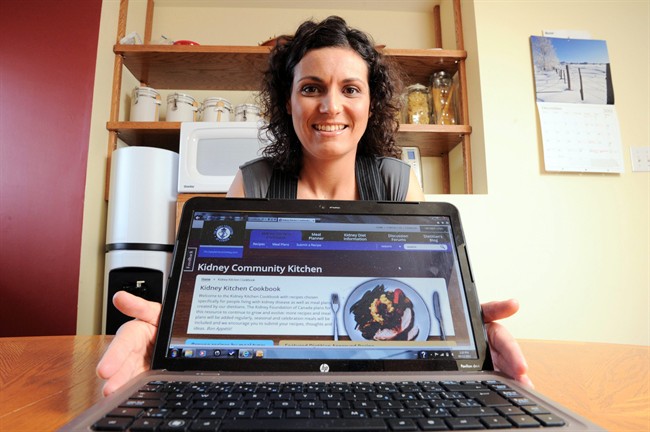
The Kidney Foundation of Canada is trying to come to the rescue. The organization has developed a web-based resource, the Kidney Community Kitchen, that helps people with kidney disease plan meals and track their nutrient intake.
“The focus in this really was reintroducing the joy and celebration of food for kidney patients,” says Nadine Valk, the foundation’s national director of programs and public policy.
“We wanted to make this as easy as possible, as normalized as possible so they can start participating again when it comes to sharing a meal.”
Eleven renal dietitians — who volunteer their time — have come up with recipes that are kidney friendly. The recipes may be as helpful for family members and friends of people with kidney disease as for the patients themselves, Valk says.
“Family and friends stopped inviting them over, because they didn’t know what to feed them. They didn’t feel comfortable going out to eat because they didn’t feel confident that they could find something they could eat on a restaurant menu,” she said.
To publicize the new resource, the Kidney Foundation sent journalists a small basket containing five food items: A chocolate bar, an orange, a box of whole wheat spaghetti, a small can of tomato sauce and a small tin of bean salad. The press release challenged recipients to figure out which food people with kidney disease can eat.
It was a trick question. The answer was none.
A healthy diet for a kidney patient is counterintuitive to people who don’t suffer from the disease, Valk says. “It’s good nutrition to eat whole grains and dark, leafy greens, but you can no longer have those when you have kidney disease.”
Take a meal of whole grain pasta and tomato sauce, with a side salad of lettuce, tomatoes, mushrooms and cheese. Fine for most people, but a very unhealthy meal for a kidney patient.
The meal planner contains a kidney-friendly alternative: white pasta with a red pepper coulis, a side salad with red peppers and cucumbers, which are lower in potassium than some other vegetables.
By necessity, the site offers a lot of choice. The restrictions facing kidney patients vary greatly, depending on their level of kidney function and the dialysis regime they follow. Some kidney patients are also diabetic, or have heart disease, making their meal planning even more challenging.
Chainey has a lot more food freedom than she did in the early days after her kidneys failed, when she lived on smoothies made of raspberries, non-dairy creamer (dairy products are restricted), corn syrup and oil.
For the past eight years, she has undergone dialysis at home at night, six times a week. Studies have shown nocturnal dialysis is more effective, and Chainey is a big proponent.
When she was undergoing dialysis three times a week in a clinic, she didn’t have the energy to wash her own hair or walk a flight of stairs. And her food restrictions were onerous.
The more frequent regime does a better job of ridding her body of the toxins her body can no longer flush on its own. As a result, she has more food options and more energy. She has been able to resume training and is again competing as a high jumper. Last year she qualified for the Canadian nationals, at the senior level.
But her dialysis machine isn’t portable. When she heads home to Kapuskasing in Northern Ontario for the holidays, she has to switch back to clinic-based dialysis. And the more restrictive diet kicks in again. This year, she’ll go armed with recipes.

“I think a lot of people don’t realize how complicated it is for someone that doesn’t have kidney function to have a normal lifestyle,” Chainey says.
___
On the web