Omicron wave may be peaking, but modelling shows COVID-19 hospitalizations to surge
Advertisement
Read this article for free:
or
Already have an account? Log in here »
To continue reading, please subscribe:

Digital Subscription
One year of digital access for only $205*
- Enjoy unlimited reading on winnipegfreepress.com
- Read the E-Edition, our digital replica newspaper
- Access News Break, our award-winning app
- Play interactive puzzles
*First annual payment billed as $205.00 + GST for one year. This annual subscription will automatically renew at $233.00 + GST every 52 weeks (10% off the regular annual price of $259.35). Offer available to new and qualified returning subscribers only. Cancel any time.
To continue reading, please subscribe:
Add Free Press access to your Brandon Sun subscription for only an additional
$1 for the first 4 weeks*
- Enjoy unlimited reading on winnipegfreepress.com
- Read the E-Edition, our digital replica newspaper
- Access News Break, our award-winning app
- Play interactive puzzles
*Your next Brandon Sun subscription payment will increase by $1.00 and you will be charged $17.95 plus GST for four weeks. After four weeks, your payment will increase to $24.95 plus GST every four weeks.
Read unlimited articles for free today:
or
Already have an account? Log in here »
Hey there, time traveller!
This article was published 14/01/2022 (1729 days ago), so information in it may no longer be current.
OTTAWA – Canada could be nearing the peak of the Omicron wave of COVID-19, but public health experts still expect the high number of cases to drive a surge in daily hospitalizations in coming weeks.
New federal modelling released Friday shows the wave might be cresting — or just about to do so — but health experts won’t know for sure for another week or so.
“It’s quite possible that in the next few days we will see that peak, at least in the number of cases,” chief public health officer Dr. Theresa Tam said at a news conference.
Quebec had already pronounced the latest wave is cresting, and on Friday British Columbia’s modelling suggested the province likely hit its peak this past weekend.
In Ontario, the expert pandemic advisory group said the latest indications suggest COVID-19 hospitalizations could peak in the next few weeks, as test positivity has started to decline in the province.
Nationally, this wave is expected to top out at between 170,000 and 300,000 actual daily cases and recede into February, based on available data.
“The true number of daily cases, driven by extremely high transmissibility of the Omicron variant, could still vastly exceed anything we have experienced to date during this pandemic,” Tam said.
Current national case counts show about 37,500 new cases are reported daily, but those far underestimate the reality. Many parts of the country no longer provide laboratory tests for most people.
About 28 per cent of lab tests that are performed are coming back positive.
“The current very high positivity rate shows that COVID-19 is widespread and that case counts underestimate the true burden of infection in the broader population,” Tam said.
The number of hospitalizations also helps to give a clearer picture of how the virus is sweeping through the population, she said.
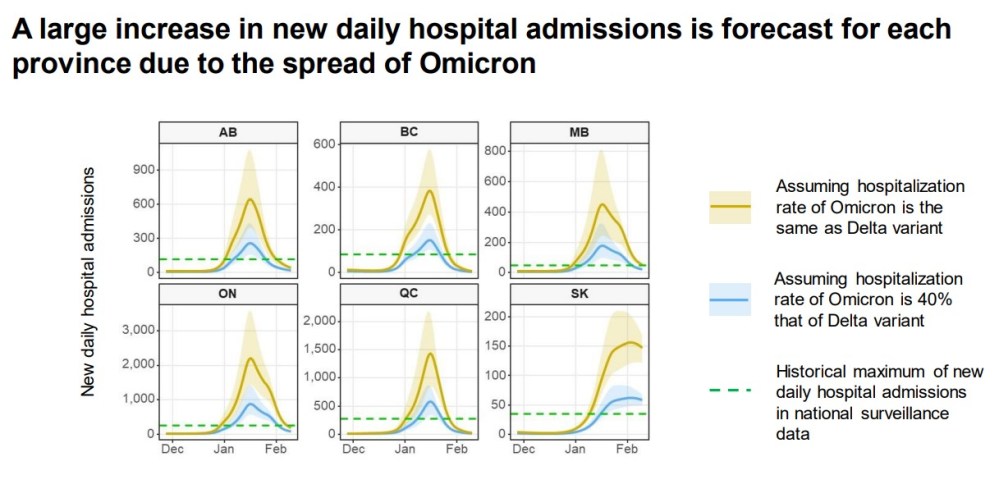
Though the rate of people who are hospitalized with Omicron is lower compared to the Delta variant, the forecast shows new daily hospital admissions will far exceed previous peaks due to the number of cases.
Severe outcomes are also possible. Prince Edward Island reported the first two deaths in the province related to COVID-19 since the pandemic began.
Since the federal government’s previous update before the holidays, the number of people with COVID-19 treated in hospitals has more than quadrupled. The average is now over 6,779 daily, the national numbers show.
The Public Health Agency of Canada expects the high number of people seeking hospital treatment for COVID-19 will put a significant strain on health-care systems over the next several weeks.
B.C.’s provincial health officer, Dr. Bonnie Henry, said these next few weeks will be the most challenging that hospitals have seen yet.
“We know that the peak is coming at the same time that we’re still seeing health care workers off ill and not being able to go into work,” Henry said at a briefing Friday.
Some parts of the United States and United Kingdom have already reported their COVID-19 cases have begun to stabilize, and Tam hopes Canada is following the same trajectory.
Quebec, following its declaration the wave had peaked in the province, announced it will lift its controversial 10 p.m. to 5 a.m. curfew on Monday.
And Nunavut officials said the tough measures it implemented just before Christmas have been so effective that it’s cancelling travel restrictions on Monday and allowing businesses to reopen. Schools will resume in-person learning on Jan. 24.
Provinces that were hit by the Omicron wave first will also likely be among the first to see signs of stabilization, Tam said, but she warned that changes to public health restrictions could change the trajectory of the virus.
“For example, as people go back to school and work those cases could come back so it won’t be necessarily a smooth curve downwards,” she said.
It’s a different story in New Brunswick, where new restrictions came into effect Friday limiting residents to a single-household bubble while also closing gyms, entertainment venues and indoor dining at restaurants.
In neighbouring Prince Edward Island, where chief medical health officer Dr. Heather Morrison says the “worst of this wave” is yet to come, current restrictions that include business capacity limits and remote learning for school students will be extended.
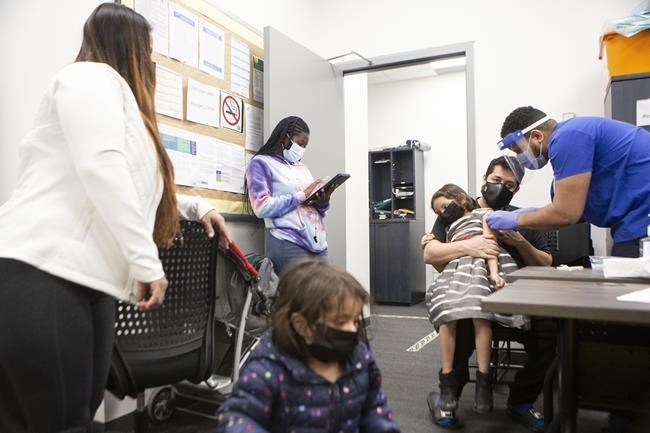
Tam said the surest way out of this wave remains vaccination.
The trends show unvaccinated people are 19 times more likely to be hospitalized with COVID-19 compared to fully vaccinated people.
“We need to continue efforts to increase vaccine coverage to enhance protection for everyone we can,” Tam said.

Even the downside of the curve will have considerable health system impacts, she warned.
She urged Canadians to get up to date on their vaccines and continue to follow public health measures and limit contacts outside their households.
The House of Commons standing committee on health voted Friday to summon Tam, the federal health minister and several other health officials to answer questions about the federal response to the Omicron wave.
Some of the key concerns are how the government plans to respond to the flagging surge capacity of Canada’s health systems as the number of hospitalizations climb and health workers fall ill.
This report by The Canadian Press was first published Jan. 14, 2022.