Report: At least 59,000 meat workers caught COVID, 269 died

Advertisement

Advertise with us

OMAHA, Neb. (AP) — At least 59,000 meatpacking workers caught COVID-19 and 269 workers died when the virus tore through the industry last year, which is significantly more than previously thought, according to a new U.S. House report released Wednesday.

Read this article for free:


or

Already have an account? Log in here »

To continue reading, please subscribe:

Subscribe and receive a limited-edition Free Press branded hat or tote.

Digital Subscription

One year of digital access for only $205*

  • Enjoy unlimited reading on winnipegfreepress.com
  • Read the E-Edition, our digital replica newspaper
  • Access News Break, our award-winning app
  • Play interactive puzzles

*First annual payment billed as $205.00 + GST for one year. This annual subscription will automatically renew at $233.00 + GST every 52 weeks (10% off the regular annual price of $259.35). Offer available to new and qualified returning subscribers only. Cancel any time.

To continue reading, please subscribe:

Add Free Press access to your Brandon Sun subscription for only an additional

$1 for the first 4 weeks*

  • Enjoy unlimited reading on winnipegfreepress.com
  • Read the E-Edition, our digital replica newspaper
  • Access News Break, our award-winning app
  • Play interactive puzzles
Start now

*Your next Brandon Sun subscription payment will increase by $1.00 and you will be charged $17.95 plus GST for four weeks. After four weeks, your payment will increase to $24.95 plus GST every four weeks.

Hey there, time traveller!
This article was published 27/10/2021 (1782 days ago), so information in it may no longer be current.

OMAHA, Neb. (AP) — At least 59,000 meatpacking workers caught COVID-19 and 269 workers died when the virus tore through the industry last year, which is significantly more than previously thought, according to a new U.S. House report released Wednesday.

The meatpacking industry was one of the early epicenters of the coronavirus pandemic, with workers standing shoulder-to-shoulder along production lines. The U.S. House Select Subcommittee on the Coronavirus Crisis, which examined internal documents from five of the biggest meatpacking companies, said companies could have done more to protect their workers.

The new estimate of infections in the industry is nearly three times higher than the 22,400 that the United Food and Commercial Workers Union has said were infected or exposed. And the true number could be even higher because the companies’ data didn’t generally include coronavirus cases confirmed by outside testing or self reported by employees.
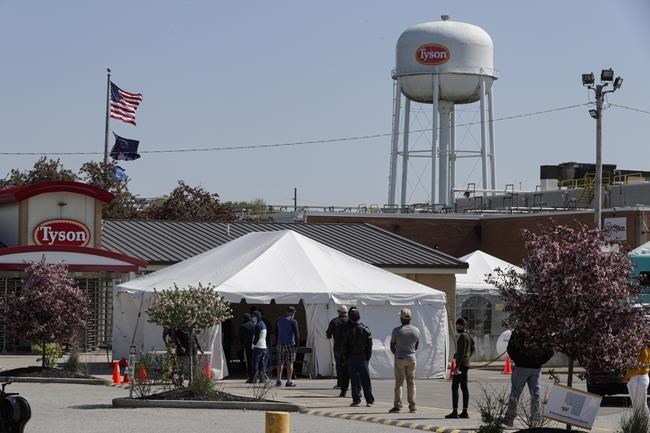
FILE - In this May 7, 2020, file photo workers wait in line to enter the Tyson Foods pork processing plant in Logansport, Ind. At least 59,000 meatpacking workers became ill with COVID-19 and 269 workers died when the virus tore through the industry last year, which is significantly more than previously thought, according to a new U.S. House report released Wednesday, Oct. 27, 2021. (AP Photo/Michael Conroy, File)

At the height of the outbreaks in the spring of 2020, U.S. meatpacking production fell to about 60% of normal as several major plants were forced to temporarily close for deep cleaning and safety upgrades or operated at slower speeds because of worker shortages. The report said companies were slow to take protective steps such as distributing protective equipment and installing barriers between work stations.

“Instead of addressing the clear indications that workers were contracting the coronavirus at alarming rates due to conditions in meatpacking facilities, meatpacking companies prioritized profits and production over worker safety, continuing to employ practices that led to crowded facilities in which the virus spread easily,” the report said.

Martin Rosas, who represents a UFCW chapter based in Kansas with over 17,000 members in three states, said the union pressed companies for better protections.

“The harsh reality is that many of the companies were slow to act in the early days of the outbreak, and whatever progress that was achieved was due to the union demanding action,” Rosas said.

The report is based on documents from JBS, Tyson Foods, Smithfield Foods, Cargill and National Beef. Together they control over 80% of the beef market and over 60% of the pork market nationwide.

The North American Meat Institute trade group defended the industry’s response to the pandemic. And Cargill, Tyson, Smithfield and JBS released statements Wednesday saying they worked aggressively to meet federal health and safety standards and took additional measures to protect their employees, such as conducting widespread testing and urging employees to get vaccinated.

“The health and safety of our team members always comes first and our response since the onset of the pandemic has demonstrated that commitment, with an investment of more than $760 million to date. We have taken aggressive action to keep the virus out of our facilities and adopted hundreds of safety measures that often outpaced federal guidance and industry standards,” JBS spokeswoman Nikki Richardson said.

The companies expressed regret at the toll the virus has taken.

“Even one illness or loss of life to COVID-19 is one too many, which is why we’ve taken progressive action from the start of the pandemic to protect the health and safety of our workers,” Tyson spokesman Gary Mickelson said.
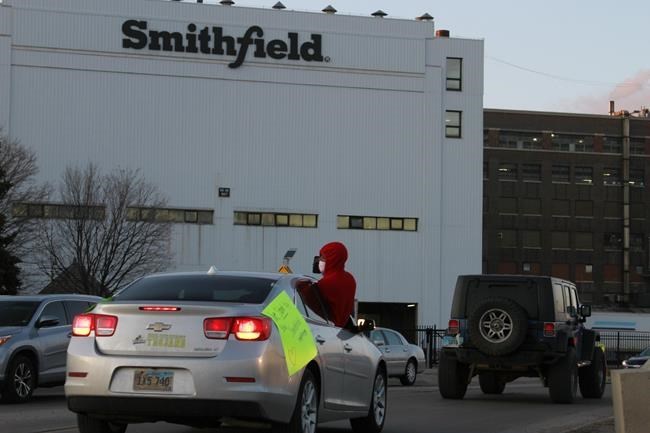
FILE - In this April 9, 2020 file photo employees and family members protest outside a Smithfield Foods processing plant in Sioux Falls, S.D. At least 59,000 meatpacking workers became ill with COVID-19 and 269 workers died when the virus tore through the industry last year, which is significantly more than previously thought, according to a new U.S. House report released Wednesday, Oct. 27, 2021. (AP Photo/Stephen Groves File)

The report said infection rates were especially high at some meatpacking plants between the spring of 2020 and early 2021. At a JBS plant in Hyrum, Utah, 54% of the workforce contracted the virus. Nearly 50% of workers at a Tyson plant in Amarillo, Texas, were infected. And 44% of employees at National Beef’s plant in Tama, Iowa, caught COVID-19.

The report said internal documents show Smithfield aggressively pushed back against government safety recommendations after experts from the Centers for Disease Control and Prevention inspected its pork plant in Sioux Falls, South Dakota, after a major outbreak. A few days earlier, Smithfield’s CEO told the CEO of National Beef in an email that “Employees are afraid to come to work.”

Maryland Rep. Jamie Raskin said the Occupational Safety and Health Administration needs to do more to protect meatpacking workers.

“Some of these companies are treating the workers in the plants not much better than the animals that go through them,” Raskin said.

Debbie Berkowitz, with Georgetown University’s Kalmanovitz Initiative for Labor and the Working Poor, said the industry was slow to respond and federal regulators didn’t force companies to act.

“When the pandemic hit, of course it was going to hit meatpacking plants really hard and really fast,” said Berkowitz, a former OSHA official who testified Wednesday. “What was the industry’s response — not to protect workers and mitigate the spread of COVID-19, not to separate workers 6 feet apart, which was the earlier guidance that came out in late February — but to just keep on going.”
Report Error Submit a Tip

More Stories

Drug recovery centre opens office in ‘heart of the city’

Morgan Modjeski 4 minute read Preview

Drug recovery centre opens office in ‘heart of the city’

Morgan Modjeski 4 minute read Yesterday at 3:38 PM CDT

Richard Halverson found his freedom from addiction through Adult & Teen Challenge and, six years later, he hopes a new Winnipeg location will bring hope to the city.

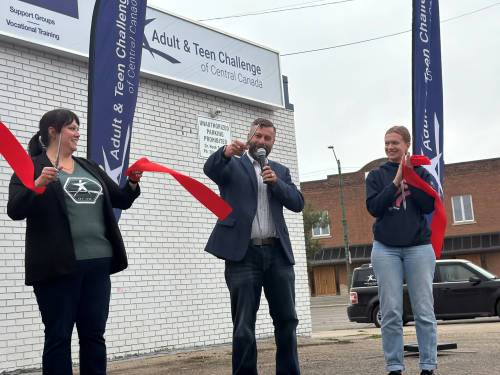
Dozens gathered Saturday morning to mark the grand opening of the recovery centre’s community services office on Main Street.

Located inside the former Wojcik funeral home, the bright-white building — which was also formerly a liquor store — will serve as an access point for people fighting drug addiction. That includes connecting them to addictions support, housing and training.

“For me, I always start with: ‘What’s your story?’” said Halverson, who now works for the faith-based organization.

Read
Yesterday at 3:38 PM CDT

Tory health critic ‘disappointed’ after being rebuffed by health officials

Carol Sanders 4 minute read Preview

Tory health critic ‘disappointed’ after being rebuffed by health officials

Carol Sanders 4 minute read Yesterday at 11:53 AM CDT

The health critic for the Progressive Conservative party says her ability to get information about the accelerated reopening of Dauphin’s emergency department was stymied by Prairie Mountain Health officials because they refused to meet with her.

“I wanted to meet with PMH staff to discuss the status of the facility and the challenges they’re facing and getting services back online,” Kathleen Cook said Friday.

“I was very disappointed that Prairie Mountain Health declined me that opportunity.”

Cook said she asked for a meeting a few days after the Sept. 7 reopening of a temporary ER at the hospital, that was severely damaged by flooding.

Read
Yesterday at 11:53 AM CDT

Nifty neighbours also jonesing for geniality

Maureen Scurfield 4 minute read Yesterday at 2:01 AM CDT

DEAR MISS LONELYHEARTS: Recently, a new couple with no children moved onto our cul de sac, and everybody is taking notice! This attractive pair with no kids both drive amazing cars, work from home and leave their garage doors up a lot. Everybody on the street walks by to sneak a peek into the big garage at just about any time of day.

Lately, the man’s been out on his front lawn in a muscle shirt in the late afternoon, planting shrubs and putting up stylish fall-themed ornaments. At night they often leave the living-room curtains open. That makes for convenient viewing for curious neighbours like us!

A few days ago, my wife invited the new couple over for a barbecue and swim in our pool. They are really nice people, but mentioned that other people nearby have been pretty stand-offish. They wonder why. Should I tell them it’s probably just jealousy over their beautiful vehicles and enviable lifestyle, or should I just shut up?

—Wanting to Help, Sage Creek

Canadians loving Carney’s decision to stand tall against floundering U.S. bully

Tom Brodbeck 5 minute read Preview

Canadians loving Carney’s decision to stand tall against floundering U.S. bully

Tom Brodbeck 5 minute read Friday, Sep. 11, 2026

It’s hard to imagine a more dramatic political contrast than the one unfolding on opposite sides of the Canada-U.S. border.

Mark Carney is fighting a trade war with Donald Trump, taking the occasional verbal punch from the American president and imposing retaliatory tariffs on U.S. products.

And the prime minister is being rewarded for it politically.

Trump, meanwhile, is fighting pretty much everyone he can find — including some of America’s closest allies — and his own voters are increasingly giving him the political equivalent of a raised middle finger. That’s quite a tale of two leaders.

Read
Friday, Sep. 11, 2026

Is Trump about to poke Quebec’s political beehive?

Peter McKenna 6 minute read Preview

Is Trump about to poke Quebec’s political beehive?

Peter McKenna 6 minute read Yesterday at 2:00 AM CDT

When was the last time that a U.S. president seriously stirred the hornet’s nest of Quebec politics?

My best recollection is former U.S. president Bill Clinton. During the 1994 Quebec referendum campaign, Clinton made clear that the U.S. wholly endorsed a united and strong federal Canada — as opposed to a dismembered one. He went on to add that an independent Quebec would have no guarantee of joining the North American Free Trade Agreement as a full-fledged member.

Today, we see U.S. President Donald Trump inserting himself — unwittingly or wittingly — into the electoral and sovereignty politics of Quebec. It’s pretty clear that the resurgent Coalition Avenir Québec government is trying to make the Oct. 5 provincial election about anything other than its own governmental record and more about Trump’s economic coercion against Canada. Of course, the Parti Québécois, the odds-on-favourite, wants to make the electoral contest a referendum on the CAQ and its party leader, Christine Fréchette.

But what if Trump really wanted to make his presence felt in Quebec’s political life? How much influence could he have on shaping political outcomes in Quebec? How much of an “X factor” could he be?

Read
Yesterday at 2:00 AM CDT

The port of Churchill — but done right

Editorial 4 minute read Preview

The port of Churchill — but done right

Editorial 4 minute read Yesterday at 2:00 AM CDT

The seagoing grain carrier wasn’t christened with a champagne bottle. There was no confetti or streamers. Nevertheless, the Aug. 31 event marking the first shipment of grain to be loaded at the Port of Churchill since 2020 was celebrated like the launch of a brand new vessel.

The presence of the federal minister of northern and arctic affairs, provincial cabinet ministers and leaders and elders from several northern First Nations signalled that the fast-tracked process of refurbishing and buffing up Manitoba’s deep-water seaport gem is gaining momentum.

For OneNorth, the partnership of 29 First Nations and 12 northern communities which owns the Port of Churchill and the Hudson Bay Railway (both operated by the Arctic Gateway Group) the event heralded a new beginning. It’s been eight years since OneNorth purchased the port and railroad, and six years since grain was moved by rail through Manitoba and then by ship to European markets. Two more grain shipments, plus shipments of potash and critical minerals, will continue through the fall.

When Prime Minister Mark Carney solicited the premiers to suggest “nation-building” projects following his election in 2025, Premier Wab Kinew pitched a Manitoba trade corridor that would move wheat, critical minerals, potash and energy (oil or liquid natural gas) through the Port of Churchill.

Read
Yesterday at 2:00 AM CDT