Scale up B.C. drug-checking programs to save lives: centre on substance use

Advertisement

Advertise with us

VANCOUVER - Checking illicit drugs for deadly toxins is the best option to prevent fatal overdoses without a safer supply, but that service should be expanded to rural and remote communities in British Columbia, says the manager of a drug-checking program being evaluated by the BC Centre for Substance Use.

Read this article for free:

or

Already have an account? Log in here »

To continue reading, please subscribe:

Subscribe and receive a limited-edition Free Press branded hat or tote.

Digital Subscription

One year of digital access for only $205*

  • Enjoy unlimited reading on winnipegfreepress.com
  • Read the E-Edition, our digital replica newspaper
  • Access News Break, our award-winning app
  • Play interactive puzzles

*First annual payment billed as $205.00 + GST for one year. This annual subscription will automatically renew at $233.00 + GST every 52 weeks (10% off the regular annual price of $259.35). Offer available to new and qualified returning subscribers only. Cancel any time.

To continue reading, please subscribe:

Add Free Press access to your Brandon Sun subscription for only an additional

$1 for the first 4 weeks*

  • Enjoy unlimited reading on winnipegfreepress.com
  • Read the E-Edition, our digital replica newspaper
  • Access News Break, our award-winning app
  • Play interactive puzzles
Start now

*Your next Brandon Sun subscription payment will increase by $1.00 and you will be charged $17.95 plus GST for four weeks. After four weeks, your payment will increase to $24.95 plus GST every four weeks.

Hey there, time traveller!
This article was published 19/02/2022 (1626 days ago), so information in it may no longer be current.

VANCOUVER – Checking illicit drugs for deadly toxins is the best option to prevent fatal overdoses without a safer supply, but that service should be expanded to rural and remote communities in British Columbia, says the manager of a drug-checking program being evaluated by the BC Centre for Substance Use.

Jenny Matthews said drug users who live in non-urban areas often can’t get their drugs tested for contaminants, including high concentrations of fentanyl and, increasingly, benzodiazepines, for which the overdose-reversing medication naloxone is not as effective.

“Ideally, we want there to be a safer supply so that people don’t have to fight for access to drug checking, but in the short term we want to try and increase access to testing,” Matthews said.
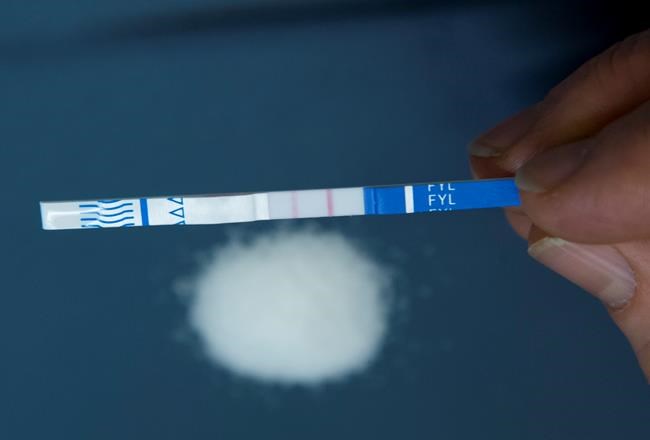
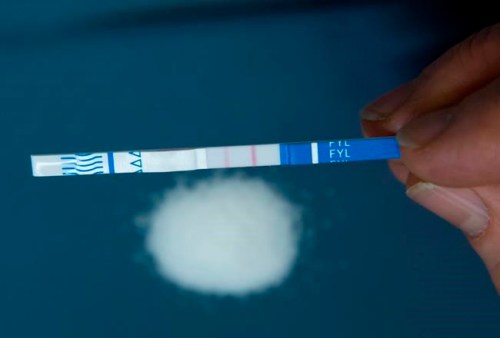
A fentanyl test strip is used at Vancouver Coastal Health in Vancouver, Tuesday, January, 21, 2020. Checking illicit drugs for potentially deadly toxins is the best option to prevent fatal overdose in the absence of a safer supply, but that service should be expanded to rural and remote communities in British Columbia, says the manager of a drug-checking program being evaluated by the BC Centre for Substance Use. THE CANADIAN PRESS/Jonathan Hayward

Health authorities and non-profit groups run drug-checking programs in B.C. using two technologies: take-home test strips that detect the presence of fentanyl or benzodiazepines; and a device called a spectrometer, which is operated by a technician at overdose prevention sites to look for a variety of substances. Results are available in five to 10 minutes.

Matthews said there are 12 spectrometers in the province — five each in the Vancouver Coastal and Interior Health regions, one each in the Fraser and Vancouver Island regions and none in Northern Health.

Data from tiny samples of checked drugs is entered into a provincial database, which is used by the BC Centre on Substance Use to report trends on what’s found in contaminated drugs as a part of a research project funded by Health Canada.

The centre’s latest report, published last month, says 1,180 samples were tested from communities participating in the project, and 88 per cent were from the Vancouver Coastal region. Nine per cent were from Interior Health, two per cent from Vancouver Island and one per cent came from Fraser Health, the largest in the province.

As fentanyl became a dominant drug in B.C., health authorities were issuing alerts about the presence of the opioid in street drugs that were killing so-called opioid naive people with little to no tolerance to it.

Those who developed an addiction to fentanyl, which is 100 times more potent compared with heroin or morphine, needed more of it to stave off withdrawal symptoms like vomiting, nausea and sweating, leading to greater amounts of it being sold in other drugs.

This week, Interior Health issued an urgent drug alert about a high risk of fatal overdose from tested drugs that contain up to 55 per cent fentanyl, up from 10 per cent, and 25 per cent benzodiazepine, often prescribed to treat conditions like anxiety.

Dr. Carol Fenton, a medical health officer with Interior Health, said there are limitations to checking samples to protect those who are at risk of overdose.

“The problem is we don’t have a really good sample of what’s going on the streets because our drug-checking data is only those people who are interested in and willing to bring in their drugs and get them checked. So, I would imagine that’s a relatively small proportion of people using the street supply,” she said.

For Matthews, raising awareness about getting drugs tested is crucial for users smoking, snorting and injecting them.

“What’s really important is that when people are getting their drugs tested, they are having conversations with a technician,” she said, adding the current pilot programs need core funding so more technicians are trained, which would allow the service to be scaled up.

“We’re all hoping that we would never need drug checking and that people could rely on a good supply that was safe to use.”

The coroners’ service says there were a record 2,224 suspected overdose deaths in the province last year, a 26 per cent jump over the previous year.

This report by The Canadian Press was first published Feb. 19, 2022.

Report Error Submit a Tip

More Stories

35-year-old charged in bus stop stabbing

1 minute read Yesterday at 12:13 PM CDT

A man was stabbed while waiting for a bus near The Forks Saturday in a random act of violence, Winnipeg police say.

An unknown man "appeared unexpectedly" while the victim, in his 20s, was standing at a bus stop in the first block of Israel Asper Way just after 6:30 p.m. Aug. 1 and stabbed him, the Winnipeg Police Service stated in a news release Sunday.

Police officers provided emergency medical care before the victim was taken to hospital in stable condition.

Police located a suspect shortly afterward along Forks Market Road and the Major Crimes Unit took over the investigation.

Use summer’s hard truth to mend your heart

Maureen Scurfield 4 minute read 2:15 AM CDT

Dear Miss Lonelyhearts: I refused to go stay at my girlfriend’s cabin in July, because her alcoholic ex-husband still owns the lot beside her. He’s building a big fancy cabin this summer and she’s more than OK with that, even though they’re divorced.

I seriously criticized him — calling him a drunk and a loser — and she actually dumped me before she went off to the lake for all of July!

When she finally came back home I went to see her. She told me I “just wasn’t enough of a lake person” for her.

Then the fight began! I said, “So are you back with him permanently?” and she said, “What do you think? You let me go!”

Scale up B.C. drug-checks program, advocate says

Camille Bains, The Canadian Press 4 minute read Preview

Scale up B.C. drug-checks program, advocate says

Camille Bains, The Canadian Press 4 minute read Saturday, Feb. 19, 2022

VANCOUVER - Checking illicit drugs for deadly toxins is the best option to prevent fatal overdoses without a safer supply, but that service should be expanded to rural and remote communities in British Columbia, says the manager of a drug-checking program being evaluated by the BC Centre for Substance Use.

Jenny Matthews said drug users who live in non-urban areas often can't get their drugs tested for contaminants, including high concentrations of fentanyl and, increasingly, benzodiazepines, for which the overdose-reversing medication naloxone is not as effective.

"Ideally, we want there to be a safer supply so that people don't have to fight for access to drug checking, but in the short term we want to try and increase access to testing," Matthews said.

Health authorities and non-profit groups run drug-checking programs in B.C. using two technologies: take-home test strips that detect the presence of fentanyl or benzodiazepines; and a device called a spectrometer, which is operated by a technician at overdose prevention sites to look for a variety of substances. Results are available in five to 10 minutes.

Read
Saturday, Feb. 19, 2022

Long journey to home ownership for Eritrean couple

Zoe Pierce 4 minute read Preview

Long journey to home ownership for Eritrean couple

Zoe Pierce 4 minute read Saturday, Aug. 1, 2026

Solomon Ghebru and his family have been building a life together in Winnipeg for the past three years after years of living apart in various countries. Now, they are working toward a new goal: owning a home.

Their story is the focus of this year’s Habitat for Humanity Manitoba Cycle of Hope fundraising ride, a seven-day cycling event through southern Manitoba that begins Monday. The ride aims to raise $150,000 to support Ghebru, his wife, Mehret Awate, and their two daughters as they work toward affordable homeownership.

The couple’s journey to Canada started in Eritrea, where they grew up and attended the same church together. They left Eritrea separately, hoping to build a better life together out of the country. Ghebru travelled through Sudan and Libya before reaching Malta, while Awate travelled to Sudan and then Uganda.

After he found work in Malta, he tried to have his family join him, but government policies prevented them from reuniting. The couple married in Uganda in 2016, and their first daughter, Peniel, was born there the following year.

Read
Saturday, Aug. 1, 2026

Stampeding to Starlette’s

David Sanderson 7 minute read Preview

Stampeding to Starlette’s

David Sanderson 7 minute read Saturday, Aug. 1, 2026

ELMA — Build it and they will come.

Lee and Star Giesbrecht are the owners of Starlette’s Burger Saloon, a western-themed, outdoor eating spot situated on the married couple’s 40-acre spread, immediately north of Elma.

Seated at one of a half-dozen picnic tables that dot the grounds, Star recalls a conversation she and Lee had prior to the May 2025 grand opening of their locale, which, with its weathered-wood exterior and rustic swinging doors, wouldn’t look out of place in an episode of Yellowstone.

Because they are “literally in the middle of nowhere,” Star says Lee thought it would be advantageous to mount a TV in one corner of the kitchen, for those occasions when they’d be twiddling their thumbs for hours on end, with little to do.

Read
Saturday, Aug. 1, 2026

240 WestJet flight attendants picket in Winnipeg

Malak Abas 6 minute read Preview

240 WestJet flight attendants picket in Winnipeg

Malak Abas 6 minute read Updated: Yesterday at 3:21 PM CDT

Winnipeg’s WestJet flight attendants took to the picket line outside of Richardson International Airport on the first day of nationwide strikes Sunday, while inside, frustrated flyers scrambled to re-route cancelled long-weekend flights.

The Canadian Union of Public Employees’ Ontario arm and the airline announced the strike would commence after the strike deadline was passed without a deal early Sunday morning. WestJet attendants have been without a contract since Dec. 31, 2025.

Hours later, the 240 WestJet flight attendants based in Winnipeg had walked off the job and were marching outside of the airport terminal, some carrying signs with slogans including “Tired with WestJet? So are We!” and “Unpaid Work Won’t Fly.”

Key issues causing the stalemate are wages and pay for work on the ground: the union says flight attendants are not being paid for some of that work, while the company says they pay for the work through a “credit hour” system rather than an hourly rate.

Read
Updated: Yesterday at 3:21 PM CDT