Science summary: A look at novel coronavirus research around the globe

Advertisement

Advertise with us

Thousands of scientists around the world are working on problems raised by the COVID-19 pandemic. Here is a summary of some recent research from peer-reviewed academic journals and scientific agencies:

Read this article for free:

or

Already have an account? Log in here »

To continue reading, please subscribe:

Subscribe and receive a limited-edition Free Press branded hat or tote.

Digital Subscription

One year of digital access for only $205*

  • Enjoy unlimited reading on winnipegfreepress.com
  • Read the E-Edition, our digital replica newspaper
  • Access News Break, our award-winning app
  • Play interactive puzzles

*First annual payment billed as $205.00 + GST for one year. This annual subscription will automatically renew at $233.00 + GST every 52 weeks (10% off the regular annual price of $259.35). Offer available to new and qualified returning subscribers only. Cancel any time.

To continue reading, please subscribe:

Add Free Press access to your Brandon Sun subscription for only an additional

$1 for the first 4 weeks*

  • Enjoy unlimited reading on winnipegfreepress.com
  • Read the E-Edition, our digital replica newspaper
  • Access News Break, our award-winning app
  • Play interactive puzzles
Start now

*Your next Brandon Sun subscription payment will increase by $1.00 and you will be charged $17.95 plus GST for four weeks. After four weeks, your payment will increase to $24.95 plus GST every four weeks.

Hey there, time traveller!
This article was published 25/05/2020 (2263 days ago), so information in it may no longer be current.

Thousands of scientists around the world are working on problems raised by the COVID-19 pandemic. Here is a summary of some recent research from peer-reviewed academic journals and scientific agencies:

The International Journal of Infectious Disease has tracked the source of Canada’s first 118 cases of COVID-19. It found that despite nearly two-thirds of the world’s cases originating in China, and despite Canada’s large human and trade links with that country, only nine (7.6 per cent ) of Canada’s earliest cases originated there. Researchers say the most commonly reported travel among the 118 cases involved the Middle East, the United States and Europe. Nearly one-third — 30 cases — were from Iran. Researchers say the results suggest that future travel bans shouldn’t necessarily be restricted to only countries with high levels of infection.
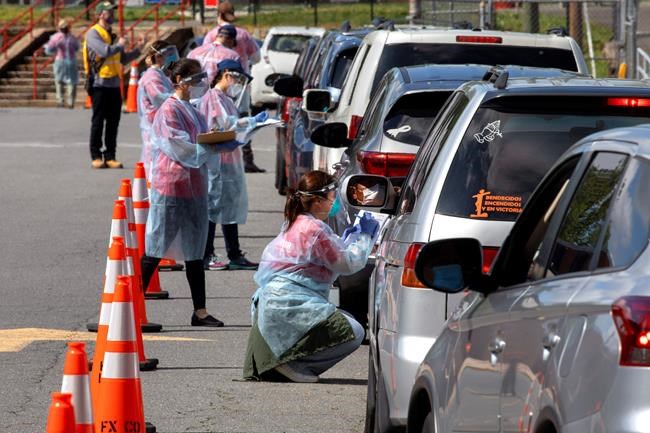
A man wearing a facemask waits inside his car to be tested for COVID-19 as volunteers take registration information in Annandale, Va., Saturday, May 23, 2020. COVID-19 testing was available from Fairfax County at no cost and without a doctor's order. Hundreds of people had lined up in cars and on foot by 10am. Officials planned on testing about 1000 people from 10 a.m. to 6 p.m. Testing will be available at Bailey's Elementary on Sunday. (AP Photo/Jacquelyn Martin)

The novel coronavirus has mutated thousands of times, but a large study from University College London suggests none of those mutations has made it more transmissible. The paper, which hasn’t been peer-reviewed, looked at more than 15,000 COVID-19 patients from 75 countries. It found 6,822 mutations. Of those, 31 mutations have occurred at least 10 times independently during the course of the pandemic. Researchers found no evidence those common mutations increased the virus’s transmissibility — including one mutation which has been widely credited with being more infectious. In fact, they found most mutations were mildly detrimental to the virus.

An unreviewed study from the Universite de Paris found cases of Kawasaki disease in children, which causes swelling blood vessels, seem to be associated with COVID-19. It found 17 children were admitted to the university hospital between late April and early May this year, when the average number of cases is one. Fourteen youngsters showed evidence of recent infection by the novel coronavirus. They also suffered gastrointestinal distress. All were treated and successfully recovered.

The journal The Lancet has published one of the largest studies yet on the value of hydroxycholoroquine as a COVID-19 treatment. The study looked at 96,032 patients from 671 hospitals on six continents. The paper reports no benefit from the antimalarial drug, either on its own or with anything else. It says hydroxychloroquine, which has known side effects on the heart, may cause more problems than its solves — although the paper cautions that conclusion isn’t definitive.

Studies in macaque monkeys suggest that developing immunity against COVID-19 is possible for humans, either through exposure to the virus causing it or through a vaccine, reports the journal Science. Researchers are still trying to determine if being infected with the virus creates immunity against future exposures. In this study, nine adult macaques who had recovered from an infection were exposed again 35 days later. All showed little to no symptoms and exhibited immune responses that protected against the second infection. The same researchers then inoculated 35 macaques with prototypes of six different COVID-19 vaccines and exposed the animals to the novel coronavirus. Antibodies showed up in all the monkeys’ bloodstreams.

A paper in the journal Science Immunology warns that testing for COVID-19 antibodies may be a good way to assess the immunity of large groups, but not of individuals. The authors suggest such tests could help with public-health questions such as when to relax stay-at-home orders or school closures. But they add such tests aren’t accurate or specific enough to determine if any one person is immune to infection, throwing into question the value of so-called immunity passports. Using currents tests for that purpose is insufficient and potentially harmful, they say.

This report by The Canadian Press was first published May 25, 2020

Report Error Submit a Tip

More Stories

Airport traffic surges despite fewer U.S. flights

Gabrielle Piché 4 minute read Preview

Airport traffic surges despite fewer U.S. flights

Gabrielle Piché 4 minute read 5:42 PM CDT

The Winnipeg airport has recorded an uptick in traffic this summer, despite the loss of notable U.S. flights.

Read
5:42 PM CDT

Canadian centre adds size to Sea Bears playoff push

Joshua Frey-Sam 4 minute read Preview

Canadian centre adds size to Sea Bears playoff push

Joshua Frey-Sam 4 minute read 6:33 PM CDT

The Winnipeg Sea Bears have added some size ahead of the playoffs.

The club announced the signing of 6-10 Canadian centre Ben Stevens on Tuesday. Stevens was released by the Montreal Alliance on July 30 and scooped up by the Sea Bears ahead of the Aug. 3 transaction deadline.

The 27-year-old from Halifax appeared in 10 games for the Alliance this summer, where he played a limited role off the bench, averaging 1.9 points and two rebounds per game in 7.5 minutes per game. Stevens had a more elevated role with Montreal in 2025, where he appeared in 20 contests, started five, and averaged 5.4 points and 3.8 rebounds in 13.2 minutes of action per game.

Stevens, at worst, adds some height and physicality off the bench that has been lacking for the Sea Bears this season. The club has struggled with rebounds for many stretches and appeared outmatched by teams with larger personnel.

Read
6:33 PM CDT

Once hailed as sign of strong bond, U.S. consulate in Winnipeg to close

Tyler Searle 6 minute read Preview

Once hailed as sign of strong bond, U.S. consulate in Winnipeg to close

Tyler Searle 6 minute read 6:21 PM CDT

There was much fanfare when the U.S. government re-established a permanent presence in Winnipeg in April 2001 as it unveiled its consulate and hailed it as a major achievement between two friendly nations.

“It is testimony not only to the importance the U.S. government attaches to our bilateral relationship with Canada but also to the increasing prominence of Winnipeg, Manitoba and the western region of the country in bilateral and multilateral affairs,” said U.S. Ambassador to Canada Gordon Giffin at a ceremony with then-premier Gary Doer.

Fast-forward to this week when it was learned the office at Portage and Main is set to close, meaning the U.S. will lose its primary advocate for American business and trade interests in Manitoba.

Dwight MacAulay was chief of protocol for the Manitoba government in 2001, calling it a time of celebration and strength between the countries.

Read
6:21 PM CDT

WestJet, CUPE reach tentative deal as passengers scramble amid flight disruptions

The Canadian Press 6 minute read Preview

WestJet, CUPE reach tentative deal as passengers scramble amid flight disruptions

The Canadian Press 6 minute read Updated: 12:08 PM CDT

CALGARY - WestJet and the union representing some 4,400 flight attendants reached a tentative deal Monday to resume work after a brief work stoppage, but neither side is sharing specifics yet.

The airline had said Sunday it had proposed a 13 per cent pay increase starting in October, and then a 2.5 per cent increase in each of the next three years until 2029.

The airline also said it offered a new duty pay premium, equivalent to another 12 per cent salary increase, which WestJet said is designed to solve the cabin crew's claim of unpaid work.

In a news conference in Calgary on Monday, CUPE local 8125 president Alia Hussain said the flight attendants have 30 days to ratify the agreement, and the union will spend the coming days preparing a slide show to present to the members.

Read
Updated: 12:08 PM CDT

Steinbach ER nurses ask for triage help as wait-averse Winnipeg patients strain hospital capacity

Nicole Buffie 5 minute read Preview

Steinbach ER nurses ask for triage help as wait-averse Winnipeg patients strain hospital capacity

Nicole Buffie 5 minute read 6:13 PM CDT

Nurses at Bethesda Regional Health Centre in Steinbach have called on the regional health authority and provincial government to hire an extra triage nurse for the emergency department as increased visits from Winnipeggers stress the rural hospital.

Forty nurses from the hospital’s emergency department signed an open letter stating because of the current staffing ratio, nurses are witnessing “excessive and unacceptable safety risks on a daily basis.”

“(Nurses) constantly fear for the safety of our patients and community,” said the July 28 letter, addressed to Premier Wab Kinew, Health Minister Uzoma Asagwara, Southern Health-Sante Sud interim CEO Dana Human and the health authority’s board chair, Adam Monteith.

It is common for patients at the hospital to wait more than an hour before being seen by a triage nurse after they arrive, and eight hours before their conditions are reassessed, the letter states, adding the emergency department’s sole triage nurse can be responsible for up to 30 patients at a time.

Read
6:13 PM CDT

A look at COVID-19 research around the globe

Bob Weber, The Canadian Press 4 minute read Preview

A look at COVID-19 research around the globe

Bob Weber, The Canadian Press 4 minute read Monday, May. 25, 2020

Thousands of scientists around the world are working on problems raised by the COVID-19 pandemic. Here is a summary of some recent research from peer-reviewed academic journals and scientific agencies:

---

The International Journal of Infectious Disease has tracked the source of Canada's first 118 cases of COVID-19. It found that despite nearly two-thirds of the world's cases originating in China, and despite Canada's large human and trade links with that country, only nine (7.6 per cent ) of Canada's earliest cases originated there. Researchers say the most commonly reported travel among the 118 cases involved the Middle East, the United States and Europe. Nearly one-third — 30 cases — were from Iran. Researchers say the results suggest that future travel bans shouldn't necessarily be restricted to only countries with high levels of infection.

---

Read
Monday, May. 25, 2020