Some nurses still don’t have proper COVID-19 personal protective equipment: union
Advertisement
Read this article for free:
or
Already have an account? Log in here »
To continue reading, please subscribe:

Digital Subscription
One year of digital access for only $205*
- Enjoy unlimited reading on winnipegfreepress.com
- Read the E-Edition, our digital replica newspaper
- Access News Break, our award-winning app
- Play interactive puzzles
*First annual payment billed as $205.00 + GST for one year. This annual subscription will automatically renew at $233.00 + GST every 52 weeks (10% off the regular annual price of $259.35). Offer available to new and qualified returning subscribers only. Cancel any time.
To continue reading, please subscribe:
Add Free Press access to your Brandon Sun subscription for only an additional
$1 for the first 4 weeks*
- Enjoy unlimited reading on winnipegfreepress.com
- Read the E-Edition, our digital replica newspaper
- Access News Break, our award-winning app
- Play interactive puzzles
*Your next Brandon Sun subscription payment will increase by $1.00 and you will be charged $17.95 plus GST for four weeks. After four weeks, your payment will increase to $24.95 plus GST every four weeks.
Read unlimited articles for free today:
or
Already have an account? Log in here »
Hey there, time traveller!
This article was published 14/01/2022 (1682 days ago), so information in it may no longer be current.
OTTAWA – When news of the first cases of COVID-19 began cropping up in Canada in early 2020, Linda Silas was one of the first to ring alarm bells about the lack of proper personal protective equipment for health workers.
While early indications showed the virus was spread by droplets that settled on surfaces, Silas, president of the Canadian Federation of Nurses, urged health authorities to learn from the SARS outbreak of 2003 and take the highest level of precaution.
Now she knows she was right — the virus is airborne — but she is still desperately calling for more protective equipment for nurses two years later.
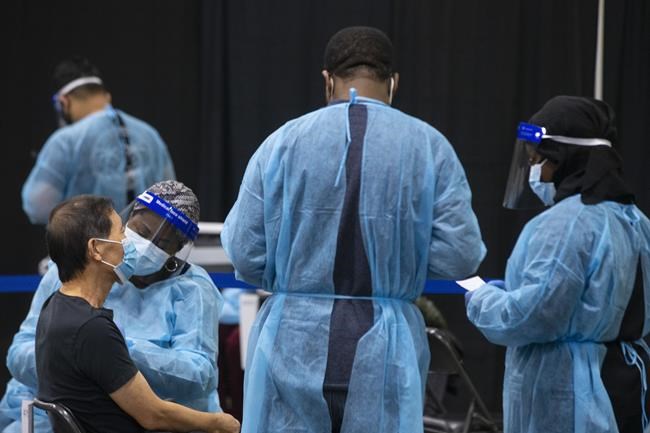
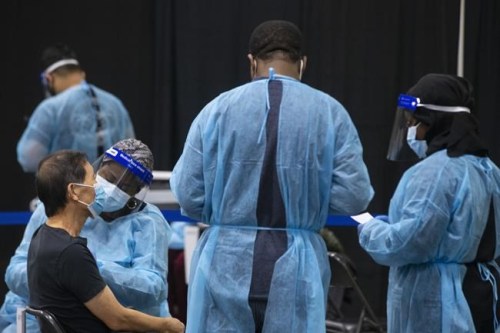
Regional unions across the country report that nurses who have requested fit-tested respirators still can’t get them in some cases, despite the Omicron variant being far more transmissible than previous variants.
The shortage of healthy nurses to address the massive wave of the Omicron variant has meant hospitals and other health institutions have deployed nurses with confirmed cases of COVID-19, and still some are not offered appropriate masks, she said.
“These vulnerable patients might have a COVID positive staff treating them, and without the proper PPE it’s plain dangerous,” she said.
Canada’s chief public health officer, Dr. Theresa Tam, describes the spread of COVID-19 as a cloud of smoke coming from someone’s mouth and nose. She and other medical officers have suggested the public use more effective masks to protect themselves.
Silas said often in places such as vaccine clinics, members of the public seem better outfitted with the proper protective equipment than the health workers.
“It’s a mishmash, and it’s a fight,” Silas said in an interview with The Canadian Press. “In long-term care it’s a real fight, in community care it’s a real fight and in acute care it depends where you work.”
Different hospitals seem to be taking different approaches when it comes to providing PPE to nurses, which doesn’t make sense, she said, “because the science is the science.”
Canada’s supply chain is likely to blame, said University of Windsor professor Anne Snowdon, a registered nurse who studies health systems and supply chains.
“The problem has always been the supply chain. The outcome of the limitations of our supply chain is not being able to access those protective products that are so important in terms of reducing the risk of transmission of this virus to our workforce, and also to our patients,” Snowdon said in an interview with The Canadian Press.
The scarce supply of PPE may have been more understandable in the early days of the pandemic, but critics like Silas question how Canada could still be in a similar situation in many parts of the health system.
The answer, Snowdon said, is that the infrastructure was so poor to begin with.
“We’re building the bridges we’re driving over,” she said.
Tam said hospital outbreaks are happening, with both health workers and patients contracting the highly contagious virus in acute care settings like hospitals.
“It really does continue to stress the need for good infection prevention control practices, but it’s been very, very difficult,” Tam said at a briefing Friday.
“This is such a transmissible virus that we have to up our game everywhere, including mask wearing, ventilation and everything else in order to reduce those risks. Health care setting-related outbreaks are something that we should do everything to try and minimize.”
In other sectors, like construction, essential workers would not be in the same situation, Silas said, because they would have the right to refuse to work in unsafe conditions.
But health workers can’t do the same without the ethical guilt of abandoning patients. It’s the same guilt that has nurses working 16 to 24-hour shifts, or taking on large patient loads, she said.
“It’s that ethical guilt that presses on the health-care workforce.”
In Quebec, unions representing nurses also expressed concern that N95 masks are not automatically given to nurses by their employers. They said this was particularly important as the province has ruled that some nurses who have tested positive for COVID-19 but have no symptoms can go to work to treat patients with the virus.
Julie Bouchard, president of the Fédération Interprofessionnelle de la Santé du Québec, a Quebec union representing nurses and respiratory therapists, said she was worried that N95s were not available to all nurses in Quebec to protect them from the Omicron variant.
“Faced with a much more contagious variant, we stepped up our interventions to remind the government and CNESST (Quebec’s workplace safety body) that it was their responsibility to apply the precautionary principle and to implement all the necessary measures, starting with access to the N95 mask, for all caregivers to protect them and their vulnerable patients,” she said.
“However, the government is still slow to comply with the CNESST directives, as well as to ensure that the N95s are available in the field.”
NDP health spokesman Daniel Blaikie called on the federal government to give nurses a pandemic pay bonus to recognize their key role in fighting the Omicron wave.
The NDP said, though health policy is determined by provinces, “hero pay” for nurses would be possible if the Liberal government wished to bring it in.
It said during the first COVID-19 wave the federal government introduced a fund to help provinces and territories offer a danger bonus to essential workers such as nurses.
This report by The Canadian Press was first published Jan. 14, 2022.