The Big Sneeze: Climate change to make pollen season nastier

Advertisement

Advertise with us

Climate change has already made allergy season longer and pollen counts higher, but you ain’t sneezed nothing yet.

Read this article for free:


or

Already have an account? Log in here »

To continue reading, please subscribe:

Subscribe and receive a limited-edition Free Press branded hat or tote.

Digital Subscription

One year of digital access for only $205*

  • Enjoy unlimited reading on winnipegfreepress.com
  • Read the E-Edition, our digital replica newspaper
  • Access News Break, our award-winning app
  • Play interactive puzzles

*First annual payment billed as $205.00 + GST for one year. This annual subscription will automatically renew at $233.00 + GST every 52 weeks (10% off the regular annual price of $259.35). Offer available to new and qualified returning subscribers only. Cancel any time.

To continue reading, please subscribe:

Add Free Press access to your Brandon Sun subscription for only an additional

$1 for the first 4 weeks*

  • Enjoy unlimited reading on winnipegfreepress.com
  • Read the E-Edition, our digital replica newspaper
  • Access News Break, our award-winning app
  • Play interactive puzzles
Start now

*Your next Brandon Sun subscription payment will increase by $1.00 and you will be charged $17.95 plus GST for four weeks. After four weeks, your payment will increase to $24.95 plus GST every four weeks.

Hey there, time traveller!
This article was published 15/03/2022 (1648 days ago), so information in it may no longer be current.

Climate change has already made allergy season longer and pollen counts higher, but you ain’t sneezed nothing yet.

Climate scientists at the University of Michigan looked at 15 different plant pollens in the United States and used computer simulations to calculate how much worse allergy season will likely get by the year 2100. It’s enough to make allergy sufferers even more red-eyed.

As the world warms, allergy season will start weeks earlier and end many days later — and it’ll be worse while it lasts, with pollen levels that could as much as triple in some places, according to a new study Tuesday in the journal Nature Communications.
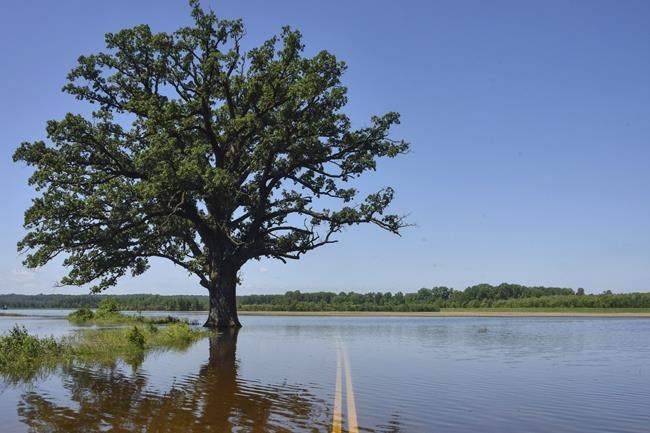
FILE - Floodwaters surround a bur oak tree southwest of Columbia, Mo., on Wednesday, June 5, 2019. A study published Tuesday, March 15, 2022, in the journal Nature Communications details how warmer temperatures and extra carbon dioxide in the air will make pollen season even more of a bother than it is now. (Kate Seaman/Missourian via AP, File)

Warmer weather allows plants to start blooming earlier and keeps them blooming later. Meanwhile, additional carbon dioxide in the air from burning fuels such as coal, gasoline and natural gas helps plants produce more pollen, said study co-author Allison Steiner, a University of Michigan climate scientist.

It’s already happening. A study a year ago from different researchers found that from 1990 to 2018, pollen has increased and allergy season is starting earlier, with much of it because of climate change.

Allergists say that pollen season in the U.S. used to start around St. Patrick’s Day and now often starts around Valentine’s Day.

The new study found that allergy season would stretch even longer and the total amount of pollen would skyrocket. How long and how much depends on the particular pollen, the location and how much greenhouse gas emissions are put in the air.

With moderate cuts in greenhouse gas emission from coal, oil and natural gas, pollen season would start 20 days earlier by the end of the century. In the most extreme and increasingly unlikely warming scenario, pollen season in much of America will start 40 days earlier than when it has generally started in recent decades.

Already about 30% of the world and 40% of American children suffer pollen allergies, which hurt the economy through lost work days and medical costs, said University of Michigan climate researcher Yingxiao Zhang, lead author of the new study.

Allergies are especially difficult for the 25 million Americans with asthma. This could make the problem much worse for them, said Amir Sapkota, a University of Maryland environmental health professor, who wasn’t part of the research.

While allergy suffering will increase across the United States, the Southeast will get hit hardest, said Steiner.

The start of alder tree pollen season will move most dramatically, an issue in the Pacific Northwest. Cypress tree pollen — which is especially bad in Texas — will see among the biggest increases.

Ragweed and grasses — common pollen allergies — will also have longer seasons and higher pollen counts in the future, Zhang said.

The University of Michigan team’s projections projects would be about twice as large a jump in pollen problems as has happened since 1990, said University of Utah biologist and climate scientist Bill Anderegg.

“Overall, this is an incredibly important study,” said Anderegg, who wasn’t involved in the new research. “It tells us that the historical trends of longer and more severe pollen seasons are likely to continue, driven by climate change, and this will absolutely have substantial health consequences in allergies and asthma for Americans.”

___

Read stories on climate issues by The Associated Press at https://apnews.com/hub/climate

___

Follow Seth Borenstein on Twitter at @borenbears.

___

The Associated Press Health and Science Department receives support from the Howard Hughes Medical Institute’s Department of Science Education. The AP is solely responsible for all content.

Report Error Submit a Tip

More Stories

‘One of a kind’: CEO, philanthropist Doug Harvey dies at 72

Morgan Modjeski 5 minute read Preview

‘One of a kind’: CEO, philanthropist Doug Harvey dies at 72

Morgan Modjeski 5 minute read Updated: Yesterday at 12:57 PM CDT

Doug Harvey, a Winnipeg business titan and philanthropist, has died after battling cancer for more than a decade.

Harvey gave millions of dollars to Winnipeg organizations while he was CEO of DLH Group, a nationwide network of businesses that support heavy duty truck and trailer users.

Loren Remillard, CEO and president of the Winnipeg Chamber of Commerce, said the business community is mourning the loss of the influential businessman who helped shape Winnipeg.

“We are a transportation and logistics hub in Winnipeg and it was partly the result of geography, and a big part because of leaders and visionaries like Doug Harvey,” he said.

Read
Updated: Yesterday at 12:57 PM CDT

Canada-U.S. trade relationship is broken, but the damage can — and will — be repaired

Tom Brodbeck 5 minute read Preview

Canada-U.S. trade relationship is broken, but the damage can — and will — be repaired

Tom Brodbeck 5 minute read Yesterday at 1:35 PM CDT

Canada needs to get serious about diversifying its trade beyond the United States. But at the same time, Canadians should expect relations with the U.S. to normalize after Donald Trump is no longer in the White House.

For generations, Canada-U.S. trade was considered almost a fact of geography. The two countries share the world’s longest undefended border, deeply integrated supply chains and a century of commercial relationships.

Canadian manufacturers depend on American customers. American manufacturers depend on Canadian suppliers. Energy, agriculture, automotive production and countless other industries operate across the border as though it barely exists.

That isn’t going to change dramatically, even in the midst of a bitter trade war unleashed by the U.S. president.

Read
Yesterday at 1:35 PM CDT

Jets GM insists club’s not working under any deadline in netminder’s trade request

Mike McIntyre 7 minute read Preview

Jets GM insists club’s not working under any deadline in netminder’s trade request

Mike McIntyre 7 minute read Updated: Yesterday at 5:27 PM CDT

Connor Hellebuyck and his family were subject to so much post-Olympic vitriol that both the Winnipeg Jets security team and even police had to get involved.

Read
Updated: Yesterday at 5:27 PM CDT

Teenage e-scooter driver in critical condition after crash

Chris Kitching 6 minute read Preview

Teenage e-scooter driver in critical condition after crash

Chris Kitching 6 minute read Wednesday, Sep. 16, 2026

A teenager riding an e-scooter suffered life-threatening injuries when he was struck by an SUV in southwest Winnipeg on Monday night.

Witnesses provided first aid to the injured rider, who police said is under 18, after the collision happened at Waverley Street and Arbour Meadow Gate/Lake Crest Road at about 9:30 p.m.

“It feels like it happened in slow motion,” said driver Audrey Vanderspek, who was waiting at a red light when she witnessed the incident. “Maybe it’s because you’re helpless, that it just feels like everything slows down in the moment.”

Police said the electric scooter rider was crossing Waverley and was hit by a southbound 2010 Honda CR-V. The posted speed limit on that stretch of Waverley is 70 kilometres per hour.

Read
Wednesday, Sep. 16, 2026

His blissful kiss is well worth the risk

Maureen Scurfield 4 minute read 2:00 AM CDT

DEAR MISS LONELYHEARTS: The best kisser I ever met knocked me off balance. My little joke was, “That’s why we have to go home now and lie down in a hurry!” We’ve been seeing each other for almost six months. This man can convince me to do almost anything — so much fun!

But, now he’s been transferred out of province for bigger money at a new company.

He’s leaving soon and he could have asked me to move with him, as his trucking partner, but he didn’t! Other women will soon have their hands on him, believe me!

I’m already 27 and I don’t want to date any more guys — just him. Now what can I do? I feel sadder every day.

‘A new future’: city dentist Cholakis donates $2M to school of dental hygiene

Melissa Martin 3 minute read Preview

‘A new future’: city dentist Cholakis donates $2M to school of dental hygiene

Melissa Martin 3 minute read Updated: Yesterday at 3:25 PM CDT

Dental hygienist training in Manitoba is getting a big boost, after a major gift from a local dentist.

On Thursday, the dental hygiene school at the University of Manitoba’s Dr. Gerald Niznick College of Dentistry unveiled a new $2-million donation from Dr. Ernest Cholakis. It’s the largest gift the program has ever received, and in honour of the funding, the school will be named the Cholakis School of Dental Hygiene.

The gift was unveiled at a ceremony Thursday morning at the U of M’s Brodie Centre in the Health Sciences Centre complex. The benefactor and other dignitaries, including Premier Wab Kinew, were in attendance, as well as the three-year program’s current students.

Cholakis, who graduated from the U of M’s dentistry school in 1982, had high praise for the dental hygiene profession.

Read
Updated: Yesterday at 3:25 PM CDT