WHO: COVID origins unclear but lab leak theory needs study

Advertisement

Advertise with us

GENEVA (AP) — Over two years after the coronavirus was first detected in China, and after at least 6.3 million deaths have been counted worldwide from the pandemic, the World Health Organization is recommending in its strongest terms yet that a deeper probe is required into whether a lab accident may be to blame.

Read this article for free:


By clicking the button above, an account will be created and you will begin to receive some of our recommended newsletters. You may opt out of any newsletter by visiting your Email and Communication Preferences page or by clicking "unsubscribe" at the bottom of any email.

or

Already have an account? Log in here »

To continue reading, please subscribe:

Digital Subscription

One year of digital access for only $1.44 a week*

  • Enjoy unlimited reading on winnipegfreepress.com
  • Read the E-Edition, our digital replica newspaper
  • Access News Break, our award-winning app
  • Play interactive puzzles

*Billed as $5.77 plus GST every four weeks. After 52 weeks, price increases to the regular rate of $19.95 plus GST every four weeks. Offer available to new and qualified returning subscribers only. Cancel any time.

To continue reading, please subscribe:

Add Free Press access to your Brandon Sun subscription for only an additional

$1 for the first 4 weeks*

  • Enjoy unlimited reading on winnipegfreepress.com
  • Read the E-Edition, our digital replica newspaper
  • Access News Break, our award-winning app
  • Play interactive puzzles
Start now

*Your next Brandon Sun subscription payment will increase by $1.00 and you will be charged $17.95 plus GST for four weeks. After four weeks, your payment will increase to $24.95 plus GST every four weeks.

Hey there, time traveller!
This article was published 09/06/2022 (1600 days ago), so information in it may no longer be current.

GENEVA (AP) — Over two years after the coronavirus was first detected in China, and after at least 6.3 million deaths have been counted worldwide from the pandemic, the World Health Organization is recommending in its strongest terms yet that a deeper probe is required into whether a lab accident may be to blame.

That stance marks a sharp reversal of the U.N. health agency’s initial assessment of the pandemic’s origins, and comes after many critics accused WHO of being too quick to dismiss or underplay a lab-leak theory that put Chinese officials on the defensive.

WHO concluded last year that it was “extremely unlikely” COVID-19 might have spilled into humans in the city of Wuhan from a lab. Many scientists suspect the coronavirus jumped into people from bats, possibly via another animal.
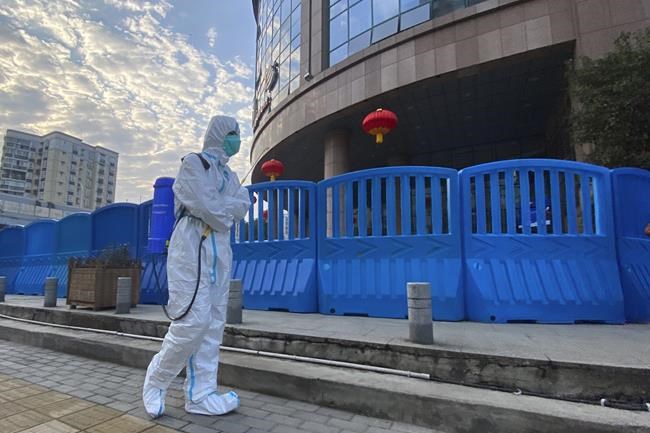
FILE - A worker in protectively overalls and carrying disinfecting equipment walks outside the Wuhan Central Hospital, China on Feb. 6, 2021. Experts drafted by the World Health Organization to help investigate the origins of the coronavirus pandemic say further research is needed to determine how COVID-19 first began. They say they need a more detailed analysis of the possibility it was a laboratory accident. (AP Photo/Ng Han Guan, File)

Yet in a report released Thursday, WHO’s expert group said “key pieces of data” to explain how the pandemic began were still missing. The scientists said the group would “remain open to any and all scientific evidence that becomes available in the future to allow for comprehensive testing of all reasonable hypotheses.”

Identifying a disease’s source in animals typically takes years. It took more than a decade for scientists to pinpoint the species of bats that were the natural reservoir for SARS, a relative of COVID-19.

WHO’s expert group also noted that since lab accidents in the past have triggered some outbreaks, the highly politicized theory could not be discounted.

Jean-Claude Manuguerra, a co-chair of the 27-member international advisory group, acknowledged that some scientists might be “allergic” to the idea of investigating the lab leak theory, but said they needed to be “open-minded” enough to examine it.

The report could revive accusations that WHO initially was too accepting of Chinese government explanations early in the outbreak, which ultimately killed millions of people, sickened millions more, forced dozens of countries into lockdown and upended the world economy.

Investigations by The Associated Press found that some top WHO insiders were frustrated by China during the initial outbreak even as WHO heaped praise on Chinese President Xi Jinping. They were also upset over how China sought to clamp down on research into the origins of COVID-19.

Former U.S. President Donald Trump speculated repeatedly — without evidence — that COVID-19 was started in a Chinese lab. He also accused WHO of “ colluding” with China to cover up the initial outbreak, citing the U.N. health agency’s continued public praise of the country despite China’s refusal to share crucial data.

WHO’s expert group said WHO Director-General Tedros Adhanom Ghebreyesus sent two letters to senior Chinese government officials in February requesting information, including details about the earliest human cases of COVID-19 in the city of Wuhan. It’s unclear whether the Chinese responded.

The experts said no studies were provided to WHO that assessed the possibility of COVID-19 resulting from a laboratory leak.

Jamie Metzl, who sits on an unrelated WHO advisory group, has suggested that the Group of Seven industrialized nations set up their own COVID origins probe, saying WHO lacks the political authority, expertise and independence to conduct such a critical evaluation.

Metzl welcomed WHO’s call for a further investigation into the lab leak possibility but said it was insufficient.

“Tragically, the Chinese government is still refusing to share essential raw data and will not allow the necessary, full audit of the Wuhan labs,” he said. “Gaining access to this information is critical to both understanding how this pandemic began and preventing future pandemics.”

In Washington, a Republican-led subcommittee in the House of Representatives on the COVID-19 pandemic tweeted: “Americans were smeared as ‘conspiracy theorists’ for asking whether #COVID19 came from a lab leak. Now, the WHO is asking the same questions.”

“WE NEED ANSWERS,” added the committee, which is headed by Rep. Steve Scalise of Louisiana.

WHO’s expert scientists said numerous avenues of research were needed, including studies evaluating the role of wild animals, and environmental studies in places where the virus might have first spread, like the Huanan seafood market in Wuhan.

FILE - Marion Koopmans, right, and Peter Ben Embarek, center, of the World Health Organization team say farewell to their Chinese counterpart Liang Wannian, left, after a WHO-China Joint Study Press Conference at the end of the WHO mission in Wuhan, China on Feb. 9, 2021. Experts drafted by the World Health Organization to help investigate the origins of the coronavirus pandemic say further research is needed to determine how COVID-19 first began. They say they need a more detailed analysis of the possibility it was a laboratory accident. (AP Photo/Ng Han Guan, File)

In March 2021, WHO released a report about COVID-19’s origins following a highly choreographed visit by international scientists to China. The report concluded that the disease most likely jumped into humans from bats and that there was no evidence to suggest there was a connection to a laboratory.

Yet after considerable criticism, including from some scientists on WHO’s team, the agency’s director acknowledged that it was “ premature ” to rule out a lab leak.

In its new report, WHO said the experts were given access to data that included unpublished blood samples from more than 40,000 people in Wuhan in 2019. The samples were tested for COVID-19 antibodies. None were found, suggesting the virus was not spreading widely before it was first identified in late December that year.

WHO’s experts called for numerous studies to be done, including testing wild animals to find which species might host COVID-19. They also said the “cold chain” supply theory should be probed. China has previously advanced the idea that traces of COVID-19 on frozen packaging was causing outbreaks rather than any domestic source, a theory widely panned by outside scientists.

To investigate whether COVID-19 might have been the result of a lab accident, WHO’s experts said interviews should be conducted “with the staff in the laboratories tasked with managing and implementing biosafety and biosecurity.”

China has called the suggestion that COVID-19 began in a laboratory “ baseless ” and countered that the virus originated in American facilities, which were also known to be researching coronaviruses in animals. The Chinese government has said it supports the search for the pandemic’s origins, but that other countries should be the focus.

In a footnote to the report, WHO’s group noted that three of its own experts — scientists from China, Brazil and Russia — disagreed with the call to investigate the possibility of COVID-19 being sparked by a lab accident.

Scientists connected to WHO lamented in August 2021 that the search for the pandemic’s origins had stalled and that the window of opportunity was “closing fast.” They warned that collecting data that was now at least two years old was increasingly difficult.

___

Cheng reported from London.

___

Follow AP’s coverage of the pandemic at https://apnews.com/hub/coronavirus-pandemic
Report Error Submit a Tip

More Stories

Echoes of Idle No More as Carney set to meet with First Nations

Niigaan Sinclair 5 minute read Preview

Echoes of Idle No More as Carney set to meet with First Nations

Niigaan Sinclair 5 minute read Yesterday at 10:29 AM CDT

The prime minister, premiers and First Nations leaders will meet in Ottawa Monday to discuss a host of issues, including Indigenous involvement in energy and resource development projects.

Read
Yesterday at 10:29 AM CDT

Letters, Oct. 26

6 minute read 2:00 AM CDT

Privacy risks of health information

Manitobans deserve answers about how their personal health information is collected, accessed and protected. Three everyday practices warrant public scrutiny: repeatedly requesting birth dates at pharmacies; exposing historical medical records to reception staff; and requiring callers to disclose personal details to Health Links.

A Manitoba health card proves health coverage. Why must patients repeatedly disclose their birth dates to collect prescriptions? What assumptions or biases might arise from a person’s age or outdated medical history? Being classified as “authorized personnel” does not eliminate the risk of unnecessary scrutiny.

I have personally experienced the distress of a doctor’s receptionist drawing attention to a decades-old medical entry by asking, “Is this you?” A last name which had apparently been removed legally was visible again. Patients should not have to explain or relive painful chapters of their past simply because historical information appears on a screen.

Is the student or the system falling short?

Karen Velthuys 5 minute read Preview

Is the student or the system falling short?

Karen Velthuys 5 minute read 2:00 AM CDT

One night at bedtime, a 10-year-old looked at her mother with tears in her eyes and said, “Mom, I think I’m stupid.”

Her friends could read. She couldn’t. The teacher kept moving on. And she’d quietly worked out that the problem must be her.

She’s not the only one. Roughly half of Manitoba students aren’t meeting grade-level reading expectations on provincial assessments. As schools begin screening young readers from kindergarten to Grade 4 this fall, it’s the right moment to ask why.

Every education system answers a basic question: who is this built for? We expect children to read by about the end of Grade 3, to sit and focus for long stretches, and to show what they know in one narrow way — written down, on time, in the format we hand them. A student who does those things is called “a good student.”

Read
2:00 AM CDT

‘Savage and brutal’ Erickson home invasion nets 17-year sentence

Tessa Adamski 6 minute read Preview

‘Savage and brutal’ Erickson home invasion nets 17-year sentence

Tessa Adamski 6 minute read Saturday, Oct. 24, 2026

BRANDON — A woman who fought off the man who slashed her throat in a random home invasion in Erickson described the violent assault as the worst day of her life and a nightmare she can’t seem to shake off.

“I feel like a shell of the person I used to be. Not every second of every day, but definitely every day. It comes in waves,” Candace Richardson said as she read from a victim impact statement in a Brandon courtroom on Friday.

Carter Prince, 21, who pleaded guilty to attempted murder for the June 2023 attack, sat in the prisoner’s box as Richardson spoke.

“I’ll be completely fine, laughing, having fun or just relaxing with my family,” she told the court. “Then time goes so slowly, like you’re floating away, but instead of floating, I’m pinned to the ground, being stabbed over and over again. There’s blood everywhere and darkness surrounding me.”

Read
Saturday, Oct. 24, 2026

WHO: COVID origins unclear but lab leak theory needs study

Maria Cheng And Jamey Keaten, The Associated Press 7 minute read Preview

WHO: COVID origins unclear but lab leak theory needs study

Maria Cheng And Jamey Keaten, The Associated Press 7 minute read Thursday, Jun. 9, 2022

GENEVA (AP) — Over two years after the coronavirus was first detected in China, and after at least 6.3 million deaths have been counted worldwide from the pandemic, the World Health Organization is recommending in its strongest terms yet that a deeper probe is required into whether a lab accident may be to blame.

That stance marks a sharp reversal of the U.N. health agency’s initial assessment of the pandemic’s origins, and comes after many critics accused WHO of being too quick to dismiss or underplay a lab-leak theory that put Chinese officials on the defensive.

WHO concluded last year that it was “extremely unlikely” COVID-19 might have spilled into humans in the city of Wuhan from a lab. Many scientists suspect the coronavirus jumped into people from bats, possibly via another animal.

Yet in a report released Thursday, WHO’s expert group said “key pieces of data” to explain how the pandemic began were still missing. The scientists said the group would “remain open to any and all scientific evidence that becomes available in the future to allow for comprehensive testing of all reasonable hypotheses.”

Read
Thursday, Jun. 9, 2022

Asessippi counting on flood relief to save ski season

Connor McDowell 5 minute read Preview

Asessippi counting on flood relief to save ski season

Connor McDowell 5 minute read Updated: 6:34 AM CDT

BRANDON — Asessippi Ski Area and Resort remains optimistic about the coming ski season, but is depending on disaster financial assistance to repair roughly $2.2 million in flood damage, a spokesperson said.

The ski resort plans to replace several pieces of equipment, including motors for destroyed lift shacks that power the Porcupine and Bear chairlifts, compressors and a pumphouse for snowmaking, and a damaged transformer, assistant manager Shannon Johnston said.

Some of the work will only take place this year if provincial funding is provided for relief from flood damage in June and July, she said.

“There is some stuff we are paying for, but we don’t have $2.2 million extra laying around for all of this. So yeah, we do need the help,” Johnston said. “We are looking at over $2 million in cost for replacement of these things.”

Read
Updated: 6:34 AM CDT