WHO criticizes travel bans on southern African countries
Advertisement
Read this article for free:
or
Already have an account? Log in here »
To continue reading, please subscribe:

Digital Subscription
One year of digital access for only $205*
- Enjoy unlimited reading on winnipegfreepress.com
- Read the E-Edition, our digital replica newspaper
- Access News Break, our award-winning app
- Play interactive puzzles
*First annual payment billed as $205.00 + GST for one year. This annual subscription will automatically renew at $233.00 + GST every 52 weeks (10% off the regular annual price of $259.35). Offer available to new and qualified returning subscribers only. Cancel any time.
To continue reading, please subscribe:
Add Free Press access to your Brandon Sun subscription for only an additional
$1 for the first 4 weeks*
- Enjoy unlimited reading on winnipegfreepress.com
- Read the E-Edition, our digital replica newspaper
- Access News Break, our award-winning app
- Play interactive puzzles
*Your next Brandon Sun subscription payment will increase by $1.00 and you will be charged $17.95 plus GST for four weeks. After four weeks, your payment will increase to $24.95 plus GST every four weeks.
Read unlimited articles for free today:
or
Already have an account? Log in here »
Hey there, time traveller!
This article was published 28/11/2021 (1755 days ago), so information in it may no longer be current.
JOHANNESBURG (AP) — The World Health Organization on Sunday urged countries around the world not to impose flight bans on southern African nations due to concerns over the new omicron variant.
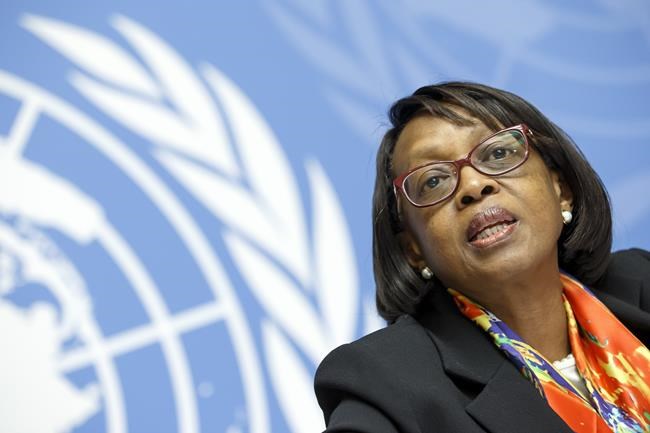
WHO’s regional director for Africa, Matshidiso Moeti, called on countries to follow science and international health regulations in order to avoid using travel restrictions.
“Travel restrictions may play a role in slightly reducing the spread of COVID-19 but place a heavy burden on lives and livelihoods,” Moeti said in a statement. “If restrictions are implemented, they should not be unnecessarily invasive or intrusive, and should be scientifically based, according to the International Health Regulations, which is a legally binding instrument of international law recognized by over 190 nations.”
Moeti praised South Africa for following international health regulations and informing WHO as soon as its national laboratory identified the omicron variant.
“The speed and transparency of the South African and Botswana governments in informing the world of the new variant is to be commended,” said Moeti. “WHO stands with African countries which had the courage to boldly share life-saving public health information, helping protect the world against the spread of COVID-19.”
South African President Cyril Ramaphosa called the restrictions “completely unjustified.”
“The prohibition of travel is not informed by science, nor will it be effective in preventing the spread of this variant,” said in a speech Sunday evening. “The only thing the prohibition on travel will do is to further damage the economies of the affected countries, and undermine the ability to respond to, and also to recover from, the pandemic.”
Cases of the omicron variant of the coronavirus popped up in countries on opposite sides of the world Sunday and many governments rushed to close their borders even as scientists cautioned that it’s not clear if the new variant is more alarming than other versions of the virus.
While investigations continue into the omicron variant, WHO recommends that all countries “take a risk-based and scientific approach and put in place measures which can limit its possible spread.”
Dr. Francis Collins, director of the National Institutes of Health in the United States, emphasized that there is no data yet that suggests the new variant causes more serious illness than previous COVID-19 variants.
“I do think it’s more contagious, when you look at how rapidly it spread through multiple districts in South Africa,” Collins said on CNN’s “State of the Union.”
Israel decided to bar entry to foreigners, and Morocco said it would suspend all incoming flights for two weeks starting Monday — among the most drastic of a growing raft of travel curbs being imposed as nations scrambled to slow the variant’s spread. Scientists in several places — from Hong Kong to Europe — have confirmed its presence. The Netherlands reported 13 omicron cases on Sunday, and Australia found two.

The U.S. plans to ban travel from South Africa and seven other southern African countries starting Monday.
“With the omicron variant now detected in several regions of the world, putting in place travel bans that target Africa attacks global solidarity,” said Moeti. “COVID-19 constantly exploits our divisions. We will only get the better of the virus if we work together for solutions.”
WHO said it scaling up its support for genomic sequencing in Africa so sequencing laboratories have access to adequate human resources and testing reagents to work at full capacity. WHO also said is ready to offer additional help, reinforcing COVID-19 responses including surveillance, treatment, infection prevention and community engagement in southern African countries, it said.
___
Follow all AP stories on the pandemic at https://apnews.com/hub/coronavirus-pandemic.