

High-voltage horror
Some incredibly fortunate athletes have walked away more or less intact after being hit by lightning; others' lives ended in a one-in-a-million-chance flash of electricity
Advertisement
Read this article for free:
or
Already have an account? Log in here »
To continue reading, please subscribe:
Digital Subscription
One year of digital access for only $1.44 a week*
- Enjoy unlimited reading on winnipegfreepress.com
- Read the E-Edition, our digital replica newspaper
- Access News Break, our award-winning app
- Play interactive puzzles
*Billed as $5.77 plus GST every four weeks. After 52 weeks, price increases to the regular rate of $19.95 plus GST every four weeks. Offer available to new and qualified returning subscribers only. Cancel any time.
To continue reading, please subscribe:
Add Free Press access to your Brandon Sun subscription for only an additional
$1 for the first 4 weeks*
- Enjoy unlimited reading on winnipegfreepress.com
- Read the E-Edition, our digital replica newspaper
- Access News Break, our award-winning app
- Play interactive puzzles
*Your next Brandon Sun subscription payment will increase by $1.00 and you will be charged $17.95 plus GST for four weeks. After four weeks, your payment will increase to $24.95 plus GST every four weeks.
Read unlimited articles for free today:
or
Already have an account? Log in here »
Hey there, time traveller!
This article was published 27/03/2021 (1897 days ago), so information in it may no longer be current.
One moment, Katherine Díaz Hernández, 22, was dreaming of surfing her way to glory at the Tokyo Olympics.
The next, her Olympic dreams — and her life — were snuffed out by a bolt that literally came out of the blue.
Diaz, one of El Salvador’s top surfers, died earlier this month after being struck by lightning while training in the ocean off El Tunco beach, not far from her home.
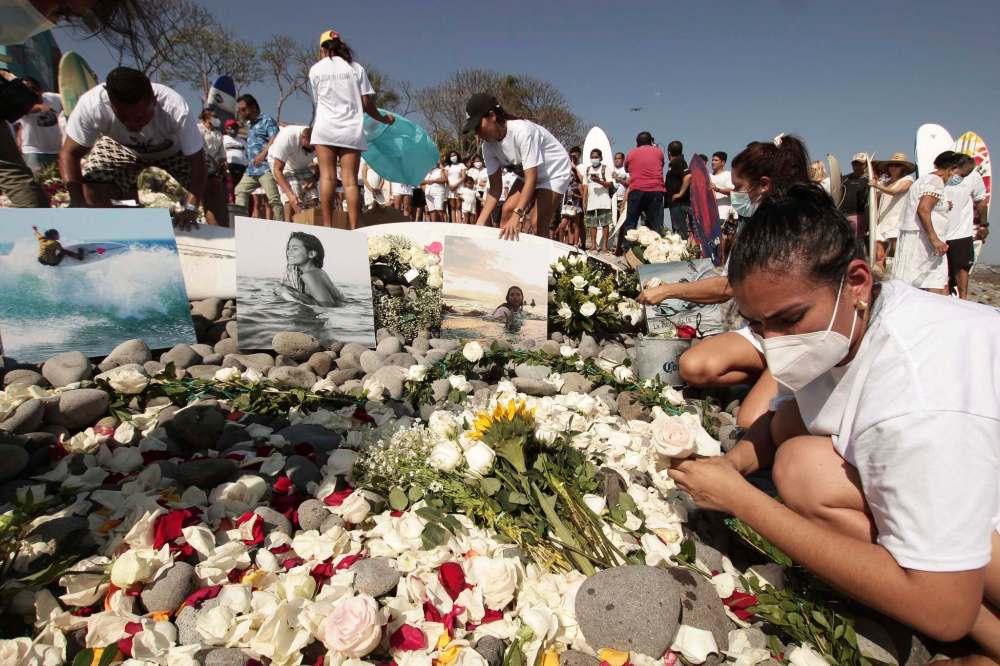
News reports said a sudden change in weather caught everyone on the beach by surprise and Diaz was struck shortly after she entered the water to train for the International Surfing Association’s World Surf Games, a qualifier for the pandemic-delayed Summer Olympics.
Paramedics tried to revive her at the scene, but were unsuccessful. “A great athlete who has represented our country has left us,” the country’s surfing federation said in a Facebook post. “See you soon, great warrior. El Salvador is in mourning.”
Her uncle, Beto Diaz, told a newspaper that he was in the water with her when the lightning strike occurred. He said his niece had just finished giving a friend a hug.
“As soon as she finished hugging her, the noise was heard,” he said, adding the young surfer died instantly. “She, the friend, was thrown by the force of the lightning strike too. The board threw me back.”
Tragically, such incidents are not as rare as you might think, as we see from today’s shocking list of Five Sports That Have Seen Athletes Killed or Injured by Lightning:
5) The unlucky sport: High school football
The bolt from the blue: It was a scorchingly hot afternoon in August 1995 and 16-year-old Douglas Clay Jones was on a practice field at Forney High School in Texas along with about 100 other young football players, gearing up for the first game of the season.
About 40 minutes into practice, the team was split up to run drills and Clay was running plays with the secondary in coach Brad Turner’s drill group. The air was heavy with the smothering, thick heat that hangs over north Texas in late August and, suddenly, there was a deafening, violent crack.
“It was like a bomb went off,” Turner, an assistant coach, told the Associated Press at the time. “I went from standing up coaching to being flat on my stomach. When I stood up I could smell something like a burnt smell.” A flash of lightning traveling at 750,000 miles per hour had sliced into the Jackrabbit field, right inside Turner’s defensive drill.
When Turner peeled himself off the grass and looked back, he noticed that everyone in his group had been slammed to the ground. One of them, Clay Jones, didn’t get back up. The sports-crazed 16-year-old was airlifted by helicopter from the football field in Forney to a hospital in Dallas. Twelve other students, two coaches and a trainer were also treated at hospitals. Jones, who went into cardiac arrest and sustained burns, died at Baylor University Medical Center four days after that lightning bolt struck him in the helmet during practice. His gravestone in the middle of Forney is in the shape of a football.
The donation of Clay’s organs helped save lives, and raised awareness of an issue that would save countless more. In Texas, coaches and sponsors of athletic activities are now required to complete a safety training course, including lightning safety, and lightning detectors are now commonplace.
4) The unlucky sport: Long-distance running
The bolt from the blue: Mother Nature seems to have it in for long-distance runners. Consider the case of first-century Macedonian athlete Apollodorus, who is famous partly for winning at the Olympics, but mostly for being struck and killed by lightning on his journey home.
In 2019, ultra-marathoner Thomas Stanley, 33, was racing in the Flatrock 50K near Independence, Kan., when he was struck and killed by a bolt less than a quarter of a mile from the finish line. Nearby racers, including a doctor, attempted CPR while they waited for medical staff to arrive, but Stanley’s time had run out.
The race organizers included Stanley as a finisher in their final results, and presented a finisher’s award to his wife, Ashley, who is also a runner but wasn’t there that day: she was waiting to hear about the race at home with their three children. In a Facebook post, race organizers said: “Thomas’ family says the chances of being killed by a lightning strike are about one in a million, and Thomas was truly a one-in-a-million guy.”
In July of that year, a thunderstorm that swept through northeast Italy claimed the life of an ultramarathoner, a 44-year-old Norwegian woman who died after being struck by lightning while competing in the Sudtirol Ultra Skyrace. Things went a little better in 2014 for Canadian ultra-marathoner Adam Campbell, a Vancouver lawyer who got zapped as he reached Mile 56 of the Hardrock 100, an ultramarathon in Colorado’s San Juan mountain range that is known as one of the world’s most punishing runs. Not only did Campbell get up and keep running — he also finished third.
As he came within 200 metres of the summit, a bolt of lightning struck the peak and sent him and another runner flying. “It was terrifying,” he told the CBC. “It looked like this tentacle of light bathing the summit. The moment we hit the summit, it was like a gunshot went off right by my ear — this incredibly white flash of light — and the next thing I knew I was lying on the ground.” Electrified, he picked up the pace and finished third.
3) The unlucky sport: Major League Baseball
The bolt from the blue: It’s been said that a kid is more likely to get hit by lightning than end up playing in Major League Baseball. So the odds have to be off the charts for getting struck by lightning WHILE playing in the big leagues.
Well, on Aug. 24, 1919, the legendary Ray Caldwell defied insurmountable odds when he became the first and only pitcher in MLB history to finish a game after being zapped by lightning. By all accounts, Caldwell was one of a kind — a talented pitcher who drank hard and partied harder. He was traded by the New York Yankees to the Red Sox prior to the 1919 season because of his bad behaviour.
In Boston, he was roommates with another tippler, the legendary Babe Ruth, and soon wore out his welcome. On Aug. 19, Caldwell signed with Cleveland and his first start on the mound came five days later against the Philadelphia Athletics on a sticky, humid day in Philly, with an evening thunderstorm brewing. The game was almost over when, out of the blue, a blinding flash zapped Caldwell, knocking him cold. After about five minutes, he came to his senses and left the field. Just kidding — he got up, dusted himself off and finished the game, recording the final out for the win.
It was a grimmer scene on Aug. 4, 1994 in Ancaster, Ont., when lightning struck a ball field during a youth baseball championship game west of Hamilton, killing one boy and injuring 26 others. The Fraser Valley Chiefs from B.C. were ahead 3-1 when the skies opened, forcing a 15-minute delay at the 1994 Canadian Big League baseball championship. Centre-fielder Matt Krol and his Calgary Blues teammates were anxious to retake the lead, but, suddenly, a blast of lightning struck in left field. Five players were knocked down and four got back up right away. Krol did not.
“Two of his coaches tried desperately to resuscitate him, but his life had been take in an instant,” the Calgary Herald reported. “After 15 years, it’s still hard, there’s never a time when it’s not hard to think about it,” his father, Gary Krol, recalled in 2009. “It’s like an open sore that doesn’t heal.” A field in Ancaster is now named for his son.
2) The unlucky sport: Golf
The bolt from the blue: It is reportedly a myth that golfers are the outdoor enthusiasts most likely to get zapped by lightning, even though they wander around waving metal sticks in the air. Some reports say fishermen are at a higher risk, but there’s no question golf is risky when there’s electricity in the air.
The danger was brought home at the PGA Tour’s Western Open in 1975 when five professional golfers — Jim Ahern, Jerry Heard, Tony Jacklin, Bobby Nichols and Lee Trevino — were lucky to survive after a brush with a bolt. Trevino, Heard and Nichols were treated at a hospital in nearby Hinsdale; only Heard was able to get out in time to continue playing.
Jacklin was in his follow-through when a lightning bolt knocked his 8-iron 10 metres out of his hands. Remembering the day in 2002, he told Golf Digest: “I was immediately aware of a burning taste in my mouth.”
Closer to home, four Manitoba golfers got the scare of their lives and one had to briefly recover in hospital after getting struck by lightning on the 11th hole of the Neepawa Golf and Country Club in 2018. The injured man, believed to be from Neepawa, was found by paramedics lying on the ground, with his clothes and body burned after the lightning strike, according to the Brandon Sun. He was conscious when they arrived, but had been briefly unresponsive before that.
The golfer, said to be in his 50s, was taken to the ICU in Winnipeg because he was in “rough shape,” Scott Lavich, an intermediate care paramedic in Neepawa, said at the time. The course was reportedly preparing to blow the air horn to clear the course when the lightning struck. Someone who was on the scene told Neepawa’s newspaper there was a “giant flash of light” and a loud boom like “standing next to a cannon as it went off.”
The odds of getting struck by lightning in Canada are generally considered to be less than one in a million. Each year on average in Canada, there are between two and three lightning-related deaths and 180 lightning-related injuries.
1) The unlucky sport: Soccer
The bolt from the blue: What with mostly being played outdoors, soccer is routinely at risk from scary weather.
Last year, a young Russian goalkeeper was hit by lightning during training, and was placed in an induced coma before recovering. Also in 2020, a women’s soccer league match in Mexico ended in tragedy as two players were killed by lightning, while three others required treatment for severe burns and other injuries.
In 2012, two soccer players were killed and one was injured in a lightning storm that struck an athletic field in north Houston. But the most horrifying incident, by far, occurred — at least it seems to have occurred — in October 1998 in Africa. That’s when, by multiple accounts, a freak blast of lightning struck dead an entire team on the playing field while their opponents were left completely untouched.

Lightning killed 11 members of a Congolese soccer team and injured dozens more people during a weekend match, the Congolese news agency reported, according to the Associated Press. “The lightning bolt wiped out all the players on the home team in the village of Bena Tshadi, in the south-central Congolese province of Eastern Kasai,” the Congolese Press Agency said.
Thirty people on the sidelines were also reported injured. The reports could not be independently confirmed because at the time the Congo was locked in a civil war between the government of Laurent Kabila and rebel forces, backed by neighbouring Rwanda, in the east of the country. Local investigators blamed the lightning on witchcraft because none of the players on the opposing team from nearby Basangana village were injured, the Congolese agency reported.
“The suspicion… arose firstly because the opposing team emerged unharmed and then again because the score at the time was a delicately balanced one-all,” Britain’s Independent newspaper reported. “The exact nature of the lightning has divided the population in this region which is known for its use of fetishes in football,” the newspaper commented.
doug.speirs@freepress.mb.ca