WEATHER ALERT

Year in space put US astronaut’s disease defences on alert

Advertisement

Advertise with us

WASHINGTON - Nearly a year in space put astronaut Scott Kelly's immune system on high alert and changed the activity of some of his genes compared to his Earth-bound identical twin, researchers said Friday.

Read this article for free:

or

Already have an account? Log in here »

To continue reading, please subscribe:

Subscribe and receive a limited-edition Free Press branded hat or tote.

Digital Subscription

One year of digital access for only $205*

  • Enjoy unlimited reading on winnipegfreepress.com
  • Read the E-Edition, our digital replica newspaper
  • Access News Break, our award-winning app
  • Play interactive puzzles

*First annual payment billed as $205.00 + GST for one year. This annual subscription will automatically renew at $233.00 + GST every 52 weeks (10% off the regular annual price of $259.35). Offer available to new and qualified returning subscribers only. Cancel any time.

To continue reading, please subscribe:

Add Free Press access to your Brandon Sun subscription for only an additional

$1 for the first 4 weeks*

  • Enjoy unlimited reading on winnipegfreepress.com
  • Read the E-Edition, our digital replica newspaper
  • Access News Break, our award-winning app
  • Play interactive puzzles
Start now

*Your next Brandon Sun subscription payment will increase by $1.00 and you will be charged $17.95 plus GST for four weeks. After four weeks, your payment will increase to $24.95 plus GST every four weeks.

Hey there, time traveller!
This article was published 15/02/2019 (2718 days ago), so information in it may no longer be current.

WASHINGTON – Nearly a year in space put astronaut Scott Kelly’s immune system on high alert and changed the activity of some of his genes compared to his Earth-bound identical twin, researchers said Friday.

Scientists don’t know if the changes were good or bad but results from a unique NASA twins study are raising new questions for doctors as the space agency aims to send people to Mars.

Tests of the genetic doubles gave scientists a never-before opportunity to track details of human biology, such as how an astronaut’s genes turn on and off in space differently than at home. One puzzling change announced Friday at a science conference: Kelly’s immune system was hyperactivated.
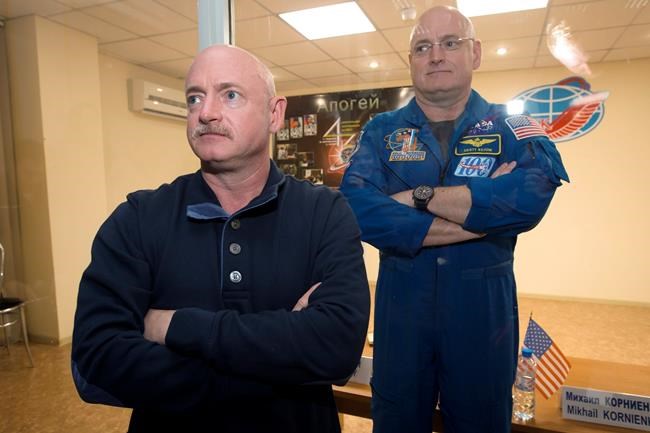
FILE - In this March 26, 2015 file photo, U.S. astronaut Scott Kelly, right, crew member of the mission to the International Space Station, stands behind glass in a quarantine room, behind his brother, Mark Kelly, also an astronaut, after a news conference in the Russian-leased Baikonur, Kazakhstan cosmodrome. Nearly a year in space put Scott Kelly's immune system on high alert and changed the activity of some of his genes compared to his Earth-bound identical twin, according to a report released on Friday, Feb. 15, 2019. (AP Photo/Dmitry Lovetsky)

“It’s as if the body is reacting to this alien environment sort of like you would a mysterious organism being inside you,” said geneticist Christopher Mason of New York’s Weill Cornell Medicine, who helped lead the study. He said doctors are now looking for that in other astronauts.

Since the beginning of space exploration, NASA has studied the toll on astronauts’ bodies, such as bone loss that requires exercise to counter. Typically they’re in space about six months at a time. Kelly, who lived on the International Space Station, spent 340 days in space and set a U.S. record.

“I’ve never felt completely normal in space,” the now-retired Kelly said in an email to The Associated Press, citing the usual congestion from shifting fluid, headaches and difficulty concentrating from extra carbon dioxide, and digestive complaints from microgravity.

But this study was a unique dive into the molecular level, with former astronaut Mark Kelly, Scott’s twin, on the ground for comparison. Full results haven’t yet been published, but researchers presented some findings Friday at a meeting of the American Association for the Advancement of Science.

A number of genes connected to the immune system became hyperactive, Mason said. It’s not a change in DNA but in what’s called “gene expression,” how genes turn off and on and increase or decrease their production of proteins. Mason also spotted a spike in the bloodstream of another marker that primes the immune system. Yet at the same time, Kelly’s blood showed fewer of another cell type that’s an early defence against viruses.

It’s not a surprise that gene activity would change in space — it changes in response to all kinds of stress.

“You can see the body adapting to the change in its environment,” Mason said.

The good news: Most everything returned to normal shortly after Kelly got back on Earth in March 2016. Those immune-related genes, however, “seemed to have this memory or this need to almost be on high alert” even six months later, Mason said.

“On the whole it’s encouraging,” said Craig Kundrot, who heads space life and science research for NASA. “There are no major new warning signs. We are seeing changes that we didn’t necessarily anticipate” but don’t know if those changes matter.

From four Russians living in space for more than a year, NASA already knew prolonged time off Earth is possible, Kundrot said, adding, “We also aim for more than just possible. We want our astronauts to do more than just survive.”

Ultimately, the twin study gives NASA a catalogue of things to monitor on future missions to see if other astronauts react the same way. Astronauts on future missions will be able to do some of this testing in space instead of freezing samples for scientists back home, Mason said.

Immune issues sound familiar to Dr. Jerry Linenger, an American astronaut who spent more than four months on the Russian space station Mir. He said he was never sick in orbit, but once he came back to Earth “I was probably more sick than I was in my life.”

Astronauts launch into orbit with their own germs and get exposed to their crewmates’ germs and then after a week with nothing else new in the “very sterile environment” of a space station “your immune system is really not challenged,” Linenger said.

A human mission to Mars, which NASA hopes to launch in the 2030s, would take 30 months, including time on the surface, Kundrot said.

Radiation is a top concern. The mission would expose astronauts to galactic cosmic radiation levels higher than NASA’s own safety standard. It’s “just a little bit over,” he said.

On Earth and even on the space station, Earth’s magnetic field shields astronauts from lots of radiation. There would be no such shielding on the way to Mars and back, but tunnels or dirt-covered habitats could help a bit on Mars, Kundrot said

Kelly, who turns 55 next week, said he’d go to Mars. He said a trip that long “wouldn’t be worse than what I experienced. Possibly better. I think the big physical challenge, radiation aside, will be a mission where you are in space for years.”

___

The Associated Press Health and Science Department receives support from the Howard Hughes Medical Institute’s Department of Science Education. The AP is solely responsible for all content.


Report Error Submit a Tip

More Stories

A 39-year-old woman has been charged after police say a retail theft attempt led to a knife being used against a security guard at a store on Portage Avenue.

The Winnipeg Police Service said Central District General Patrol officers arrested the woman at about 5:30 p.m. on Thursday in connection with a robbery at a retail store in the 300 block of Portage Avenue.

Police said the woman entered the store shortly before 2 p.m. and attempted to steal merchandise before being confronted by store security. Police said the suspect then brandished a knife and assaulted a security guard.

Security was able to gain control of the suspect, and police were contacted.

For unique Menno-centric take on Free Press, satirist mines her jibes between the lines

David Sanderson 8 minute read Preview

For unique Menno-centric take on Free Press, satirist mines her jibes between the lines

David Sanderson 8 minute read Yesterday at 10:40 AM CDT

Free Press readers of a certain vintage may remember when tuning into a local radio station to hear a pair of disc jockeys perusing a section of the Saturday edition was appointment listening.

On Sunday mornings from 1962 until the mid-1980s, CKRC 630 personalities Bob Washington and Tom Ashmore — better known as Wash and Ash — entertained Winnipeggers of all ages by impersonating the likes of Dennis the Menace, Beetle Bailey and Archie Andrews, as they lent their voices to that weekend’s multi-page, colour comic insert.

In a 1984 interview, Washington, who died in 2016 at the age of 82, attributed the weekly program’s longevity to audiences enjoying the antics of “two middle-aged guys in 24 dialects, giving their version of what Dagwood is saying to Blondie, or what Hägar the Horrible is bragging about.”

More than 40 years later, another Winnipegger is turning to the Free Press for her material. Only instead of reading the paper’s funnies, Lori Klassen, a mother of three and grandmother of two, is funnily reading the paper.

Read
Yesterday at 10:40 AM CDT

A Life's Story: Beloved matriarch, kindergarten teacher lived a musical life

Gabrielle Piché 5 minute read Preview

A Life's Story: Beloved matriarch, kindergarten teacher lived a musical life

Gabrielle Piché 5 minute read Yesterday at 6:00 AM CDT

Phyllis Dana faced a choice: leave Winnipeg to study opera at a prestigious Philadelphia school, or marry the man she loved.

She chose the latter.

Now, her Juno-winning granddaughter cherishes a Happy Birthday voicemail sung by Phyllis. Three generations of Dana women — Phyllis, her daughter, and granddaughter — would sing in Winnipeg’s prominent Jewish spaces. And hundreds of Manitobans know the matriarch as their kindergarten teacher.

“My mom said, ‘A sheet of music won’t keep you warm at night,’” Karen Dana recalled.

Read
Yesterday at 6:00 AM CDT

Automation reaches new heights on farm

Laura Rance-Unger 4 minute read Preview

Automation reaches new heights on farm

Laura Rance-Unger 4 minute read Yesterday at 2:01 AM CDT

LANGHAM, Sask. — The thousands of farmers from across the Prairies who flock to the annual Ag in Motion show every July seem oblivious to the possibility the technology on display could one day replace many of them.

Families with children in tow, Hutterite colony workers, grandparents and young couples just starting out roamed through the 600 or more exhibitor displays, amazed at how everything about farming just keeps getting bigger, more efficient and increasingly more automated.

It’s now possible to seed using a 100-foot-wide drill — a 12-foot jump over the widest available a few years ago — provided the farmer can afford a tractor with enough horsepower to pull it. Those sell for around $850,000 and up.

Granted, the number of farms with enough acres to justify that kind of width and drawing power is still relatively small, but farms continue to grow. And it’s no secret the number of people who have the interest, skills and financial wherewithal to run them continues to shrink.

Read
Yesterday at 2:01 AM CDT

Longtime Assiniboine Park Zoo resident Blizzard the bison dies

Zoe Pierce 2 minute read Preview

Longtime Assiniboine Park Zoo resident Blizzard the bison dies

Zoe Pierce 2 minute read Friday, Jul. 24, 2026

Blizzard, the white bison that became one of Assiniboine Park Zoo’s most recognizable residents during nearly 20 years at the facility, has died, the zoo announced Friday.

The zoo said Blizzard’s health declined in recent weeks, so a diagnostic exam was recommended to better understand his condition. He died during the procedure.

Blizzard arrived at Assiniboine Park Zoo in 2006 and went on to become a favourite among visitors, inspiring “millions of visitors with his remarkable presence,” the zoo said in a social media post.

“While all animals in our care are deeply valued, Blizzard held a special place in the hearts of many people and carried profound cultural and spiritual significance for many Indigenous peoples,” the post reads.

Read
Friday, Jul. 24, 2026

Men cycling across Canada for charity have bikes stolen in Winnipeg

Chris Kitching 5 minute read Preview

Men cycling across Canada for charity have bikes stolen in Winnipeg

Chris Kitching 5 minute read Friday, Jul. 24, 2026

Thomas Clark and Valentin Duquenne were devastated after their bikes went missing outside CBC Manitoba’s headquarters, but uplifted by the outpouring of support from Manitobans afterward.

Read
Friday, Jul. 24, 2026