Inhuman behaviour
Species we've lost due to influence of humankind
Advertisement
Read this article for free:
or
Already have an account? Log in here »
To continue reading, please subscribe:

Digital Subscription
One year of digital access for only $205*
- Enjoy unlimited reading on winnipegfreepress.com
- Read the E-Edition, our digital replica newspaper
- Access News Break, our award-winning app
- Play interactive puzzles
*First annual payment billed as $205.00 + GST for one year. This annual subscription will automatically renew at $233.00 + GST every 52 weeks (10% off the regular annual price of $259.35). Offer available to new and qualified returning subscribers only. Cancel any time.
To continue reading, please subscribe:
Add Free Press access to your Brandon Sun subscription for only an additional
$1 for the first 4 weeks*
- Enjoy unlimited reading on winnipegfreepress.com
- Read the E-Edition, our digital replica newspaper
- Access News Break, our award-winning app
- Play interactive puzzles
*Your next Brandon Sun subscription payment will increase by $1.00 and you will be charged $17.95 plus GST for four weeks. After four weeks, your payment will increase to $24.95 plus GST every four weeks.
Read unlimited articles for free today:
or
Already have an account? Log in here »
Hey there, time traveller!
This article was published 24/03/2018 (3030 days ago), so information in it may no longer be current.
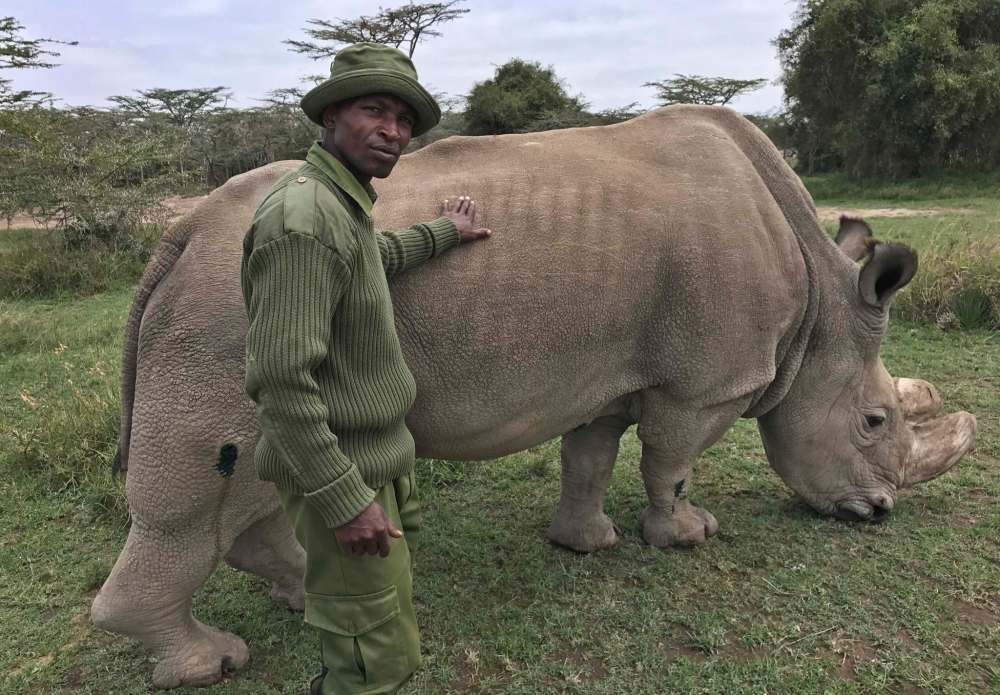
It would be a grotesque understatement to say the northern white rhino has seen better days.
It was headline news when the world’s last male northern white rhino, a 45-year-old bruiser named Sudan, had to be euthanized last week at the Ol Pejeta Conservancy, a private reserve in Kenya.
According to Reuters, Sudan was put down because of a rapid deterioration in his health. He was being treated for age-related complications that affected his muscles and bones and left him with extensive skin wounds.
Sudan’s death means there are only two female white rhinos alive in the world — his 27-year-old daughter Nadine and 17-year-old granddaughter Fatu — to save the subspecies from extinction. The majestic creature has all but been wiped out by poaching.
Researchers have saved some of Sudan’s genetic material in hopes it can be used in the future to attempt reproduction of northern white rhinos.
“It’s very sad to lose Sudan because it shows clearly the extent of human greed and what sort of impact humans beings can have on nature,” Samuel Mutisya, head of wildlife conservation at Ol Pejeta, told Reuters. “If we don’t take care of what we have, we will definitely continue to lose it, particularly lose other species that are currently endangered.”
There is faint hope for the northern white rhino, which is more than we can say for the creatures on today’s list of Five Species That Have Vanished Since Humans Hit the Scene:
5) The ex-species: The Caribbean monk seal
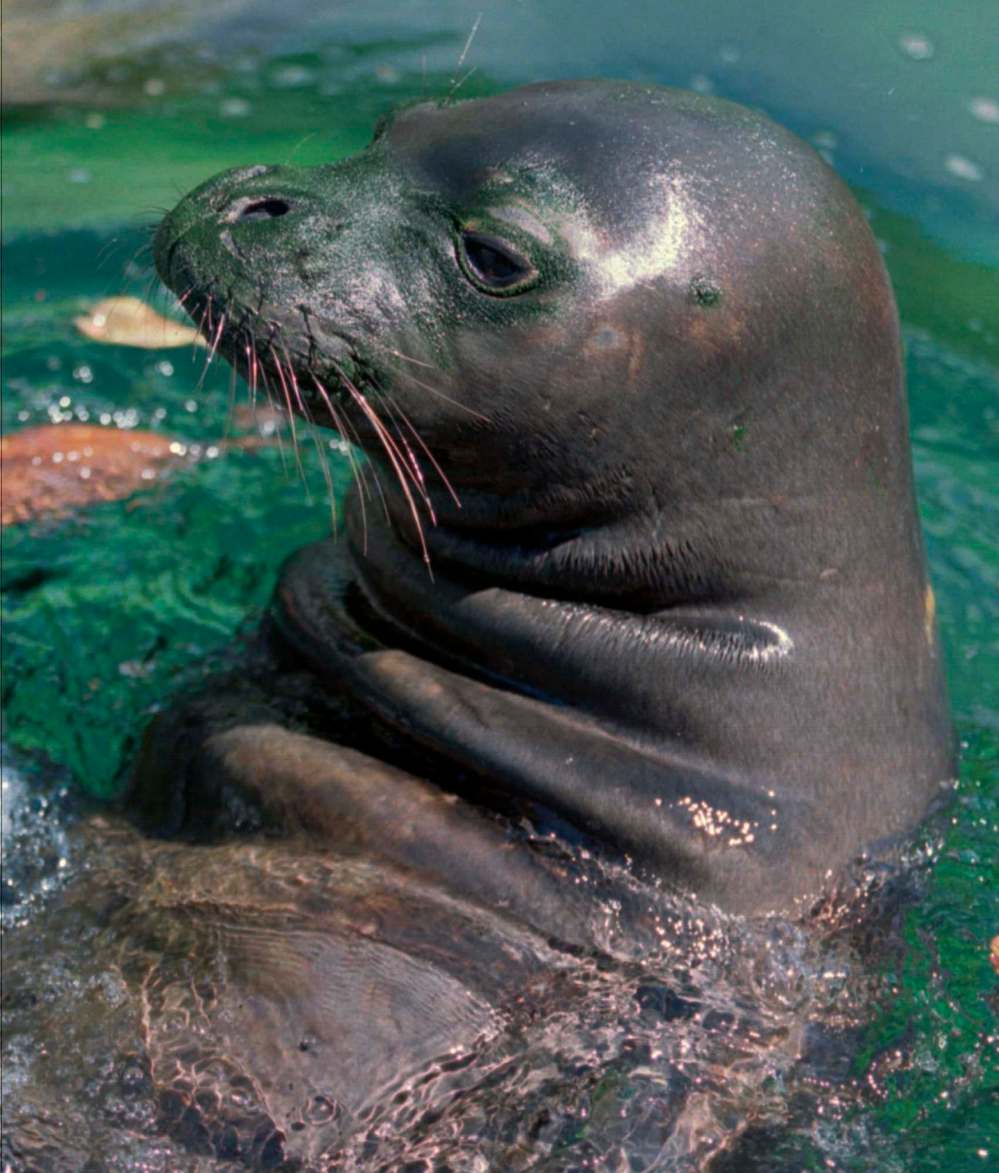
What it (used to) look like: These large brownish and/or greyish seals could grow up to 2.4 metres in length and weighed 170 to 270 kilograms. They had a distinctive rounded head with wide-spaced eyes, upward opening nostrils and light-coloured whiskers on their broad muzzle.
The obituary: This species, the only seal native to the Caribbean Sea and the Gulf of Mexico, had the honour of being the first New World mammal to be discovered by Christopher Columbus and his company on the coast of Santo Domingo during the legendary explorer’s second voyage in 1494. It did not end well for the seal, as Columbus promptly ordered his crew to kill eight of the animals, which he dubbed “sea wolves,” for food, which paved the carnivorous way for European immigrants who came in his wake.
The once-abundant creatures were hunted for their oil, fur and meat, and slaughtered by fishermen, who saw them as competitors, notes listverse.com. Sluggish on land, these creatures also lacked a fear of humans.
Last seen in the early 1950s, the seals were declared extinct in 2008 after a five-year review by the National Oceanic and Atmospheric Administration’s National Marine Fisheries Service.
“Humans left the Caribbean monk seal population unsustainable after overhunting them in the wild,” Kyle Baker, biologist for NOAA’s Fisheries Service southeast region, said in 2008. “Unfortunately, this led to their demise and labels the species as the only seal to go extinct from human causes… Worldwide, populations of the two remaining monk seal species are declining. We hope we’ve learned from the extinction of Caribbean monk seals, and can provide stronger protection for their Hawaiian and Mediterranean relatives.”
4) The ex-species: The Tasmanian tiger
What it (used to) look like: This shy, nocturnal creature looked like a medium-to-large-sized dog, with a stiff tail, abdominal pouch and dark stripes that radiated from the top of its back (kind of like a tiger) to the base of the tail. A fully grown specimen could measure 180 centimetres from the tip of the nose to the tip of the tail and stand 58 cm high.
The obituary: What we are talking about here is the largest known carnivorous marsupial of modern times, formally known as the thylacine but commonly called the Tasmanian tiger.
These creatures were already rare or extinct on the Australian mainland before the arrival of the British, but survived on the isolated island state of Tasmania off Australia’s south coast. Like the dingo, it was a quiet animal but was considered a relentless hunter, not unlike a wolf. It was basically hunted to extinction in 1936 in Tasmania, where it was thought to be a threat to sheep and other small farm animals. Constant hunting, disease, the introduction of dogs and human encroachment all contributed to the demise of this unique creature.
The last known thylacine, who became known as Benjamin, died on Sept. 7, 1936, apparently as the result of neglect — he was reportedly locked out of his sheltered sleeping quarters and exposed to freezing temperatures at night in Tasmania’s Hobart Zoo.
Thanks to a preserved pup floating in a jar of alcohol in an Aussie museum, the entire thylacine genome has been sequenced by University of Melbourne researchers, revealing the predator was in poor “genetic health” and may have struggled to fight disease had it survived.
“Our hope is that there is a lot the thylacine (genome) can tell us about the genetic basis of extinction to help other species,” Prof. Andrew Pask, the project leader, said in 2017. “As this genome is one of the most complete for an extinct species, it is technically the first step to ‘bringing the thylacine back,’ but we are still a long way off that possibility.”
Sightings have been reported as recently as 2015, but none have yet been confirmed.
3) The ex-species: The Pyrenean ibex
What it (used to) look like: Also known by the Spanish name bucardo, it was a form of wild mountain goat. The male was faded greyish-brown in summer and had black fur on the mane, forelegs and forehead. In winter, it became dull and faded. The female could be mistaken for a deer, while the male had distinctive, thick horns that curved outwards and backwards, then outwards and downwards, then inwards and upwards.
The obituary: This is an animal that famously went extinct, then even more famously — albeit extremely briefly — became “un-extinct.”
The Pyrenean ibex was once common in northern Spain and in the French Pyrenees, but extensive hunting during the 19th century reduced the wild goat’s numbers to fewer than 100 individuals, according to Britain’s Telegraph newspaper.
Poaching, diseases and the inability to compete with other species for limited food are also seen as reasons the once-abundant animals disappeared. They were declared protected in 1973, but by 1981 just 30 remained in their last foothold in the Ordesa National Park in the Aragon District of the Pyrenees.
They were declared extinct when the last bucardo, a 13-year-old female known as Celia, was found dead in January 2000 by park rangers near the French border with her skull crushed by a fallen tree.
Shortly before Celia’s death, scientists had preserved skin samples of the goat in liquid nitrogen.
“Using DNA taken from these skin samples, the scientists were able to replace the genetic material in eggs from domestic goats, to clone a female Pyrenean ibex, or bucardo as they are known,” the Telegraph reported in 2009. “Its the first time an extinct animal has been cloned.”
Tragically, the cloned newborn died seven minutes after birth because of physical defects in its lungs.
“Other cloned animals, including sheep, have been born with similar lung defects,” the Telegraph notes. “But the breakthrough has raised hopes that it will be possible to save endangered and newly extinct species by resurrecting them from frozen tissue.”
2) The ex-species: The quagga
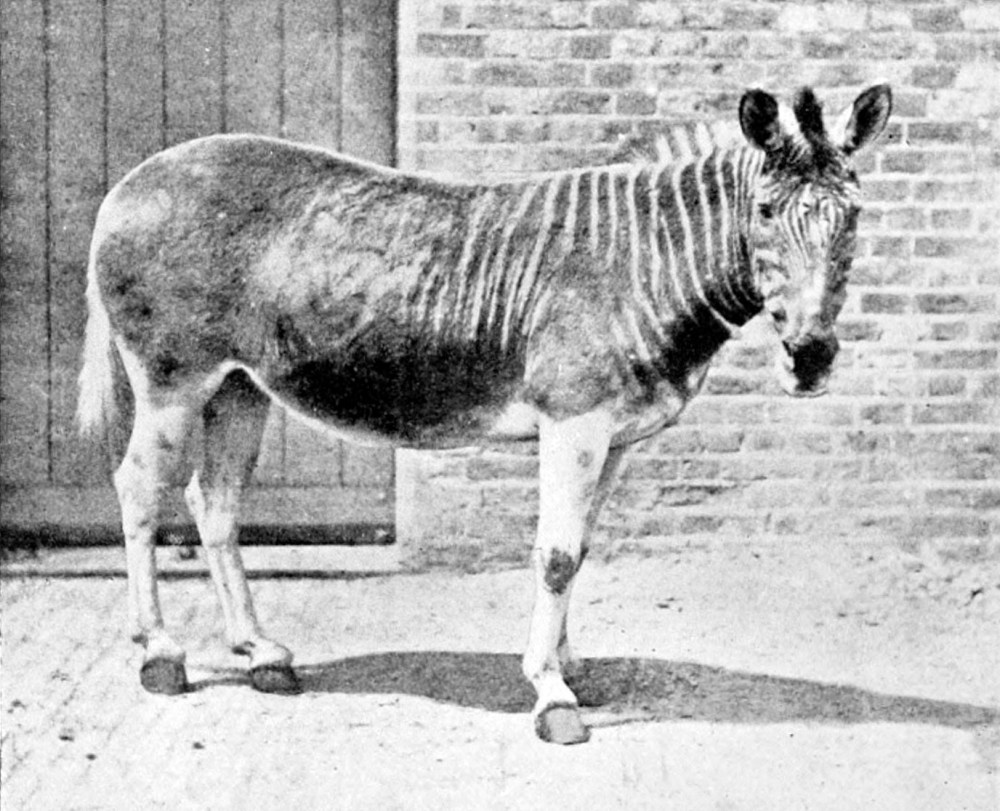
What it (used to) look like: A subspecies of the Plains Zebra, it looked like a horse and a zebra squished into one animal. Believed to have been around 257 cm long and 125 to 135 cm tall at the shoulder, it was distinguished from other zebras by a pattern of mainly brown and white stripes on the front part of the body, whereas the rear was brown and without stripes, much like a small horse.
The obituary: The quagga (named for its call, which sounded like “Kwa-ha-ha”) used to roam South Africa in vast herds — at least until European settlers fixed the beasts in their sights in the 19th century, killing them at an alarming rate.
“The quagga became extinct because it was ruthlessly hunted down for meat and leather by South African farmers, also they were seen by the settlers as competitors, like other wild grass-eating animals, for their livestock, mainly sheep and goats,” listverse.com notes.
It was likely hunted out of existence in the wild by 1878, and the last captive specimen, a mare, died on Aug. 12, 1883, in an Amsterdam zoo, where she had lived since May 1867.
It is believed only one quagga was ever photographed alive and only 23 skins are preserved today. In 1984, the quagga famously became the first extinct animal to have its DNA analyzed, and a group of scientists outside of Cape Town known as the Quagga Project is trying to bring the creature back from the grave through selective breeding of its closest living relative, the Burchell’s zebra.
They have bred an animal that is strikingly similar to the original quagga, working on the theory the quagga genes are still present in the zebra.
“The progress of the project has in fact followed that prediction,” project leader Eric Harley told CNN in 2016. “And in fact, we have over the course of four, five generations seen a progressive reduction in striping, and lately an increase in the brown background colour showing that our original idea was in fact correct… If we can retrieve the animals or retrieve at least the appearance of the quagga, then we can say we’ve righted a wrong.”
1) The ex-species: The passenger pigeon
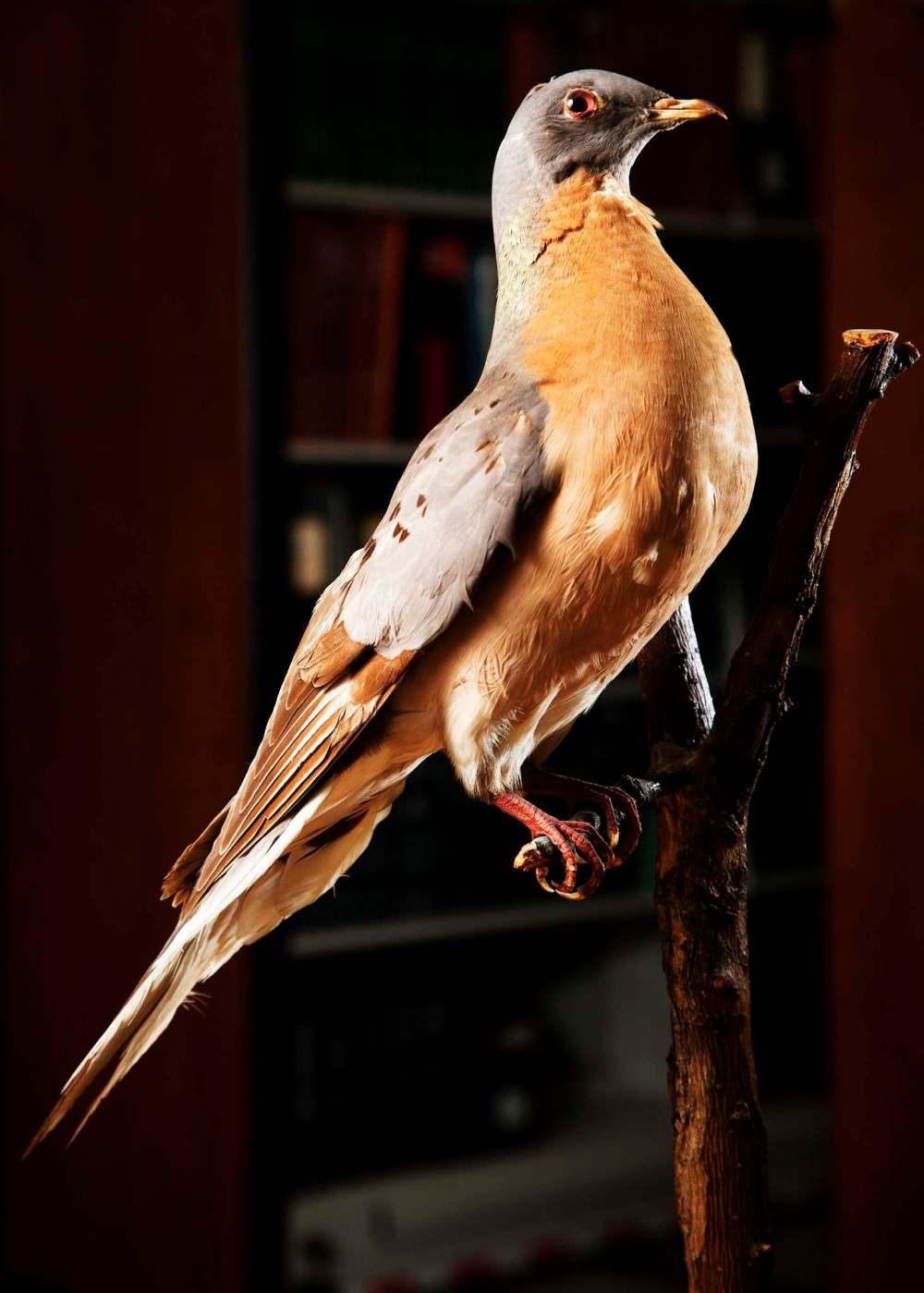
What it (used to) look like: It was a pigeon, with the males 390 to 410 millimetres in length, mainly slate-blue with copper undersides and hints of purple, whereas the females were 380 to 400 mm long and duller and browner than the males.
The obituary: The demise of the passenger pigeon has been described as the most tragic extinction story in modern times, because it underscores the fact mankind is the most destructive force to ever wallop Mother Nature.
At the height of their population, some 200 years ago, these pigeons were not just abundant, especially in North America, they were arguably the most common species of bird on the planet, with numbers estimated as high as five billion.
“Passenger pigeons once migrated through Canada, the United States and the Gulf of Mexico in numbers so huge that they darkened the sky,” the website of the American Museum of Natural History notes. “One flock was described as ‘a column, eight or ten miles in length… resembling the windings of a vast and majestic river.’ In 1808, one flock of passenger pigeons in Kentucky was estimated at more than two billion birds. Today, they are extinct owing to a combination of results of human activity, including the destruction of their food sources, westward expansion and overhunting.”
The massive size of the flocks led to the birds being hunted as a cheap source of meat, especially for the poor, and vilified as a threat for farmers’ crops.
“The flocks were so thick that hunting was easy — even waving a pole at the low-flying birds would kill some,” recalls the website of Audubon magazine. “The professionals and amateurs together outflocked their quarry with brute force. They shot the pigeons and trapped them with nets, torched their roosts and asphyxiated them with burning sulfur. They attacked the birds with rakes, pitchforks and potatoes. They poisoned them with whiskey-soaked corn.”
The last wild bird was shot in 1901, and the last passenger pigeon, a bird nicknamed Martha, died alone in the Cincinnati Zoo at about 1 p.m. on Sept. 1, 1914, almost 113 years ago.
It’s somehow comforting to know scientists are working to reconstruct this once-common bird’s genome in an effort to bring it back from oblivion. As with most creatures that disappear from the planet — and there are a stunning number of them — its extinction can largely be traced to another animal, the human being.
doug.speirs@freepress.mb.ca