

Into the wild blue yonder
Manitoba 'birdmen,' 'birdwomen' and inventors played a pivotal role in development of commercial and military aviation in Canada
Advertisement
Read this article for free:
or
Already have an account? Log in here »
To continue reading, please subscribe:
Digital Subscription
One year of digital access for only $1.44 a week*
- Enjoy unlimited reading on winnipegfreepress.com
- Read the E-Edition, our digital replica newspaper
- Access News Break, our award-winning app
- Play interactive puzzles
*Billed as $5.77 plus GST every four weeks. After 52 weeks, price increases to the regular rate of $19.95 plus GST every four weeks. Offer available to new and qualified returning subscribers only. Cancel any time.
To continue reading, please subscribe:
Add Free Press access to your Brandon Sun subscription for only an additional
$1 for the first 4 weeks*
- Enjoy unlimited reading on winnipegfreepress.com
- Read the E-Edition, our digital replica newspaper
- Access News Break, our award-winning app
- Play interactive puzzles
*Your next Brandon Sun subscription payment will increase by $1.00 and you will be charged $17.95 plus GST for four weeks. After four weeks, your payment will increase to $24.95 plus GST every four weeks.
Read unlimited articles for free today:
or
Already have an account? Log in here »
Hey there, time traveller!
This article was published 22/08/2020 (2111 days ago), so information in it may no longer be current.
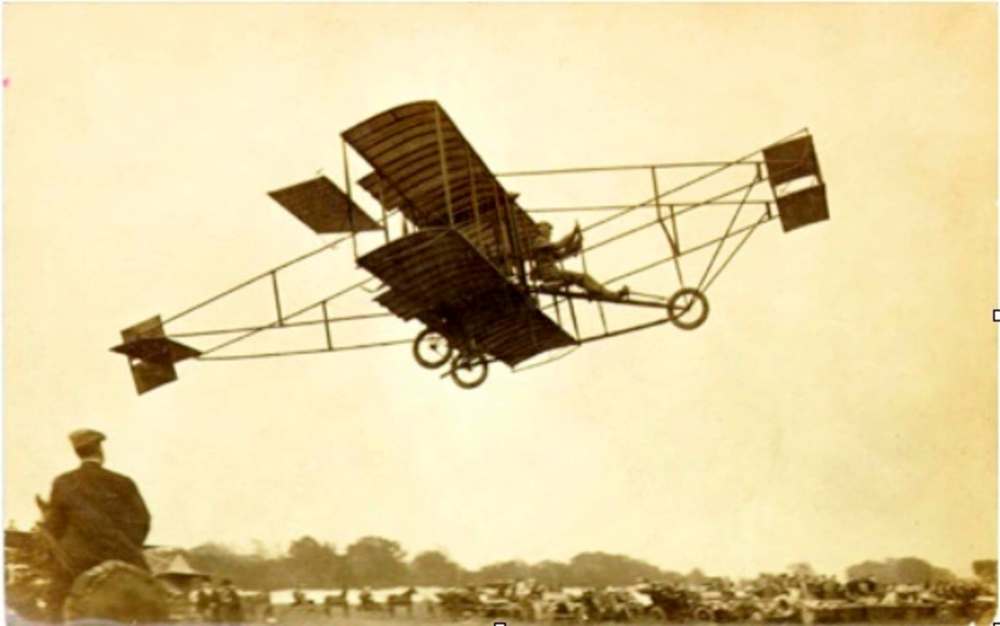
From contemporary reports, a picture emerges of the scene on July 15, 1910, when Eugene Ely, the Curtiss test pilot, made the first heavier-than-air flight in Manitoba.
Spectators came on foot and in a procession of wagons, carriages and buggies, on bicycles, on horseback and in a few sputtering automobiles. Matrons in giant plumed hats, businessmen with slicked-back pompadours, small boys in knickerbockers and little girls in bloomers and patent slippers, all squirmed and leaned over the rope barrier to see a small, fragile aircraft trundle onto an improvised grass airstrip near the Polo grounds of Winnipeg. The biplane gathered speed and ascended in a fluttering circle above their heads. Mouths dropped open and remained fixed in place as their world transformed before them.
Those who watched his third takeoff witnessed the spectacular crash-landing that ended Ely’s exhibition and also went down in history as Canada’s first major air crash. Ely was one of a succession of demonstration pilots who introduced the first airplanes to communities across the continent. He was to go on to fame as the first pilot to take off from the first aircraft carrier — a collier fitted with a modified deck — on Nov. 10, 1910. Subsequently on Jan. 18, 1911, he would be the first to land on a converted cruiser, completing the trials to prove an aircraft carrier was feasible as a new weapon of war. By the end of the year he was dead. He had stalled and crashed during a barnstorming tour at Macon, Ga., on Oct. 19, 1911, and just as others had done before, he had died with his hands still on the control wheel.
Manitoba 150 celebrates 150 years of history, progress and innovation in our province. During this period, from its early beginnings at the turn of the 20th century, the development of aviation in Manitoba has had a significant impact on Winnipeg, its surrounding communities as well as the North. Manitoba ushered in the age of flight with the first aviation association primarily devoted to the development of aeronautics in Canada, the Aero Club of Canada that was headquartered in Winnipeg. Their initial ambitious project resulted in the first aircraft designed and built entirely in Canada, the “Aero Car Canada,” which was unveiled to the public shortly after the association’s inauguration.
Accounts from the Manitoba Free Press (a precursor of the current Winnipeg Free Press) and Winnipeg Telegram, recount the saga of the dawn of aviation in Manitoba. A series of earlier 19th-century experiments and demonstrations with “birdmen” and “birdwomen” had investigated flight in the form of balloon ascents and parachute flights. Miss Louisa Bates parachuted from a hot-air balloon at the Winnipeg Industrial Exhibition on July 21, 1893. She made a total of three successful “jumps” during the engagement. In 1896, Professor H. Menier parachuted from a hot-air balloon at River Park, Winnipeg May 27-30 in four successive jumps. Professor Thompson made a parachute jump from a hot-air balloon on June 2, 1900 at River Park. Miss Adela Thompson made a series of further parachute jumps from balloons at the same location on June 16 and June 29, 1900, narrowly escaping drowning when she dropped into the Red River. On July 10, 1907, Professor Thompson made another parachute jump from a hot-air balloon at the Industrial Fair at Portage la Prairie. Although these tentative “flights” took place earlier, it was in 1909 that powered flight first became more feasible in Manitoba.
Taking a page from aviation historian, Charles Gibbs-Smith, “The year 1909 was an annus mirabilis in aviation history.” Translated as a year of wonders, the date was significant in Manitoba’s aviation history, as the Aero Club of Canada was formed by 25 enthusiasts at the Winnipeg Industrial Bureau on March 31, 1909 “to assist and promote practical aeronautics by encouraging Canadian Inventors.” In describing the efforts of this pioneering association, observers noted that it was the first “of its kind in Canada” with efforts to provide communication with other scientific associations worldwide. The eventual chairman of the club was to be Hon. Sir Hugh John MacDonald, although at the first meeting, Col. H.W.A. Chambre presided. One of the first functions of the Aero Club of Canada was to establish headquarters in Winnipeg and create a constitution that would enable aeronautical research and support of individual projects.
One of the founding members, William J. Robertson, commenced one the first of the Aero Club of Canada’s programs, the “Aero Car Canada” (also variously described as the “Aerocar Canada”). It was the first aircraft designed and built in Canada and ready for display on July 14, 1909, ushering in the age of powered flight in Manitoba.
Although resembling other earlier Wright and Curtiss designs, the sole prototype was 30 feet long, six feet wide, featured “V-shaped planes,” weighed a scant 700 pounds and used a 15-horsepower engine propelling a large seven-inch single “pusher” propeller. The inventor developed an ingenious launching device he called a “travelling carriage” which would propel the aircraft to a speed of 30 m.p.h. before launch. Robertson utilized another unique launching system in which the airplane was suspended 15 feet off the ground “supported on five air pyramids,” intended to be dropped to gain flying speed.
Despite the innovative design, the Aero Car Canada displayed for two days at the Happyland Ball Grounds in Winnipeg, was not successful, with its first flight delayed partly by weather as well as a lack of parts that were being sent from the United States. Although the aircraft was examined by the public as well as experts, the test flight was delayed and it was not until the arrival of Eugene Burton Ely, demonstration pilot for Curtiss Aircraft who flew in Winnipeg exactly one year later, that the first powered flight in Manitoba was recorded.

A second aircraft design was initiated in 1909 under the auspices of the Aero Club of Canada, although it was not able to proceed beyond research and design. The “Kelsey Helicopter,” named after its Winnipeg inventor, Edwin E. Kelsey, was revealed to the public on April 6, 1909. Described as a “dirigible helicopter,” although the design proved to be successful in scale-model form, lifting into the air and flying even in a confined space, it never progressed to final construction. A further five aeronautical projects commenced by members of the Aero Club of Canada were similarly fated to never be completed.
The Aero Club of Canada played a significant role in furthering aviation in Manitoba and Canada. After the dissolution of the Royal Canadian Flying Club Association, it was resurrected under the new Aero Club of Canada banner as an umbrella organization for sports aviation associations in Canada. Working with the Federation Aeronautique Internationale (FAI), the Aero Club of Canada today provides information on the constituent bodies as well as information on Canadian aviation world records.
From these tentative forays into aviation, Manitoba emerged as a leader in Canada’s aerospace technology, launching the first commercial flying operation off the Red River with bush pilots pushing back the frontiers west and north. Manitoba served as one of the bulwarks of democracy in the world wars to come, training thousands and building an industrial base that still is recognized as Canada’s third-largest aerospace industrial hub.
This article was written by Bill Zuk who is a member of the Manitoba Historical Society. Bill is a Winnipeg author, historian and filmmaker. He is also a director of the Canadian Aviation Historical Society and the Air Cadet League of Canada (Manitoba).
For more information or to become a member of the Manitoba Historical Society, call 204-947-0559 or email: info@mhs.mb.ca. The MHS is on Facebook, Twitter and Instagram as manitoba-history. You can see hundreds of other stories on the website at www.mhs.mb.ca.