WEATHER ALERT

Kintsugi: Broken pottery becomes more beautiful, precious

Advertisement

Advertise with us

If you search online for "kintsugi," most of what you'll find in English is self-help advice that uses this Japanese craft as a jumping-off point. The idea of repairing broken pottery in a way that makes it more beautiful than it was before is apparently an irresistible metaphor for recovering from life's trials and tribulations.

Read this article for free:

or

Already have an account? Log in here »

To continue reading, please subscribe:

Subscribe and receive a limited-edition Free Press branded hat or tote.

Digital Subscription

One year of digital access for only $205*

  • Enjoy unlimited reading on winnipegfreepress.com
  • Read the E-Edition, our digital replica newspaper
  • Access News Break, our award-winning app
  • Play interactive puzzles

*First annual payment billed as $205.00 + GST for one year. This annual subscription will automatically renew at $233.00 + GST every 52 weeks (10% off the regular annual price of $259.35). Offer available to new and qualified returning subscribers only. Cancel any time.

To continue reading, please subscribe:

Add Free Press access to your Brandon Sun subscription for only an additional

$1 for the first 4 weeks*

  • Enjoy unlimited reading on winnipegfreepress.com
  • Read the E-Edition, our digital replica newspaper
  • Access News Break, our award-winning app
  • Play interactive puzzles
Start now

*Your next Brandon Sun subscription payment will increase by $1.00 and you will be charged $17.95 plus GST for four weeks. After four weeks, your payment will increase to $24.95 plus GST every four weeks.

Hey there, time traveller!
This article was published 02/01/2019 (2761 days ago), so information in it may no longer be current.

If you search online for “kintsugi,” most of what you’ll find in English is self-help advice that uses this Japanese craft as a jumping-off point. The idea of repairing broken pottery in a way that makes it more beautiful than it was before is apparently an irresistible metaphor for recovering from life’s trials and tribulations.

When I tried kintsugi for myself at a workshop in Tokyo recently, I couldn’t help wondering how many of those writers based their simile on hands-on experience. The craft was a lot more tedious than I’d expected — but maybe that made the metaphor all the more true?

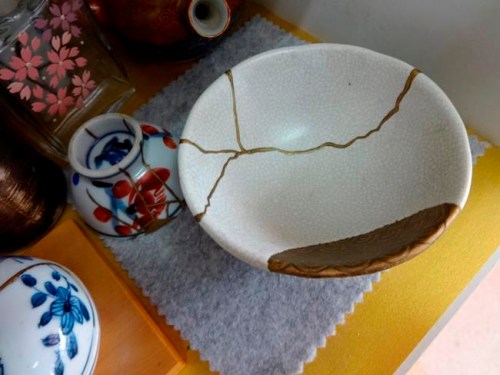
The usual goal when repairing something is to make the fix unnoticeable, restoring an object as closely as possible to its original appearance. Kintsugi takes the opposite approach: Chips and cracks are outlined and filled in with gold, creating a new design and adding a material that looks precious.
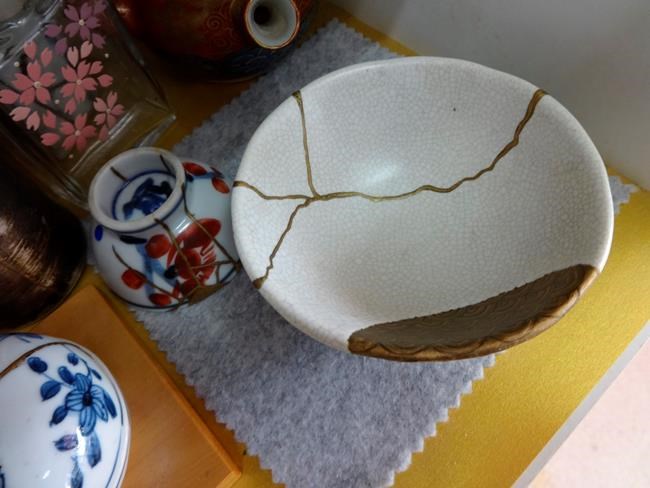
This Nov. 11, 2018 photo shows an example of Kintsugi at the Kuge Crafts workshop in Tokyo. Kintsugi is an ancient Japanese method of repairing broken pottery with gold that creates a new work of art. (Linda Lombardi via AP)

The craft is said to go back to the 15th century, and I was disappointed at first to learn from instructor Yoshiko Kuge that we would not be using traditional materials. The reasons soon became obvious, though. Of course it makes sense that beginners wouldn’t be using real gold — the usual replacement is a powder made of copper and brass — but, in addition, the ancient method took literally months to complete.

Kuge demonstrated the old technique by mixing a little sticky plant resin with clay powder, and then dripping a drop of it onto a chip on the lip of a cup. That was it for today: Now, you’d have to wait a month for that thin layer to dry, then repeat the process until enough layers had been built up to fill the gap.

Instead, we would use an epoxy putty that dries in a few minutes — an obvious improvement as far as speed, especially for a two-hour class. It’s also not as toxic as the old-fashioned materials, which can cause allergic reactions.

The workshop had many beautiful examples on display of pottery broken into several pieces and reassembled with lines of gold, as well as some with decorative additions incorporated, like pieces of sea glass. We, however, started small, each choosing a cup that was intact except for a small chip on its rim.

We each filled in the chip with a lump of putty that extended beyond the gap in all directions. After the putty dried, the next step was filing down the lump using a metal file that’s flat on one side and curved on the other — flat for the outside of the cup, curved for the inside.

The gold of a finished kintsugi piece is textured, so we students were a bit surprised as we kept showing our pieces to the instructors and being told we weren’t done yet. Turns out the texture is completely due to the gold added later — we really needed to file the filler down till it was completely level with the original surfaces, a process that took quite some time. Then, when it looked like it was finally perfectly smooth, we had to make it even smoother with wet sandpaper so fine you can’t feel any roughness with your fingertip.

At this point, the piece would normally be left to dry overnight, but so the workshop could be finished in one afternoon, Kuge effected a little time-travel with the use of a hair dryer. Once the piece cooled off, finally we got to what we came for: the gold.

In a tiny tray, the gold powder (made of brass and copper) is mixed with a resin; this is made from cashew nuts and is apparently less toxic than the traditional kind. We dipped a fine-tipped brush into some thinner and then into the gold mixture and used it to first outline our chip, then fill it in. (This is harder on the inside of the cup, where it’s hard to get a good angle.) Next we got to indulge in a tiny bit of artistic license: When you paint the fine crack that extends from the bottom of the chip, no one’s going to know if you make it a little longer than it really was. A more experienced craftsperson can also add designs to flat areas; Kuge showed us examples covered with tiny dots and with traditional patterns of nested half-circles.

Finally, with a larger brush, we took more of the dry powder and dusted it onto everything we’d just painted. At first, we needed to be careful not to touch the wet surface, but once it was covered with powder, it was safe to brush off the extra.

Although this didn’t take the months of waiting that it did in earlier centuries, we still were not quite done: After two days we’d need to wash the extra gold powder off with soapy water and a sponge, and then wait two weeks for the piece to dry completely.

If you want to try kintsugi, you can buy Japanese-made kits with all the materials. These will cost over $100 if you wait to go home to the U.S. and order them online, but even if you’re shopping in Japan they’re pricier than buying the components separately. Kuge provides students with a shopping list (with photos, for the Japanese-impaired).

The shopping list was a nice gesture, but for my part, what I learned about this craft is that I’m going to leave it to the experts, as least for pottery. As far as the life metaphor, I’ll have to think on it.

___

Online:

http://www.teshigotoya-kuge.com/
Report Error Submit a Tip

More Stories

Cleanup squad makes positive waves across city

Zoe Pierce 4 minute read Preview

Cleanup squad makes positive waves across city

Zoe Pierce 4 minute read 4:49 PM CDT

The period after the snow melts isn’t when Winnipeg is at its most attractive.

As months of hidden trash and accumulated waste emerge, streets and sidewalks across the city quickly become covered in litter.

But Take Pride Winnipeg’s latest litter index has found the city looks cleaner than it did earlier this spring. Every area of Winnipeg showed improvement.

The organization’s overall litter index score dropped from 5.92 after the snow melted to 3.47 in its latest assessment. The index measures litter levels on a scale of one to 10, with one representing a perfectly clean area and 10 representing the worst levels of litter.

Read
4:49 PM CDT

Mountain View teacher stripped of licence over explicit messages

Maggie Macintosh 5 minute read Preview

Mountain View teacher stripped of licence over explicit messages

Maggie Macintosh 5 minute read Updated: Yesterday at 6:48 AM CDT

A Roblin teacher has been stripped of his professional licence after an undercover police investigation found he sent explicit messages to a social media user he believed to be a 15-year-old girl.

Manitoba cancelled Josh Braaksma’s credentials — listed in the province’s online registry under his full name, Joshua William Braaksma — on July 6. His certificate was suspended on an interim basis in the fall.

The misconduct case involving Braaksma, who has taught and coached in the Mountain View School Division over the last decade, is the first to be resolved via a “written hearing.”

“Having regard to the nature, content and context of (his) communications, the panel finds that the teacher’s conduct renders him unsuitable to be a teacher,” the disciplinary decision states.

Read
Updated: Yesterday at 6:48 AM CDT

String of Polo Park thefts totalling $27K leads to charges

1 minute read Updated: Yesterday at 9:25 AM CDT

A 23-year-old man has been linked to a string of commercial thefts at Polo Park shopping centre totalling more than $27,000.

In July, the Winnipeg Police Service began an investigation regarding a string of retail thefts to a number of businesses. Investigators determined a man was involved in a number of thefts including:

Between June 29 and July 4, a man attended a store five times and stole merchandise valued at $4,805Between July 16 and July 20, a man attended a store five times and stole merchandise valued at $22,985July 21, a man attended a store and stole merchandise valued at $123All incidents were captured on security cameras and reported to police. Officers identified a 23-year-old man as a suspect and on July 21 arrested him. He's been charged with nine counts of theft under $5,000 and two counts of theft over $5,000.

He remains in custody.

Kintsugi: Broken pottery becomes more beautiful, precious

Linda Lombardi, The Associated Press 5 minute read Preview

Kintsugi: Broken pottery becomes more beautiful, precious

Linda Lombardi, The Associated Press 5 minute read Wednesday, Jan. 2, 2019

If you search online for "kintsugi," most of what you'll find in English is self-help advice that uses this Japanese craft as a jumping-off point. The idea of repairing broken pottery in a way that makes it more beautiful than it was before is apparently an irresistible metaphor for recovering from life's trials and tribulations.

When I tried kintsugi for myself at a workshop in Tokyo recently, I couldn't help wondering how many of those writers based their simile on hands-on experience. The craft was a lot more tedious than I'd expected — but maybe that made the metaphor all the more true?

The usual goal when repairing something is to make the fix unnoticeable, restoring an object as closely as possible to its original appearance. Kintsugi takes the opposite approach: Chips and cracks are outlined and filled in with gold, creating a new design and adding a material that looks precious.

The craft is said to go back to the 15th century, and I was disappointed at first to learn from instructor Yoshiko Kuge that we would not be using traditional materials. The reasons soon became obvious, though. Of course it makes sense that beginners wouldn't be using real gold — the usual replacement is a powder made of copper and brass — but, in addition, the ancient method took literally months to complete.

Read
Wednesday, Jan. 2, 2019

Gillingham promises city will pay for volunteers’ criminal record checks if re-elected

Malak Abas 3 minute read Preview

Gillingham promises city will pay for volunteers’ criminal record checks if re-elected

Malak Abas 3 minute read Updated: 5:19 PM CDT

Scott Gillingham’s first promise of his re-election campaign is a commitment to cover the cost of criminal record checks for Winnipeg volunteers.

The mayor said the $65 charge is the highest for volunteers of major cities in Canada.

About 6,500 Winnipeggers obtain criminal record checks for volunteer purposes every year. Fees are collected by the Winnipeg Police Service. Gillingham said taxpayers would cover the lost revenue to the police service. The city would set up a voucher program that would allow organizations to offer free record checks to volunteers.

“Some pay those fees themselves, and in many cases, it’s the community organizations who cover the costs on their behalf,” Gillingham said Friday at the Sturgeon Heights Community Centre.

Read
Updated: 5:19 PM CDT

Decrease in crime an inconvenient truth for Poilievre

Tom Brodbeck 5 minute read Preview

Decrease in crime an inconvenient truth for Poilievre

Tom Brodbeck 5 minute read Updated: Yesterday at 4:33 PM CDT

Pierre Poilievre’s Conservatives have apparently decided that facts are an obstacle to their crime narrative.

Read
Updated: Yesterday at 4:33 PM CDT