WEATHER ALERT

Liberals dare Trump to back their bills lowering drug prices

Advertisement

Advertise with us

WASHINGTON - Challenging President Donald Trump to make good on his pledge to cut prescription drug prices, congressional liberals proposed legislation Thursday to bring U.S. prices in line with the much lower costs in other countries.

Read this article for free:

or

Already have an account? Log in here »

To continue reading, please subscribe:

Subscribe and receive a limited-edition Free Press branded hat or tote.

Digital Subscription

One year of digital access for only $205*

  • Enjoy unlimited reading on winnipegfreepress.com
  • Read the E-Edition, our digital replica newspaper
  • Access News Break, our award-winning app
  • Play interactive puzzles

*First annual payment billed as $205.00 + GST for one year. This annual subscription will automatically renew at $233.00 + GST every 52 weeks (10% off the regular annual price of $259.35). Offer available to new and qualified returning subscribers only. Cancel any time.

To continue reading, please subscribe:

Add Free Press access to your Brandon Sun subscription for only an additional

$1 for the first 4 weeks*

  • Enjoy unlimited reading on winnipegfreepress.com
  • Read the E-Edition, our digital replica newspaper
  • Access News Break, our award-winning app
  • Play interactive puzzles
Start now

*Your next Brandon Sun subscription payment will increase by $1.00 and you will be charged $17.95 plus GST for four weeks. After four weeks, your payment will increase to $24.95 plus GST every four weeks.

Hey there, time traveller!
This article was published 10/01/2019 (2757 days ago), so information in it may no longer be current.

WASHINGTON – Challenging President Donald Trump to make good on his pledge to cut prescription drug prices, congressional liberals proposed legislation Thursday to bring U.S. prices in line with the much lower costs in other countries.

The Democratic bills stand little chance of becoming law in a divided government. But the effort could put Republicans on the defensive by echoing Trump’s pledge to force drugmakers to cut prices.

Democrats and Trump agree that people in the United States shouldn’t have to pay more for their medications than do those in other economically advanced countries.
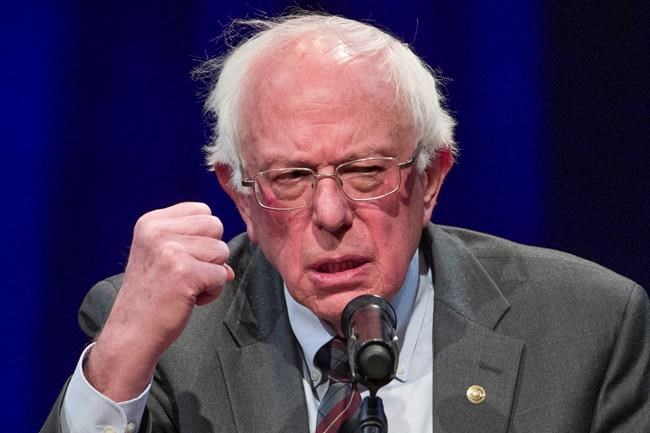
FILE - In this Nov. 27, 2018, file photo, Sen. Bernie Sanders, I-Vt., speaks about his new book at a George Washington University/Politics and Prose event in Washington. Leading congressional liberals are unveiling a package of bills that aims to reduce what Americans pay for prescription drugs by linking prices to lower costs in other countries. Sanders and Maryland Democratic Rep. Elijah Cummings plan to introduce three bills Thursday, Jan. 10, 2019. (AP Photo/Alex Brandon, File)

The Trump administration has put forward its own plan for reducing drug prices, but industry analysts have seen little impact so far. The pharmaceutical industry said the Democratic bills would “wreak havoc on the U.S. health care system.”

The new legislation was offered by Sen. Bernie Sanders, I-Vt., Rep. Elijah Cummings, D-Md., and others. Cummings leads the House Oversight and Government Reform Committee, which is expected to take a major role on drug pricing.

The lawmakers want to:

—Open up generic competition to patent-protected U.S. brand-name drugs that are deemed “excessively priced.”

—Allow Medicare to directly negotiate with drugmakers.

—Let consumers import lower-priced medications from Canada.

There was no immediate response from the administration.

“Today I say to President Trump, if you are serious about lowering the cost of prescription drugs in this country, support our legislation and get your Republican colleagues on board,” Sanders said at a Capitol Hill press conference.

“No more talk. No more tweets,” said Cummings. “The American people want action.”

Holly Campbell, a spokeswoman for the Pharmaceutical Research and Manufacturers of America, said Sanders’ plan would harm U.S. patients. The industry argues that government price regulation could limit access to some medicines, undermine financial incentives for research, and compromise safety standards. Sanders says drugmakers are primarily interested in protecting profits.

As a presidential candidate, Trump initially called for Medicare to negotiate drug prices and favoured allowing people to legally import lower-priced medications from abroad.
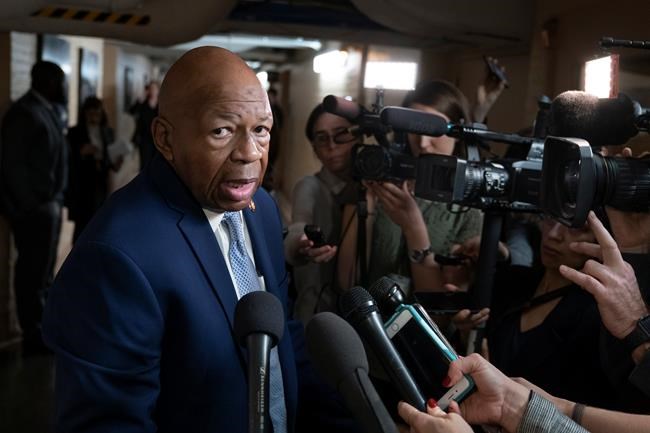
FILE - In this Jan. 4, 2019, file photo Rep. Elijah Cummings, D-Md., speaks at the Capitol in Washington, Friday, Jan. 4, 2019. Leading congressional liberals are unveiling a package of bills that aims to reduce what Americans pay for prescription drugs by linking prices to lower costs in other countries. Vermont Independent Sen. Bernie Sanders and Cummings plan to introduce three bills Thursday, Jan. 10. (AP Photo/J. Scott Applewhite, File)

But Medicare negotiation is a political nonstarter for most Republicans, who favour a free-market approach to the U.S. pharmaceutical industry and prize its capacity for innovation.

As president, Trump has come out with a plan to lower drug costs that relies on dozens of regulatory actions. The goal is to eliminate incentives for drugmakers, pharmacy benefit managers and insurers to stifle competition at the expense of consumers. Independent experts say the administration proposals would have an impact, but not limit the ability of drug companies to set high prices.

Time and again, Trump has complained that other countries where governments set drug prices are taking advantage of Americans. Indeed, one of his ideas would shift Medicare payments for drugs administered in doctors’ offices to a level based on international prices.

“We are taking aim at the global freeloading that forces American consumers to subsidize lower prices in foreign countries through higher prices in our country,” the president said when he made that proposal shortly before last year’s congressional elections.

The Democratic bills would go far beyond Trump’s approach.

The newest idea would essentially apply to any U.S. patent-protected brand-name drug, whether or not government programs are bearing the cost. By comparison, Trump’s international pricing proposal would not apply to retail pharmacy drugs purchased by Medicare beneficiaries or to medications for privately insured people. It’s the result of a joint effort between Sanders and Rep. Ro Khanna, D-Calif.

Drugs found to be “excessively priced” by the government could face generic competition. A medication’s cost would be deemed “excessive” if its price in the U.S. was higher than the median, or midpoint, price in Canada, the United Kingdom, Germany, France and Japan.

If the manufacturer was unwilling to cut its U.S. price, then the government could allow generic companies to make a more affordable version of the medication. Generic drugmakers would have to pay “reasonable” royalties to the company holding the patent.
Report Error Submit a Tip

More Stories

Province announces review of child welfare funding, governance

Carol Sanders 5 minute read Preview

Province announces review of child welfare funding, governance

Carol Sanders 5 minute read Updated: Yesterday at 5:34 PM CDT

An independent external review of provincial Child and Family Services funding and its governance model, which is expected to begin this fall, is long overdue, says one Indigenous leader who described a system in crisis.

Read
Updated: Yesterday at 5:34 PM CDT

The Manitoba government is taking more time to evaluate and select a preferred corridor for the twinning of a 16-kilometre section of the Trans-Canada Highway near the Ontario boundary.

An earlier timeline indicated Manitoba Transportation and Infrastructure expected to choose an alignment by the fall of 2025. A provincial spokesperson told the Free Press a decision is now expected this winter.

“The department continues to evaluate corridor alternatives and will undertake additional geotechnical, environmental and design work as part of the (functional design study) to support the selection of a preferred corridor,” the spokesperson said in a statement.

The study, which will include Crown-Indigenous and public consultation, is expected to be completed in late 2027, with a detailed design to follow.

Liberals dare Trump to back their bills lowering drug prices

Ricardo Alonso-Zaldivar, The Associated Press 5 minute read Preview

Liberals dare Trump to back their bills lowering drug prices

Ricardo Alonso-Zaldivar, The Associated Press 5 minute read Thursday, Jan. 10, 2019

WASHINGTON - Challenging President Donald Trump to make good on his pledge to cut prescription drug prices, congressional liberals proposed legislation Thursday to bring U.S. prices in line with the much lower costs in other countries.

The Democratic bills stand little chance of becoming law in a divided government. But the effort could put Republicans on the defensive by echoing Trump's pledge to force drugmakers to cut prices.

Democrats and Trump agree that people in the United States shouldn't have to pay more for their medications than do those in other economically advanced countries.

The Trump administration has put forward its own plan for reducing drug prices, but industry analysts have seen little impact so far. The pharmaceutical industry said the Democratic bills would "wreak havoc on the U.S. health care system."

Read
Thursday, Jan. 10, 2019

A stealthy tax increase

Gage Haubrich 4 minute read 2:00 AM CDT

About $2,100. That’s how much Premier Wab Kinew’s bracket creep tax hike could cost your family by 2030, depending on how much you make.

Bracket creep is an income tax hike that happens when the government stops indexing tax brackets to inflation. That means that after getting a cost-of-living raise, taxpayers can be bumped into a new tax bracket and have their tax bill increased even though they can’t afford to buy more.

Think about it this way: A raise that only covers higher grocery prices isn’t a real raise. You’re not richer. Your cart costs the same. But the bigger number on your paycheque bumps you into a higher bracket. That means higher taxes on a paycheque that buys the exact same number of groceries as last year.

That’s why most provincial governments and the federal government adjust income tax brackets with inflation.

Troubling photo worth a significant number of words for coach who refuses to speak

Dan Lett 5 minute read Preview

Troubling photo worth a significant number of words for coach who refuses to speak

Dan Lett 5 minute read Monday, Jul. 27, 2026

There’s nothing funny about violent hazing rituals in youth sport. Why then, you might ask, is Doug Kovacs laughing?

Read
Monday, Jul. 27, 2026

Letters, July 29

7 minute read Preview

Letters, July 29

7 minute read 2:00 AM CDT

I was excited to see the cover of (the July 27) Free Press. However, it appears the Canadian Press reporter, Ian Bickis, missed key aspects of the story. Purpose Construction not only bought the lot: they built the home Mr. Bettcher now lives in using labour from the neighbourhood as a part of a trades-training program. And they helped build the financing model.

Read
2:00 AM CDT