NASA twins study explores space, the final genetic frontier
Advertisement
Read this article for free:
or
Already have an account? Log in here »
To continue reading, please subscribe:

Digital Subscription
One year of digital access for only $205*
- Enjoy unlimited reading on winnipegfreepress.com
- Read the E-Edition, our digital replica newspaper
- Access News Break, our award-winning app
- Play interactive puzzles
*First annual payment billed as $205.00 + GST for one year. This annual subscription will automatically renew at $233.00 + GST every 52 weeks (10% off the regular annual price of $259.35). Offer available to new and qualified returning subscribers only. Cancel any time.
To continue reading, please subscribe:
Add Free Press access to your Brandon Sun subscription for only an additional
$1 for the first 4 weeks*
- Enjoy unlimited reading on winnipegfreepress.com
- Read the E-Edition, our digital replica newspaper
- Access News Break, our award-winning app
- Play interactive puzzles
*Your next Brandon Sun subscription payment will increase by $1.00 and you will be charged $17.95 plus GST for four weeks. After four weeks, your payment will increase to $24.95 plus GST every four weeks.
Read unlimited articles for free today:
or
Already have an account? Log in here »
Hey there, time traveller!
This article was published 11/04/2019 (2666 days ago), so information in it may no longer be current.
WASHINGTON – From his eyes to his immune system, astronaut Scott Kelly’s body sometimes reacted strangely to nearly a year in orbit, at least compared to his Earth-bound identical twin — but newly published research shows nothing that would cancel even longer space treks, like to Mars.
The good news: Kelly largely bounced back after returning home, say scientists who released final results from NASA’s “twins study,” a never-before opportunity to track the biological consequences of spaceflight in genetic doubles.
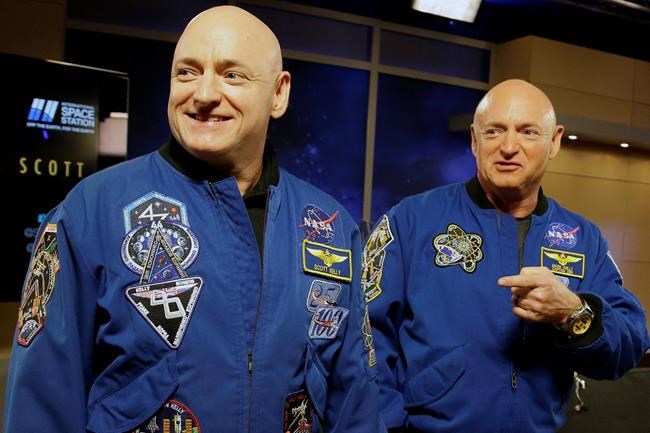
It marks “the dawn of human genomics in space,” said Dr. Andrew Feinberg of Johns Hopkins University. He led one of 10 teams of researchers that scrutinized the twins’ health down to the molecular level before, during and after Kelly’s 340-day stay at the International Space Station.
More importantly, the study “represents more than one small step for mankind” by pointing out potential risks of longer-duration spaceflight that need study in more astronauts, said Markus Lobrich of Germany’s Darmstadt University and Penny Jeggo of the University of Sussex, who weren’t involved in the work.
The findings were published in Friday’s edition of the journal Science, on some notable space anniversaries — when Soviet cosmonaut Yuri Gagarin became the first person in space in 1961, and the first launch of the space shuttle in 1981.
KEY FINDINGS
NASA already knew some of the toll of space travel, such as bone loss that requires exercise to counter. This time, NASA-funded scientists looked for a gamut of physiologic and genomic changes that Scott Kelly experienced in space, comparing them to his DNA double on the ground, former astronaut Mark Kelly. Some results had been reported in February.
Possibly the weirdest finding had to do with something called telomeres, the protective ends of chromosomes. Those tips gradually shorten as we get older, and are thought to be linked to age-related diseases including some cancers.
But in space, Scott Kelly’s telomeres got longer. “We were surprised,” said Colorado State University telomere expert Susan Bailey. She can’t explain it although it doesn’t mean Kelly got younger. Back on Earth, his telomeres mostly returned to preflight average although he did have more short telomeres than before.
Next, Kelly’s DNA wasn’t mutated in space but the activity of many of his genes — how they switch on and off — did change, especially in the last half of the voyage, which ended in March 2016.
Immune system genes especially were affected, putting it “almost on high alert as a way to try and understand this new environment,” said study co-author Christopher Mason, a Weill Cornell Medicine geneticist in New York.
Again, most gene expression returned to normal back home, but some of the immune-related genes were hyperactive six months later.
“We learned that the human body is pretty resilient and we can survive and to some extent maybe even thrive on these long-duration flights,” Mark Kelly said.
Other findings:
—Some changes in the structure of Kelly’s eye and thickening of his retina suggested that, like about 40% of astronauts, he experienced symptoms of “spaceflight-associated neuro-ocular syndrome.” It may be caused by fluids shifting in the absence of gravity.
—He experienced some chromosomal instability that might reflect radiation exposure in space.
—A flu shot given in space worked as well as one on Earth.
—Kelly aced cognitive tests in space but slowed down after his return, maybe as more things competed for his attention.
WHAT THE KELLYS SAY
“It was a real privilege to be part of this study,” said Scott Kelly, who spent the year in space along with Russia’s Mikhail Kornienko. Kelly retired from NASA soon after his return.
He said it probably took him six months once back on Earth before he felt 100% again, but acknowledged his wife said it seemed more like eight months. What was particularly hard, he said, was getting used to not having a schedule dictating his life in five-minute increments every single day, like there was in space.
During a teleconference he joked with his twin, “I got all the glory and you got a lot of work.”
“I got people coming to my house, right, for tubes of blood,” responded Mark Kelly.
“But it’s great we saw and we learned that the human body is pretty resilient and we can survive and to some extent maybe even thrive on these long-duration flights,” he added.
As for trips to Mars, Mark Kelly said: “I hope it’s sooner rather than later, and hopefully, our participation in this study will help us get closer to making a mission like that a success.”
ULTRA LONG-DISTANCE TESTING
Researchers needed months’ worth of blood, urine and fecal samples, along with cognitive and physical tests and ultrasound scans. That meant getting creative: Some blood samples required analysis so rapidly that Kelly would time collection so the blood could travel on Russian Soyuz capsules carrying other astronauts back to Earth.
That wouldn’t be an option on a three-year trip to Mars. One of the study’s technological advances: Portable DNA-sequencing equipment that will let astronauts run some of their own genomic analyses on future missions, said Weill Cornell’s Mason.
WHAT’S NEXT?
Studying one pair of twins can’t prove risks of spaceflight, researchers cautioned. And longer missions, to the moon or Mars, will mean greater stress and radiation exposure.
Colorado State’s Bailey plans to study 10 additional astronauts on yearlong missions, using the twin findings as a road map. More one-year missions are planned by NASA, officials said, but no details were given Thursday.
“We need to get outside of low-Earth orbit and we need for the astronauts to spend longer periods of time to really evaluate some of these health effects,” she said.
___
The Associated Press Health and Science Department receives support from the Howard Hughes Medical Institute’s Department of Science Education. The AP is solely responsible for all content.