Recipient in rare paired living liver donation thanks “angel” donor
Advertisement
Read this article for free:
or
Already have an account? Log in here »
To continue reading, please subscribe:

Digital Subscription
One year of digital access for only $205*
- Enjoy unlimited reading on winnipegfreepress.com
- Read the E-Edition, our digital replica newspaper
- Access News Break, our award-winning app
- Play interactive puzzles
*First annual payment billed as $205.00 + GST for one year. This annual subscription will automatically renew at $233.00 + GST every 52 weeks (10% off the regular annual price of $259.35). Offer available to new and qualified returning subscribers only. Cancel any time.
To continue reading, please subscribe:
Add Free Press access to your Brandon Sun subscription for only an additional
$1 for the first 4 weeks*
- Enjoy unlimited reading on winnipegfreepress.com
- Read the E-Edition, our digital replica newspaper
- Access News Break, our award-winning app
- Play interactive puzzles
*Your next Brandon Sun subscription payment will increase by $1.00 and you will be charged $17.95 plus GST for four weeks. After four weeks, your payment will increase to $24.95 plus GST every four weeks.
Read unlimited articles for free today:
or
Already have an account? Log in here »
Hey there, time traveller!
This article was published 16/04/2019 (2723 days ago), so information in it may no longer be current.
TORONTO – One of the recipients of what’s believed to be North America’s first paired living liver donation is calling the stranger who saved his life “an angel.”
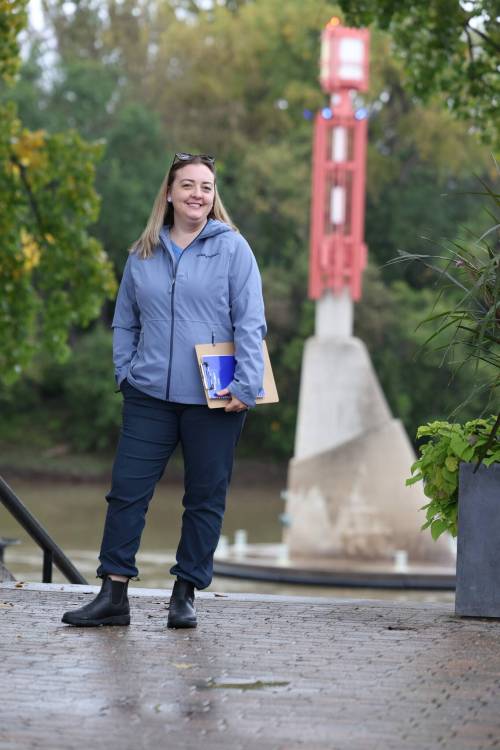
Fifty-four-year-old Muhammad Khan of Mississauga, Ont., is sharing his gratitude nearly one year after 38-year-old Kelly Bryan of Peterborough, Ont., gave him more than half of her liver.
In turn, Khan’s wife, Hina, donated more than half of her liver to another stranger.
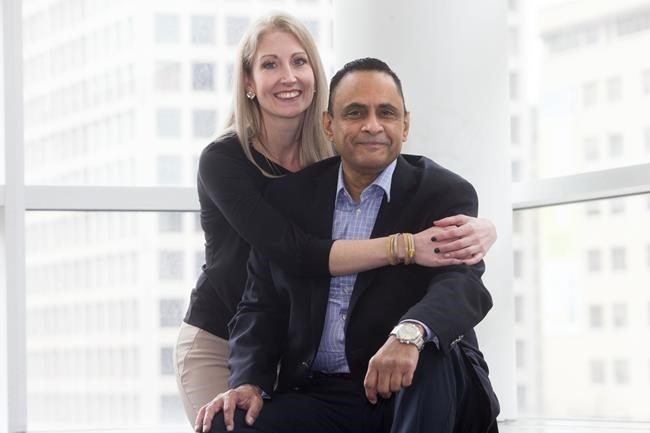
The feat was revealed at Toronto General Hospital where patients and doctors touted the potential that the carefully orchestrated “swap” has to save lives.
“Kelly was an angel to me,” Khan said Tuesday as details of the four simultaneous surgeries were made public for the first time.
“It is the biggest gift to me that I could have ever received, someone saving my life that I never knew of.”
Officials with the University Health Network Transplant Program say the multiple procedures took place July 9, 2018 and took 12 hours, four operating rooms and 28 staff and surgeons. About 100 staff and doctors looked after the pairs before, during and after the surgeries. They add that all four patients are now doing well.
Khan was diagnosed with non-alcoholic liver cirrhosis in 2017, and he suspects he would not have survived if Bryan had not come forward. Her blood type is the rare universal 0-negative, allowing her to donate blood to anyone.
Hina was not a match for her husband, so she was paired by the medical team with another, compatible recipient. That person chose to remain private.
The procedures required incredible resources, with many weeks of planning that UHN transplant surgeon Dr. David Grant likened to “training for a marathon.”
“Very few institutions have the capacity to staff four operating rooms to do a surgery like this,” notes Grant, who served as Bryan’s surgeon during the procedure. “And of course there still aren’t that many people that step forward to be an anonymous donor.”
Bryan experienced complications — transient intestinal blockage required her to stay in hospital longer than expected. But she returned to work as a paramedic three months after her operation and says she has no regrets.
The liver returns to about 75 per cent of its size within six weeks after surgery, says Grant, and continues growing slowly until it reaches its full volume in about a year.
“The risks and the recovery are hardly even a sacrifice when it comes to saving someone’s life,” says Bryan, who donated 70 per cent of her liver.
“And I think it’s important that people know that living donation is a possibility; it’s not just deceased organs that people receive and the need for it is so great.”
An anonymous living donor — someone who chooses to donate to a recipient they don’t know — can help two dying patients, by effectively creating two new compatible pairs, says Grant. It also allows those remaining on the deceased donors’ list to move up two places.
He notes that 50 to 100 people a year die while waiting for a liver transplant in Ontario. Almost 300 people are on the waiting list for a liver in the province.
But determining who should receive Bryan’s gift required serious ethical considerations.
Khan suspects he never would have received a liver if his wife had not been paired with a very ill person who also needed a transplant.
“It’s a very long list,” says Khan, a family physician who teaches medicine at the University of Toronto.
“I was sick, but not that sick at the same time. But my liver was going into a state of failure and I could notice that I was getting very weak, I was not able to eat properly.”
For Grant, the challenge was to “balance organs going to the sickest versus organs going to the greatest benefit.”
“In this case, because it meant taking two people off the deceased donor waiting list, our ethicist advised us that this was a reasonable choice,” he says, noting “Hina’s recipient was very sick.”
And although Khan received Bryan’s liver in part because of his wife’s willingness to help another person, Grant says that doesn’t mean Khan wasn’t a legitimate recipient.
“Everyone on our waiting list is at risk of death, that’s why they’re on our waiting list,” he says. “It’s just a question of how sick you are relative to the other unwell people on the waiting list.”
A huge factor in the struggle for liver donations remains the fact that there are not enough deceased donors, he adds.
“In an ideal world we wouldn’t have to operate on Kelly,” says Grant, who is eyeing Nova Scotia’s recent adoption of a law that presumes consent for organ donation.
“If we had more deceased donors then we would never operate on a healthy person and put their life at risk to help others.”
The transplant program says paired liver exchanges have been performed in South Korea and Hong Kong, but there are no published reports of them being done in Europe or North America.
Similar paired exchanges involving kidneys have been performed for 15 years, but liver exchanges are far more rare, and riskier.
“That’s why Kelly is such a hero,” says Grant.
“We all hear of things that are needed, that we need to do and often think in our minds, ‘oh yeah, I’d like to do that or help in that way.’ It really takes an extraordinary person to step forward and say, ‘I’m not just going to think about it, I’m going to act on this and do something about it.'”