WEATHER ALERT

Researchers find clues that depression may speed brain aging

Advertisement

Advertise with us

WASHINGTON - Memory and thinking skills naturally slow with age but now scientists are peeking inside living brains to tell if depression might worsen that decline — and finding some worrisome clues.

Read this article for free:

or

Already have an account? Log in here »

To continue reading, please subscribe:

Subscribe and receive a limited-edition Free Press branded hat or tote.

Digital Subscription

One year of digital access for only $205*

  • Enjoy unlimited reading on winnipegfreepress.com
  • Read the E-Edition, our digital replica newspaper
  • Access News Break, our award-winning app
  • Play interactive puzzles

*First annual payment billed as $205.00 + GST for one year. This annual subscription will automatically renew at $233.00 + GST every 52 weeks (10% off the regular annual price of $259.35). Offer available to new and qualified returning subscribers only. Cancel any time.

To continue reading, please subscribe:

Add Free Press access to your Brandon Sun subscription for only an additional

$1 for the first 4 weeks*

  • Enjoy unlimited reading on winnipegfreepress.com
  • Read the E-Edition, our digital replica newspaper
  • Access News Break, our award-winning app
  • Play interactive puzzles
Start now

*Your next Brandon Sun subscription payment will increase by $1.00 and you will be charged $17.95 plus GST for four weeks. After four weeks, your payment will increase to $24.95 plus GST every four weeks.

Hey there, time traveller!
This article was published 14/02/2019 (2720 days ago), so information in it may no longer be current.

WASHINGTON – Memory and thinking skills naturally slow with age but now scientists are peeking inside living brains to tell if depression might worsen that decline — and finding some worrisome clues.

Depression has long been linked to certain cognitive problems, and depression late in life even may be a risk factor for the development of Alzheimer’s. Yet how depression might harm cognition isn’t clear.

One possibility: Brain cells communicate by firing messages across connections called synapses. Generally, good cognition is linked to more and stronger synapses. With cognitive impairment, those junctions gradually shrink and die off. But until recently, scientists could count synapses only in brain tissue collected after death.

Yale University scientists used a new technique to scan the brains of living people — and discovered that patients with depression had a lower density of synapses than healthy people the same age.

The lower the density, the more severe the depression symptoms, particularly problems with attention and loss of interest in previously pleasurable activities, Yale neuroscientist Irina Esterlis said Thursday at a meeting of the American Association for the Advancement of Science. She wasn’t studying just seniors but a range of ages including people too young for any cognitive changes to be obvious outside of a brain scan — on the theory that early damage can build up.

“We think depression might be accelerating the normal aging,” she said.

Her studies so far are small. To prove if depression really worsens that decline would require tracking synaptic density in larger numbers of people as they get older, to see if and how it fluctuates over time in those with and without depression, cautioned Jovier Evans, a staff scientist at the National Institute on Mental Health.

Esterlis is planning a larger study to do that. It’s delicate research. Volunteers are injected with a radioactive substance that binds to a protein in the vesicles, or storage bins, used by synapses. Then during a PET scan, areas with synapses light up, allowing researchers to see how many are in different regions of the brain.

Esterlis said there are no medications that specifically target the underlying synapse damage.

But other brain experts said the preliminary findings are a reminder of how important it is to treat depression promptly, so people don’t spend years suffering.

“If your mood isn’t enough to make you go and get treated, then hopefully your cognition is,” said Dr. Mary Sano, who directs the Mount Sinai Alzheimer’s Disease Research Center in New York and wasn’t involved in the new research.

Still, she cautioned that normal cognitive aging is a complicated process that involves other health problems, such as heart disease that slows blood flow in the brain. It might be that depression, rather than worsening synaptic decline, just makes it more obvious, Sano noted.

With depression “at any age, there’s a hit on the brain. At an older age the hit may be more visible because there may already be some loss,” she explained.

Indeed, another way the brain ages: The blood-brain barrier, which normally protects against infiltration of damaging substances, gradually breaks down, Daniela Kaufer of the University of California, Berkeley, told the AAAS meeting. That triggers inflammation, setting off a cascade that can cause cognitive impairment. Her lab found a specific molecular culprit and is developing, in studies with mice, a way to block the inflammatory damage.

The University of Toronto’s Etienne Sibille is developing a compound to target yet another piece of the puzzle, brain receptors that are impaired with both aging and depression. Mouse studies showed it could reverse stress-induced memory loss, he said. Any human testing is at least several years away.

___

The Associated Press Health & Science Department receives support from the Howard Hughes Medical Institute’s Department of Science Education. The AP is solely responsible for all content.


Report Error Submit a Tip

More Stories

For unique Menno-centric take on Free Press, satirist mines her jibes between the lines

David Sanderson 8 minute read Preview

For unique Menno-centric take on Free Press, satirist mines her jibes between the lines

David Sanderson 8 minute read Yesterday at 10:40 AM CDT

Free Press readers of a certain vintage may remember when tuning into a local radio station to hear a pair of disc jockeys perusing a section of the Saturday edition was appointment listening.

On Sunday mornings from 1962 until the mid-1980s, CKRC 630 personalities Bob Washington and Tom Ashmore — better known as Wash and Ash — entertained Winnipeggers of all ages by impersonating the likes of Dennis the Menace, Beetle Bailey and Archie Andrews, as they lent their voices to that weekend’s multi-page, colour comic insert.

In a 1984 interview, Washington, who died in 2016 at the age of 82, attributed the weekly program’s longevity to audiences enjoying the antics of “two middle-aged guys in 24 dialects, giving their version of what Dagwood is saying to Blondie, or what Hägar the Horrible is bragging about.”

More than 40 years later, another Winnipegger is turning to the Free Press for her material. Only instead of reading the paper’s funnies, Lori Klassen, a mother of three and grandmother of two, is funnily reading the paper.

Read
Yesterday at 10:40 AM CDT

Selfie part of investigation into Grant Park football coach

Maggie Macintosh 4 minute read Preview

Selfie part of investigation into Grant Park football coach

Maggie Macintosh 4 minute read Friday, Jul. 24, 2026

A selfie of a high school football coach grinning beside a Free Press front-page story about the investigation into his professional conduct has become part of the case.

Doug Kovacs, a resource teacher at Grant Park High School who runs the Pirates football program, was put on leave in the spring.

The Winnipeg School Division employee is the subject of an investigation into allegations that athletes on his AAAA varsity team engaged in hazing that led to at least one player getting injured last year.

The Free Press has learned that on July 8 — the day it was revealed in print that Manitoba’s teacher commissioner had launched a third-party probe — a photo of Kovacs posing with a newspaper began circulating in the football community.

Read
Friday, Jul. 24, 2026

Researchers find clues that depression may speed brain aging

Lauran Neergaard, The Associated Press 4 minute read Thursday, Feb. 14, 2019

WASHINGTON - Memory and thinking skills naturally slow with age but now scientists are peeking inside living brains to tell if depression might worsen that decline — and finding some worrisome clues.

Depression has long been linked to certain cognitive problems, and depression late in life even may be a risk factor for the development of Alzheimer's. Yet how depression might harm cognition isn't clear.

One possibility: Brain cells communicate by firing messages across connections called synapses. Generally, good cognition is linked to more and stronger synapses. With cognitive impairment, those junctions gradually shrink and die off. But until recently, scientists could count synapses only in brain tissue collected after death.

Yale University scientists used a new technique to scan the brains of living people — and discovered that patients with depression had a lower density of synapses than healthy people the same age.

An eroding Winnipeg neighbourhood looks to new foundations

Ian Bickis, The Canadian Press 5 minute read Preview

An eroding Winnipeg neighbourhood looks to new foundations

Ian Bickis, The Canadian Press 5 minute read Updated: 1:34 PM CDT

WINNIPEG - The lot Jesse Bettcher lives on in Winnipeg's north end used to be a pile of burnt rubble. Same with the one next door. And the one across the street.

But he's now the proud owner of a two-storey house with blue-grey siding and white trim, so new the orange construction fencing is still out front.

It's a dream home for Bettcher, and the latest hope for a city seeking to knock down, clean up and revitalize neighbourhoods that have seen hundreds of homes left vacant, leading to safety hazards and worries about the future.

He bought the house as part of a pilot project aimed at creating affordable home ownership. It let him and his family move out of a rental that he said was falling apart.

Read
Updated: 1:34 PM CDT

Up to the challenge

Zoe Pierce 3 minute read Preview

Up to the challenge

Zoe Pierce 3 minute read Yesterday at 6:13 PM CDT

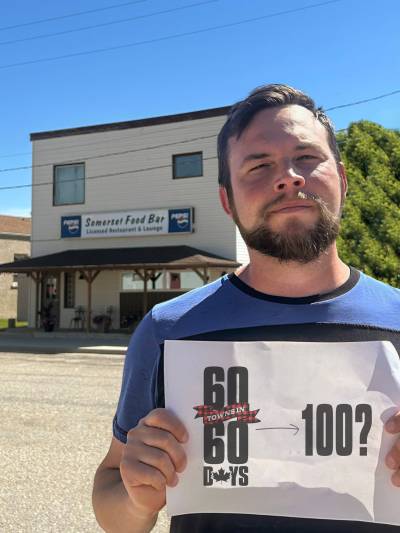
There may not be another restaurant in Manitoba that can say it has welcomed visitors from as many communities across the province and beyond as the Somerset Food Bar & Lounge has this summer.

In just over a two week span, visitors from more than 100 towns have come out to the family-owned restaurant tucked away in Somerset, a community of roughly 450 people in the Pembina Valley 130 kilometres southwest of Winnipeg.

It started as a challenge, “60 Towns in 60 Days,” where the restaurant wanted to document how many different places they could reach, as it often sees people travelling across Canada stop at the restaurant. The goal was also to encourage people to make a drive they normally wouldn’t.

“The more we started sharing, the more people really started getting behind it, and it turned into this really big thing fairly quickly,” said Jay Friesen, restaurant manager.

Read
Yesterday at 6:13 PM CDT

Trailblazer returns to share success, inspire next generation

Grace Penner 5 minute read Preview

Trailblazer returns to share success, inspire next generation

Grace Penner 5 minute read Yesterday at 5:14 PM CDT

Starstruck kids and fans zigzagged throughout the rink, anxiously waiting to get an autograph from Kati Tabin and to see their role model on the same side of the glass.

Tabin, Montreal Victoire defender and Team Canada silver medallist, on Saturday came home to the rink where it all began, the Oakbank Community Club. She brought the PWHL championship trophy, the Walter Cup, won in her third season with the club, as well as her 2026 Milan Cortina Olympic medal.

The arena was packed to the brim with fans from all over coming to see Tabin — the local player who made history in women’s hockey. Hundreds of enthusiasts of all ages lined up with their Victoire or Team Canada merchandise, some waiting over two hours to see their idol.

Eight-year-old Loxley Cierzan came with her mother, Ainsley, and other family members to meet the one and only Tabin. Cierzan has loved seeing other girls grace the ice and play the competitive sport she adores. When the PWHL takeover stopped in Winnipeg in March, she not only got to watch the game but also a practice beforehand where Tabin signed her Victoire hat.

Read
Yesterday at 5:14 PM CDT