Riding the waves to health and happiness
Learning to surf helped bring autistic son out of retreat
Advertisement
Read this article for free:
or
Already have an account? Log in here »
To continue reading, please subscribe:

Digital Subscription
One year of digital access for only $205*
- Enjoy unlimited reading on winnipegfreepress.com
- Read the E-Edition, our digital replica newspaper
- Access News Break, our award-winning app
- Play interactive puzzles
*First annual payment billed as $205.00 + GST for one year. This annual subscription will automatically renew at $233.00 + GST every 52 weeks (10% off the regular annual price of $259.35). Offer available to new and qualified returning subscribers only. Cancel any time.
To continue reading, please subscribe:
Add Free Press access to your Brandon Sun subscription for only an additional
$1 for the first 4 weeks*
- Enjoy unlimited reading on winnipegfreepress.com
- Read the E-Edition, our digital replica newspaper
- Access News Break, our award-winning app
- Play interactive puzzles
*Your next Brandon Sun subscription payment will increase by $1.00 and you will be charged $17.95 plus GST for four weeks. After four weeks, your payment will increase to $24.95 plus GST every four weeks.
Read unlimited articles for free today:
or
Already have an account? Log in here »
Hey there, time traveller!
This article was published 17/09/2017 (3239 days ago), so information in it may no longer be current.
Our son, Dan, hit all of his early life milestones on time — walking, talking, playing and interacting — until he was three, when worrying changes began to emerge. He started chewing the collars off his shirts, ripping them to shreds. Nothing would stop him, nothing we said or did, not even soaking his clothes in super-hot Thai chili sauce.
More troubling, he became increasingly withdrawn. Our once highly gregarious blond son retreated to the corner in the Montessori classroom and to the far end of the crowded kiddie pool in our apartment complex. The pediatrician told us not to worry and wrote it off as “a phase.”
In the months that followed, we realized it wasn’t just a phase. It was a disaster.
Dan spoke less and less and finally, one day, he stopped talking completely. A long journey took us to Yale University where our son was diagnosed with a rare form of autism, alternately called childhood disintegrative disorder or Heller’s Syndrome, whose hallmark is the kind of extreme developmental reversal we had been witnessing.
We were warned that the condition would likely get worse and that we might have to institutionalize Dan before he reached middle school. Another, smarter doctor at Albert Einstein University confirmed the diagnosis but proposed we try something to stave off the worst.
“Teach him to ice skate,” she said. “Activity is good.”
So, Dan learned to ice skate. Then he learned to play hockey, to jump on a trampoline, to hit a softball and to swim. Exercise, particularly in the water, can soothe the jangly nervous systems of people with autism, decreasing anxiety, and help improve brain function.
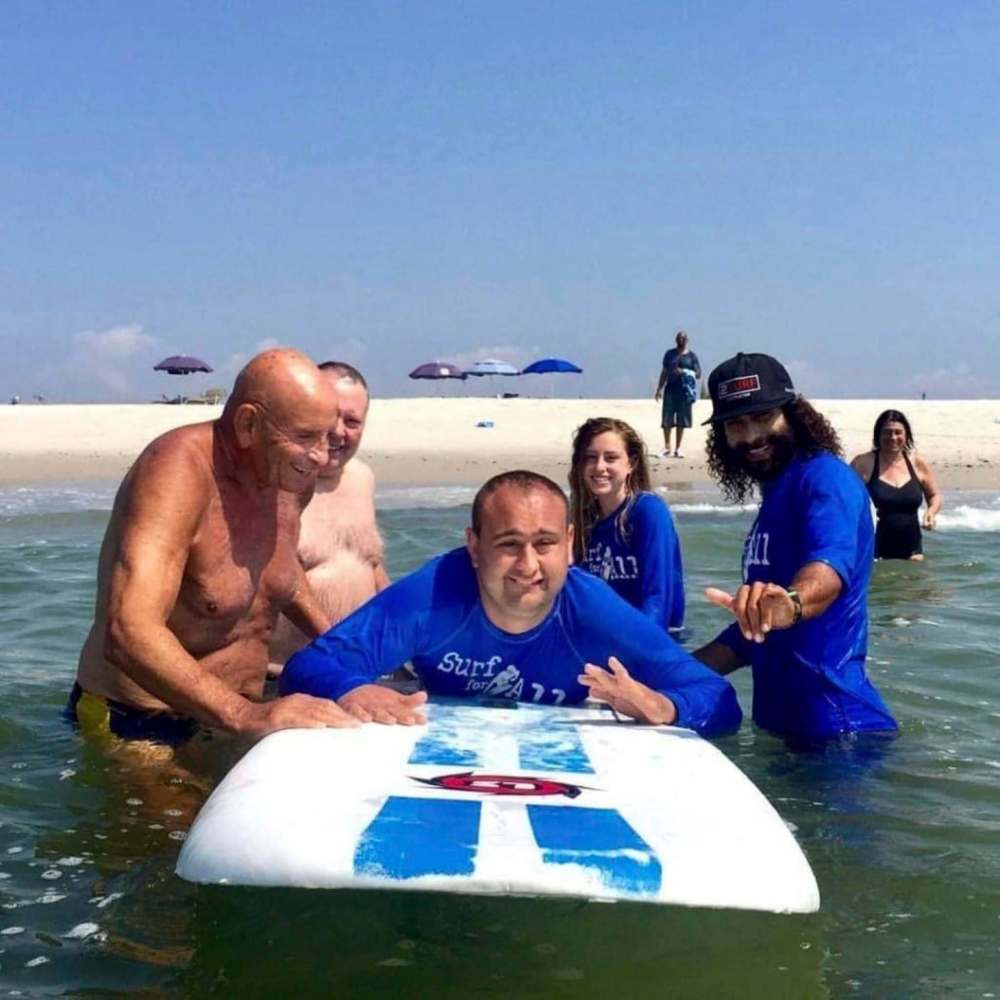
In 2002, friends gave Dan, then 15, his first surf lesson. He loved it. The ocean became a rare joyful place for him. He even sparked a local movement: Surf For All. We joined with New York State assemblyman and fierce advocate for the disabled Harvey Weisenberg, and a pair of third-generation Long Beach surf instructors, to create a program to get people with disabilities into the waves and onto surfboards in order to experience the healing power of the ocean. I’m not calling it a form of Lourdes water, but it was as close to a miracle as I’ve seen. Kids with autism said their first words; blind surfers wowed the world popping up on boards and riding standing to the shore, fists pumping to the sky. Surf For All expanded to include cancer survivors, paraplegics, quadriplegics, amputees and platoons of Wounded Warriors on temporary furlough from Walter Reed Hospital.
Then five years ago, Dan reversed course. He suddenly abandoned his surfboard, rejected the ocean and even refused to enter a swimming pool. We tried to get him in the water. In my frustration, I was less than the perfect parent. I yelled, shoved, dragged and finally I surrendered. He’s a big guy, 6-3, 225 plus pounds. He had no trouble pushing me away.
We tried to solve the mystery. Perhaps, we wondered, it had to do with Dan’s recent move to a group home, an otherwise idyllic place. His three housemates, young men with similar conditions, were not swimmers and feared the water. Maybe he was just trying to fit in.
Last summer, we managed to lure Dan back to the neighbourhood pool where he had spent thousands of happy hours as a teenager. It was slow going, but by closing time last fall, Dan was enthusiastic again about the water.
“What do you say, Dan, maybe we’ll get back into the ocean, back on a surfboard next summer?” I said. I got a tentative grin in reply.
We concocted a strategy. On a crystal clear July day, we went to the beach, coaxed him into a surfer’s rash guard and gave him a pep talk. I took one arm and the other was taken by Dan’s old friend Weisenberg, a rare adult who always treated him with respect.
The ocean was 22 C, but felt a bit chilly on a 27-degree day. Dan waded in up to his ankles and stopped. We coaxed him further. He stopped again knee deep, then again waist deep. Weisenberg let go of Dan’s arm, dove in the water and began to swim. A wave came and slapped Dan in the chest. He watched Weisenberg swim. Another wave came and Dan shouted with triumphant joy. He jumped waves, timing his leaps with his old precision. He swam some strokes with Weisenberg, jumped some more waves and belted out infectious laughter.
Harvey nodded, it was time for the next step. “Ready to surf?” I asked. Dan hesitated, then a determined smirk crept across his face.
I told his surf instructor that Dan had “quit” surfing.
“Wrong, dude,” he said. “Dan just became disinterested. He’s interested again. Let’s go.” They’d never met before, but the two young men had developed a non-verbal understanding.

Weisenberg, the instructor, the surf camp counsellor and I waded into the water with Dan. It wasn’t graceful but Dan hoisted himself onto the wave jet board fitted with a special mechanism to help disabled athletes catch a wave. Minutes later, he caught his first wave, zooming past his elated mother and washing up on the sand. He bent to remove the leash that tethered his ankle to the board.
“Don’t tell me that’s it,” his mother scolded.
He sheepishly reattached the leash and used it to drag the board back into the ocean. He caught half a dozen more waves that day, riding prone and relearning proper positioning. Over the next weeks he returned, getting better each time. Next year, the goal is to surf while standing.
We did not solve the mystery of why our son rejected the ocean, but I suppose any of us can grow “disinterested” in things we loved not long before. We’re all — parents, friends, the whole crew at Surf For All and, most important, Dan himself — just delighted now that Dan’s passion for surfing has been rekindled. His return to the ocean strengthens our faith that we are right to concentrate on what Dan can do, rather than what he can’t. Each step forward helps Dan live a better life, and makes one Dad indescribably proud.
— Washington Post