Save the bees (and time and money) by creating a bee lawn

Advertisement

Advertise with us

Flowering "bee lawns" that attract pollinators are a compromise between fastidious turf management and the more casual yard approach. They add biodiversity to the landscape and need less maintenance. That makes them cost-effective, too.

Read this article for free:

or

Already have an account? Log in here »

To continue reading, please subscribe:

Subscribe and receive a limited-edition Free Press branded hat or tote.

Digital Subscription

One year of digital access for only $205*

  • Enjoy unlimited reading on winnipegfreepress.com
  • Read the E-Edition, our digital replica newspaper
  • Access News Break, our award-winning app
  • Play interactive puzzles

*First annual payment billed as $205.00 + GST for one year. This annual subscription will automatically renew at $233.00 + GST every 52 weeks (10% off the regular annual price of $259.35). Offer available to new and qualified returning subscribers only. Cancel any time.

To continue reading, please subscribe:

Add Free Press access to your Brandon Sun subscription for only an additional

$1 for the first 4 weeks*

  • Enjoy unlimited reading on winnipegfreepress.com
  • Read the E-Edition, our digital replica newspaper
  • Access News Break, our award-winning app
  • Play interactive puzzles
Start now

*Your next Brandon Sun subscription payment will increase by $1.00 and you will be charged $17.95 plus GST for four weeks. After four weeks, your payment will increase to $24.95 plus GST every four weeks.

Hey there, time traveller!
This article was published 28/05/2019 (2621 days ago), so information in it may no longer be current.

Flowering “bee lawns” that attract pollinators are a compromise between fastidious turf management and the more casual yard approach. They add biodiversity to the landscape and need less maintenance. That makes them cost-effective, too.

Bee lawns are turf grasses blended with low-growing perennials that bloom again after mowing. They’re cared for like typical lawns, making them comfortable for playing and lounging. But they also contain protein-rich ingredients providing vital nutrients for foraging pollinators.

Their natural diversity — they might contain fine fescues mixed with such spontaneous plants as white clover, dandelions (that bloom early when little else is flowering), creeping thyme, daisies and shade-tolerant lamium — make them less demanding and more resilient than Kentucky bluegrass. Bee lawns require minimal watering and little fertilizing, encourage deeper roots and build healthier soil — especially when their clippings are returned to the turf.
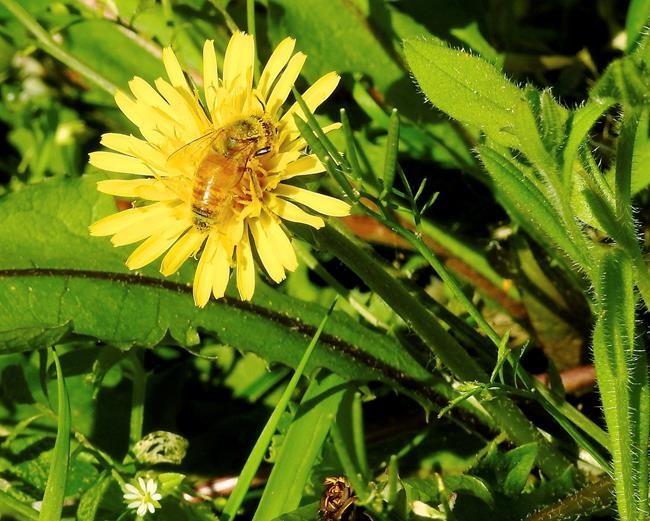
This May 2, 2019 photo shows a pollen-laden Italian honeybee in a bee lawn near Langley, Wash. Bee lawns are turf grasses blended with low-growing perennials that bloom again after mowing. This is a spontaneous ground cover that is a great pollen source for beneficial insects. Dandelions may be considered weeds by fastidious lawn managers but they bloom early in spring when little else is flowering and are favored by foraging pollinators. (Dean Fosdick via AP)

James Wolfin, a graduate research assistant working on the University of Minnesota’s bee lawn project, suggests using the fescue Festuca brevipila.

“This grass has a thin leaf blade and a slow rate of growth,” Wolfin said. “The slow rate of growth is essential in making sure the grass blades do not create a canopy over the flowers.”

Hand weeding is recommended.

For people who feel they don’t have the time, money or talent for gardening, bee lawns mean “we can mow our lawns less frequently, let the lawn flowers grow and provide habitat for bees,” said Susannah Lerman, a research ecologist with the U.S. Forest Service Northern Research Station in Amherst, Massachusetts. “Everyone can contribute to this simple solution for advancing bee conservation.”

Bee populations have been crashing for the past couple of decades because of habitat loss, chemical use and parasitic mites. These collapses are particularly worrisome since pollinators are instrumental in the growth of more than a third of the food making it to our tables.

Every pollinator plant helps rebuild those insect stocks, even if it’s just part of a colorful arrangement on a corner of the property.

Sunny slopes, rocky ground, boulevards, athletic fields and golf courses are optimal locations. “Also, office parks could benefit from bee lawns, particularly since they have very low human traffic,” Lerman said.

Check, though, with your neighbours and city hall before doing any lawn-alternative landscaping.

“It shouldn’t be too much of a hassle to get your community on board with bee lawns,” Wolfin said. “In terms of dealing with neighbours, sometimes it can be useful to install a row or strip of rocks or wood chips along your fence line to hinder the ability of flowers to spread to your neighbour’s lawn.”

Signage also helps, he said.

Monitor growth regularly to ensure you’re not introducing invasive weeds or creating a tall, unsightly yard. Mowing to about 3 inches is a good rule to follow.
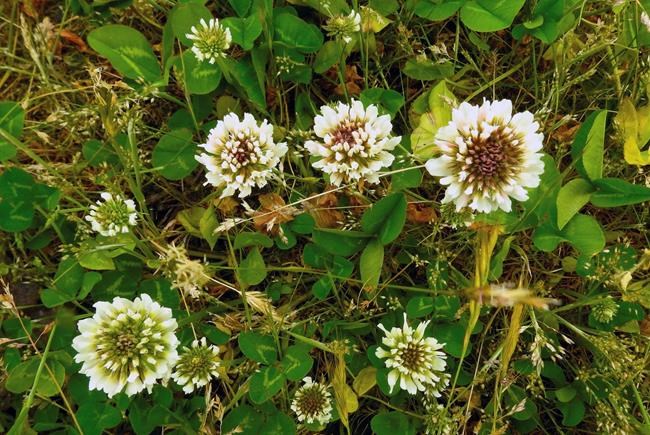
This May 12, 2019 photo shows a white clover in a bee lawn near Langley, Wash. Bee lawns are turf grasses blended with low-growing perennials that bloom again after mowing. This is a spontaneous ground cover that is a great pollen source for beneficial insects. (Dean Fosdick via AP)

“The two-week mowing regime supported the highest abundance of bees,” Lerman said, citing data from a recent turf study in Springfield, Massachusetts.

“We documented 111 species of bee (mostly native species and the majority wild bees) using the lawn flowers in western Massachusetts suburban yards,” she said.

Bee lawns are compatible with family activities unless you run into aggressive colonies of ground-dwelling yellow jackets. Honeybees, wild bees and bumblebees usually are docile unless provoked.

___

Online:

For more about managing lawns for pollinators, see this fact sheet from the University of Minnesota Extension’s Bee Lab:

http://www.beelab.umn.edu/sites/beelab.umn.edu/files/bee-lawns-2018-mg.pdf

You can contact Dean Fosdick at deanfosdick@netscape.net

Report Error Submit a Tip

More Stories

Brown goes down, so do Blue

Taylor Allen 6 minute read Preview

Brown goes down, so do Blue

Taylor Allen 6 minute read Updated: 10:15 AM CDT

The Winnipeg Blue Bombers suffered one of their most embarrassing and inexcusable losses in recent memory on Thursday night.

A one-win B.C. Lions team — featuring a rookie quarterback making his first career start, a rookie running back making his first career start and two backup offensive lineman in action — somehow, someway dealt the Blue and Gold a 35-19 defeat in front of 31,509 disgruntled fans at Princess Auto Stadium.

The Bombers, now 1-4 on home turf this season, have dropped back-to-back games to fall to 4-4. The Lions improved to 2-5.

“Shit wasn’t good enough. Offence, defence, special teams. Wasn’t good enough,” said defensive end Willie Jefferson.

Read
Updated: 10:15 AM CDT

Use it twice: a data centre we could support

Hersh Seth 5 minute read Preview

Use it twice: a data centre we could support

Hersh Seth 5 minute read Yesterday at 2:00 AM CDT

In June, Premier Wab Kinew rejected a massive AI data centre planned near Île-des-Chênes. The project would have used 500 megawatts of power, which is about the same as the Grand Rapids generating station, and would have run on six natural gas turbines. Kinew said the environmental cost was too high and the long-term benefit for Manitobans was too low.

Read
Yesterday at 2:00 AM CDT

Chinese newcomers protest over delays in security screening clearance

Tyler Searle 4 minute read Preview

Chinese newcomers protest over delays in security screening clearance

Tyler Searle 4 minute read 4:00 PM CDT

Dozens of Chinese newcomers rallied outside Winnipeg’s federal immigration office Friday to protest what they describe as untenable delays to Canada’s security screening process.

The rally against Immigration, Refugees and Citizenship Canada comes after a surge in immigration security screening requests created backlogs for the Canadian Security Intelligence Service.

Protesters said the resulting delays have left them in limbo as they try to obtain permanent residency.

“We just want transparency,” said Pakying Chau, 26, who travelled from Hong Kong to Winnipeg in 2018 to study agribusiness.

Read
4:00 PM CDT

Smoke taint new reality in wine as world burns

Ben Sigurdson 6 minute read Preview

Smoke taint new reality in wine as world burns

Ben Sigurdson 6 minute read 6:01 PM CDT

Summer seems to come with a familiar smell these days: the pungent aroma of smoke.

The haze of smoke from wildfires in warmer months is now the norm rather than the exception. Breathing gets tougher, particularly for those whose health is compromised, and clothes pick up that unpleasant smoky smell.

But your shirt or sweater isn’t the only thing that absorbs the scent — in wildfire-affected grape-growing regions, winemakers also have to contend with the potential for their wines to develop what is called smoke taint.

Early in the growing season grapes, like most fruit, are small and green with thick skins. The berries get larger until around late July-ish (in the northern hemisphere) the bunches stop growing, the skins get thinner and the fruit begins changing colour in a process called veraison.

Read
6:01 PM CDT

Woman, 23, charged with fatal stabbing outside Portage Place

Tyler Searle and Erik Pindera 4 minute read Preview

Woman, 23, charged with fatal stabbing outside Portage Place

Tyler Searle and Erik Pindera 4 minute read Updated: Yesterday at 4:42 PM CDT

A 23-year-old woman has been charged with fatally stabbing a woman after they argued outside the entrance of Portage Place mall in the middle of the afternoon Tuesday.

Read
Updated: Yesterday at 4:42 PM CDT

Wild weather uproots trees across city, leaves thousands in Manitoba without power

Chris Kitching 7 minute read Preview

Wild weather uproots trees across city, leaves thousands in Manitoba without power

Chris Kitching 7 minute read Updated: Yesterday at 5:06 PM CDT

This summer’s latest barrage of severe thunderstorms caused widespread property damage and power outages for more than 30,000 Manitoba Hydro customers, mostly in Winnipeg, as winds of up to 133 km/h wreaked havoc.

Charleswood resident Ian Glover’s house had minor damage compared with a neighbour’s home, where a large, uprooted poplar tree crashed through the roof while the storm pummelled Winnipeg late Wednesday night and early Thursday.

“I opened the window after I woke up (around 6 a.m.) and the tree — oh my God,” Glover said. “I got my wife up and she couldn’t believe it. I was totally blown away. (Our neighbour) said the branch went right through the house into their living room.”

Glover was thankful his neighbours were not injured. Some of the tree’s outer branches clipped the corner of his home.

Read
Updated: Yesterday at 5:06 PM CDT