Saving seats for friends a busy bar faux pas
Hogging stools a pet peeve of bartenders
Advertisement
Read this article for free:
or
Already have an account? Log in here »
To continue reading, please subscribe:

Digital Subscription
One year of digital access for only $205*
- Enjoy unlimited reading on winnipegfreepress.com
- Read the E-Edition, our digital replica newspaper
- Access News Break, our award-winning app
- Play interactive puzzles
*First annual payment billed as $205.00 + GST for one year. This annual subscription will automatically renew at $233.00 + GST every 52 weeks (10% off the regular annual price of $259.35). Offer available to new and qualified returning subscribers only. Cancel any time.
To continue reading, please subscribe:
Add Free Press access to your Brandon Sun subscription for only an additional
$1 for the first 4 weeks*
- Enjoy unlimited reading on winnipegfreepress.com
- Read the E-Edition, our digital replica newspaper
- Access News Break, our award-winning app
- Play interactive puzzles
*Your next Brandon Sun subscription payment will increase by $1.00 and you will be charged $17.95 plus GST for four weeks. After four weeks, your payment will increase to $24.95 plus GST every four weeks.
Read unlimited articles for free today:
or
Already have an account? Log in here »
Hey there, time traveller!
This article was published 09/08/2018 (2912 days ago), so information in it may no longer be current.
Ask a bartender about their least-favourite customer behaviours, and you’ll get a variety of answers: boors who snap their fingers to get attention, “gerbils” who nervously shred napkins and beer labels and leave trash on the bar, groups who don’t know what everyone wants when it’s their turn to order.
But if you ask me what behaviour I’d like to abolish, it’s easy: people who save bar stools for their absent friends when the room is full of customers looking for a seat.
In my decade-plus reporting on bars, I’ve heard all the excuses from stool-guardians: “My friend is in the bathroom.” “She is outside having a cigarette.” “My husband is parking the car.” Then, 20 minutes later, the friend “in the bathroom” inevitably rushes in and sits, wearing a winter coat and apologizing for being late.
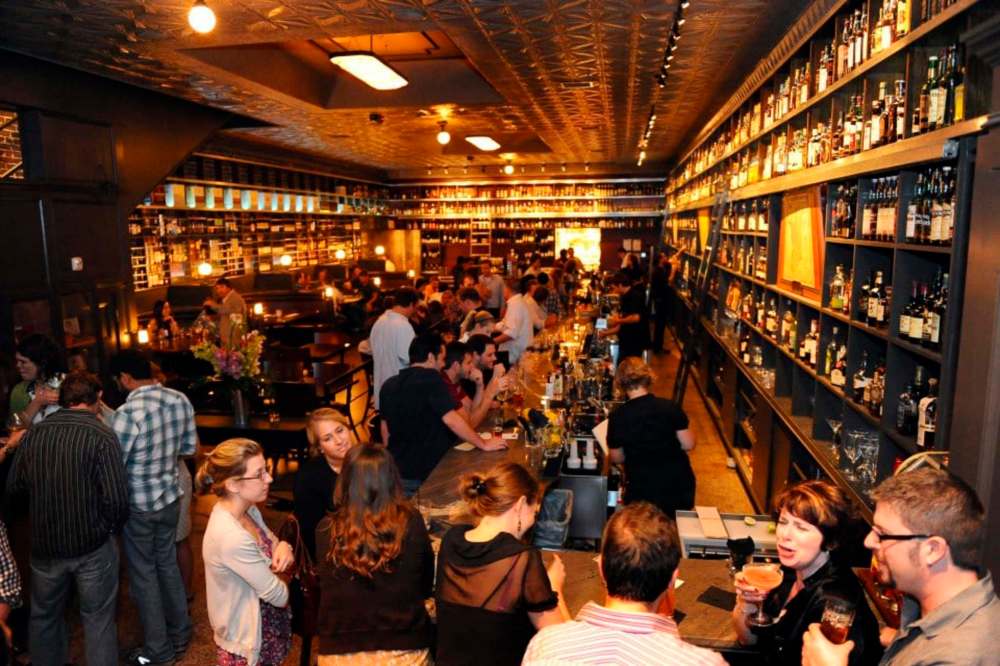
The seat-saver knows their behaviour is wrong — why else would they feel compelled to lie about their companion’s whereabouts? — and they do it anyway.
A bar is full of unspoken rules, most of which are basic behaviours you should have picked up in elementary school: be polite. Wait your turn. Don’t act obnoxiously. Always tip your bartender. (OK, I said most.) But watch enough people hogging chairs at crowded bars and you realize there is no good rule about when you should and shouldn’t try to save a stool.
David Wondrich, the cocktail historian and author who once picked the best bars in America for Esquire, thinks there’s a sliding scale: “a few minutes while your friend is parking or making it over from the subway is fine,” he says.
“Half an hour is not fine at all. After 10 minutes it starts to be annoying, and after 15, it’s very dodgy unless there are extreme extenuating circumstances. I would give up the seat or at least start buying rounds at that point.”
It’s not hard to find defenders of the practice: they say that it’s impractical to assume that a group will arrive at a bar at the same time or that early birds should reap the benefits of arriving first. To which I reply: fine.
If your group is turning up over the course of 30 minutes and you want to make sure everyone gets a seat, reserve a table. Can’t do that? Then maybe your friend who’s always running just a little behind will eventually get the message.
Beyond the general rudeness to other patrons, leaving a stool empty costs the bar (and the bartender): There are a finite number of seats, and an empty one is not buying cocktails or tipping on them.
If two customers walk into a bar and decide to leave because two otherwise empty seats are being held for friends who are “on the way,” that money isn’t going into the bartender’s pocket at the end of the night.
But the main reason that extended seat-saving rubs me the wrong way is that it goes against the traditional openness of bars. You don’t need to make reservations to enjoy a great bar, as you must for a hot restaurant. Sure, you might have to stand for a while, or stalk fellow customers to see who’s getting the check or where seats are opening up, but at least there’s a level playing field.
Obviously, if I show up at a bar on a Tuesday and half the stools are empty, I have no problem saving the one next to me for a friend who swears they’re on the way. But if the bar is busier, it becomes a judgment call: what if only three of the dozen-or-so stools are empty? Or two?
“Context matters,” says Andrea Tateosian, the president of the D.C. Craft Bartenders Guild and a bartender at the Passenger in Washington.
“If you’re saving seats on a Friday night at 10:30, that’s no good. But if the bar just opened, there are two people there and you’re saving seats in the corner, that’s fine.”

But, she says, “There’s always those people who feel entitled to the space or don’t think about others. Holding a seat at the bar for 20 or 25 minutes isn’t cool.”
So if a bartender notices someone “waiting for a friend” for a long time at peak hours, do they have an obligation to step in and ask the seat-saver to let someone else sit down? Negative, Tateosian says: “as a bartender, you don’t want to police it. You’re a facilitator of fun.”
My wife and I try to practise what we preach: when one of us arrives before the other and finds two seats together, we hold the spare for only 10 minutes (possibly less if the bar is really crowded). After that, if someone asks for the seat, they can have it. If that means the one taking their sweet time has to stand — and, to be fair, it’s often me — so be it.
Treat people the way you’d want to be treated — that sounds like something I learned in kindergarten.
— Washington Post