Titanic tragedy led to scientific understanding of deep ocean mysteries
Advertisement
Read this article for free:
or
Already have an account? Log in here »
To continue reading, please subscribe:

Digital Subscription
One year of digital access for only $205*
- Enjoy unlimited reading on winnipegfreepress.com
- Read the E-Edition, our digital replica newspaper
- Access News Break, our award-winning app
- Play interactive puzzles
*First annual payment billed as $205.00 + GST for one year. This annual subscription will automatically renew at $233.00 + GST every 52 weeks (10% off the regular annual price of $259.35). Offer available to new and qualified returning subscribers only. Cancel any time.
To continue reading, please subscribe:
Add Free Press access to your Brandon Sun subscription for only an additional
$1 for the first 4 weeks*
- Enjoy unlimited reading on winnipegfreepress.com
- Read the E-Edition, our digital replica newspaper
- Access News Break, our award-winning app
- Play interactive puzzles
*Your next Brandon Sun subscription payment will increase by $1.00 and you will be charged $17.95 plus GST for four weeks. After four weeks, your payment will increase to $24.95 plus GST every four weeks.
Read unlimited articles for free today:
or
Already have an account? Log in here »
Hey there, time traveller!
This article was published 11/04/2012 (5287 days ago), so information in it may no longer be current.
HALIFAX – When Steve Blasco peered through the gloom and gazed upon the Titanic a dozen years ago, he saw the fabled ship as both a burial ground and a wonder of science.
The marine geologist, who travelled to the site with other scientists, says the ghostly wreck sat like a tomb in the pitch-dark as shadows darted by four kilometres below the ocean’s surface.
But as his submersible settled on the fore deck, he viewed the ship as a scientific treasure trove that could help explain mysteries of a part of the ocean so far down it had rarely been studied.
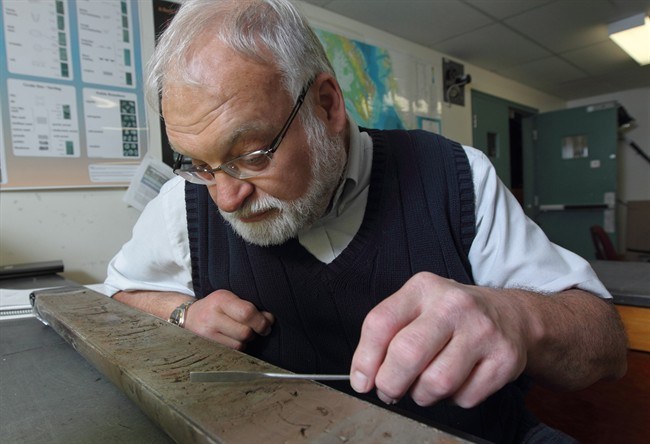
“Titanic is a perfect time marker. It had been in the bottom for several decades and was only four days old when it sank, so I could look at what happened between the wreck and the bottom,” he said from his office at the Bedford Institute of Oceanography in Halifax.
“We have very little knowledge of what happens over time on the sea floor and … we’ve learned a lot about the process of what’s going on in the deep sea.”
One of the key discoveries, made when Titanic was found in 1985 by Robert Ballard, was the orange icicle-like growths that began draping the bulk of the once-majestic ship sometime after it went down on April 15, 1912.
Both the bow and stern were covered in so-called rusticles, which had not been seen before. Blasco and the others determined a corrosive bacteria were metabolizing — or eating away at — the ship and producing the rusty growths.
The discovery generated vigorous discussion in the science world that continues today, with researchers debating the rate at which the rusticles will gobble up the ship entirely.
“It possibly could decompose completely within the next couple of hundred of years or the next few decades,” said Blasco, whose work during the 1991 dive was featured in the documentary “Titanica.”
“It’s a scientific question and a controversial one.”
Researchers have documented more than two dozen types of microbial bacteria, including one named Halomonas titanicae by scientists at Dalhousie University in Halifax.
Roy Cullimore, a microbiologist in Regina, has been to the Titanic three times and left experiments on site to explore the ecosystem’s effect on steel. He said the bacteria are producing organic acids and hydrogen sulphide, which is also corroding the steel.
“The Titanic has brought science into that deep ocean environment and what we’re looking at is nature’s natural pattern of recycling everything,” he said, adding that the trips revealed a layer of life forms that he equated to an oceanic landfill.
“It’s a huge unstudied mass of life which makes a rainforest look small.”
Blasco’s group documented at least 24 species in the oxygen-depleted depths, doing away with assumptions that the site would be a lifeless void.
Blasco’s groundbreaking research also led to a key discovery about Titanic’s sad fate.
He recovered a piece of the ship’s steel to measure corrosion and other effects of the deep sea on the material.
Blasco says the fatigue tester was stunned when he learned the sample was from the Titanic since it showed little sign of corrosion, but shattered when tested.
“He said, ‘My God, you gotta be kidding. It’s got brittle fracture,’ ” he said.
“He found the steel was very brittle and he said, ‘I bet that’s why the iceberg could do so much damage.’ “
It was later determined that Titanic’s steel was high in sulphur and the rivets were high in slag, making them brittle.
“That was quite a major advance and it’s a Canadian discovery, ” Blasco said, standing beneath a photo of the steel plate at the institute’s Titanic exhibit.
“That was quite a surprise — that the ice actually cracked the plates.”
Blasco’s team also solved a lingering question about why the 46,000-tonne ship didn’t sink into the sea floor. Using core soil samples he took from the ocean bottom, scientists realized that the wreck was sitting in the firm floor of a million-year-old landslide.
The discovery launched more research into marine landslides, an issue of vital importance and interest to pipeline and telecommunications cable companies.
The sinking also led to improvements in maritime safety with the creation of the International Ice Patrol, which monitors icebergs near the Grand Banks and passes the information onto mariners.
“The Titanic disaster brought the danger into sharp focus and the international community created a system that improved safety in the North Atlantic,” said Donald Murphy, an oceanographer with the ice patrol in New London, Conn.
“It also had everybody agree on the use of the SOS message and had everybody required to have enough lifeboats for everyone.”
Blasco says the Titanic has greatly added to science’s understanding of one of the ocean’s least-known areas, but that research should continue.
“We’re still learning,” he says. “I’d love to go back to the site and look at it again because in the next decade or two there will be changes again and can we find out more about what’s going on in the deep ocean.”
Related Articles
Cable ships accepted grim task of recovering victims from Titanic
Advertisement Advertise With Us
Advertisement Advertise With Us