

Long in the tooth
Centuries-old sharks patrol Arctic depths
Advertisement
Read this article for free:
or
Already have an account? Log in here »
To continue reading, please subscribe:
Monthly Digital Subscription
$1 per week for 24 weeks*
- Enjoy unlimited reading on winnipegfreepress.com
- Read the E-Edition, our digital replica newspaper
- Access News Break, our award-winning app
- Play interactive puzzles
*Billed as $4.00 plus GST every four weeks. After 24 weeks, price increases to the regular rate of $19.95 plus GST every four weeks. Offer available to new and qualified returning subscribers only. Cancel any time.
Monthly Digital Subscription
$4.99/week*
- Enjoy unlimited reading on winnipegfreepress.com
- Read the E-Edition, our digital replica newspaper
- Access News Break, our award-winning app
- Play interactive puzzles
*Billed as $19.95 plus GST every four weeks. Cancel any time.
To continue reading, please subscribe:
Add Free Press access to your Brandon Sun subscription for only an additional
$1 for the first 4 weeks*
*Your next subscription payment will increase by $1.00 and you will be charged $16.99 plus GST for four weeks. After four weeks, your payment will increase to $23.99 plus GST every four weeks.
Read unlimited articles for free today:
or
Already have an account? Log in here »
Hey there, time traveller!
This article was published 20/08/2016 (3535 days ago), so information in it may no longer be current.
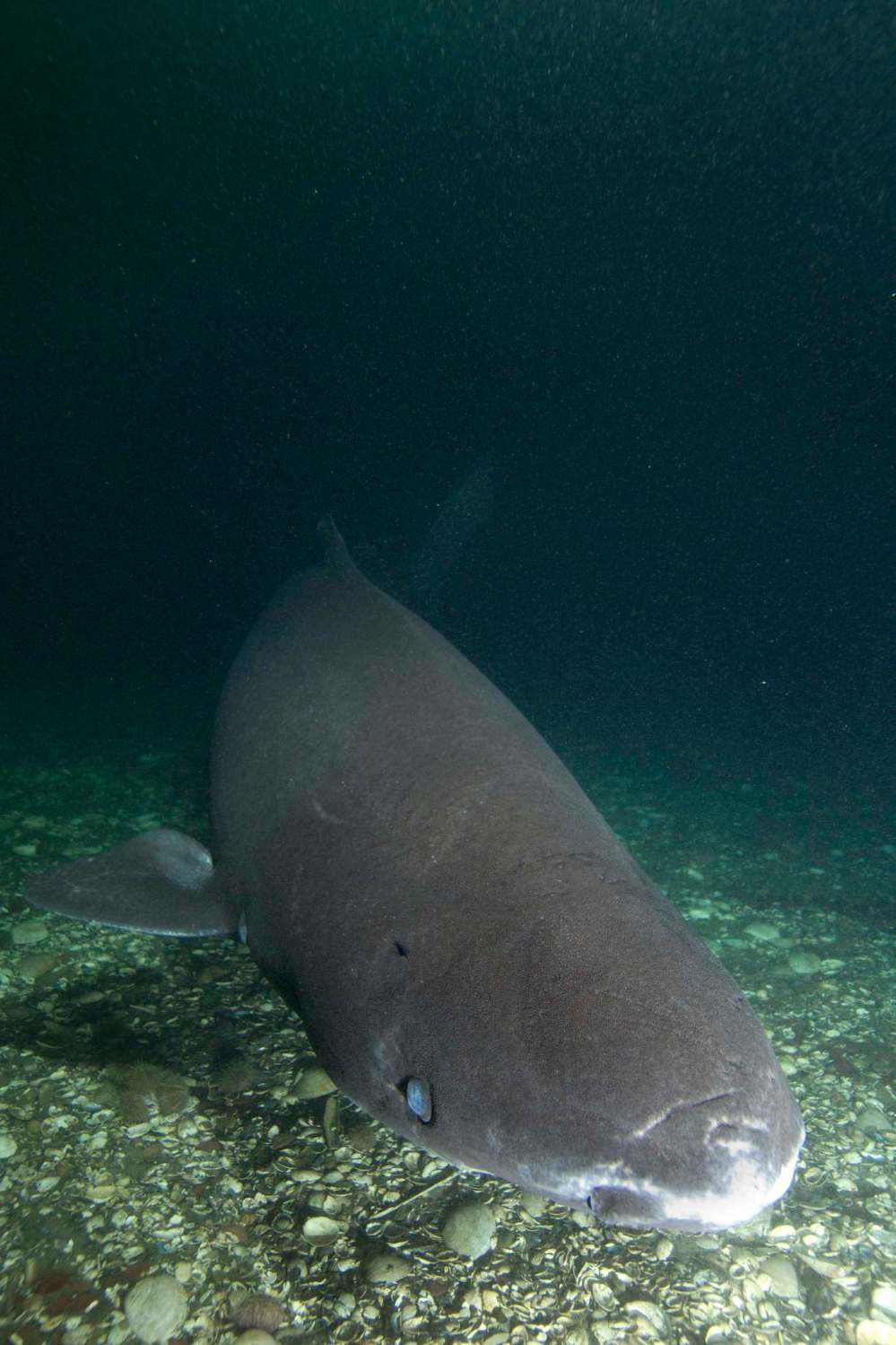
In the frigid waters of the sub-Arctic ocean lurks a mysterious and slow-moving beast known as the Greenland shark. It’s a massive animal that can grow up to six metres in length. Now, new research suggests it may have a massive lifespan as well.
According to a paper published recently in Science, the Greenland shark could live for well over 250 years, making it the longest-living known vertebrate on Earth.
“I am 95 per cent certain that the oldest of these sharks is between 272 and 512 years old,” said lead author Julius Nielsen, a marine biologist at the University of Copenhagen. “That’s a big range, but even the age estimate of at least 272 years makes it the oldest vertebrate animal in the world.”
The oldest-animal record holder is a clam called Ming that was dredged up from the ocean floor off the coast of Iceland. It was said to be 507 years old when it died in 2006.
Shortraker rockfish off the Alaskan coast and orange roughy off Namibia are both estimated to live up to 200 years or longer.
Still, if Nielsen’s estimates are correct, the Greenland shark would be a record breaker.
Greenland sharks are among the largest sharks on the planet. They are dark brown or purple with small, beady eyes. They inhabit the Arctic and sub-Arctic waters, as well as cold, deep water in other oceans throughout the world.
Because they spend most of their time in the darkness their eyesight is thought to be very poor, but a vast network of neurons in their snouts suggests they hunt and scavenge using their powerful sense of smell.
“They are basically a giant swimming nose,” said Aaron Fisk, a professor at the University of Windsor who has studied the Greenland shark for two decades.
Scientists have long suspected these lethargic giants have extremely long lifespans in part because previous research shows they grow very slowly —possibly as little as a centimetre per year.
Determining the exact age of the Greenland shark is a tricky business. When scientists determine the age of fish such as cod, rockfish and salmon, they usually look at the otolith —a bony structure that grows in the ear of a fish.
Otoliths have seasonal growth rings, kind of like the rings in tree trunks. If researchers can figure out how long it took the animal to lay down one ring, they can easily determine the age of the fish.
Sharks and rays don’t have otoliths, so scientists have found other ways to determine their ages. For some species of sharks, it’s possible to tell how old they are by looking at growth layers deposited in calcified parts of their vertebra or fin spines. The Greenland shark doesn’t have fin spines, and its cartilage skeleton is extremely soft with almost no calcified material, so there are no layers to count.
To overcome this hurdle, Nielsen and his collaborators turned to a more complicated technique called eye lens radiocarbon dating, which has been used to determine the age of other animals.
The eye lenses of all vertebrates continue to grow with the animal through its life, adding layers like an onion. However, the core of the eye lens is formed before the animal is born and remains metabolically stable throughout its life, Nielsen explained. That means embedded in this small piece of tissue in the center of a shark’s eye is a chemical signature from the environment just before it was born.
In the late 1950s, atmospheric tests of thermonuclear weapons caused a big and easily detectable spike in the amount of radiocarbon that eventually made its way into the sea. Scientists call this bump “the bomb pulse,” and it has become a handy way to verify the age of marine organisms.
If the amount of radiocarbon in a shark’s lens represents post bomb-pulse levels, that’s a pretty clear indicator that the animal was born after 1960.
For this study, Nielsen examined the eye lenses of 28 female specimens that were caught off the coast of Greenland between 2010 and 2013.
The centre of the eye lenses of the 25 larger sharks all had pre-bomb-pulse radiocarbon levels, leading the authors to conclude they were more than 60 years old.
The group’s next step was to determine how long before 1960 they were born, and here’s where they had to get creative. They then measured the radiocarbon levels in each of those eye lens samples and then compared them to a published reference of how radiocarbon levels in the ocean have changed over time.
This chronology of much more subtle radiocarbon fluctuations goes back 50,000 years and is usually used to date corals and other organisms that are thousands of years old. When it is used to date more recent organisms, it shows a wide range of error.
To further constrain their results, the authors made the assumption the longer a shark is, the older it is.
When they added the lengths of the specimens to their model, they found the biggest shark in the data set —at five metres —would have been 392 years old, give or take 120 years.
The authors concede the margin of error is still very large, but they say their findings demonstrate the Greenland shark is extremely long-lived and its population would take a long time to bounce back to normal if the animals were exploited by humans.
— Los Angeles Times