

Upper-limb amputee builds computer controller for feet
Advertisement
Read this article for free:
or
Already have an account? Log in here »
To continue reading, please subscribe:
Monthly Digital Subscription
$1 per week for 24 weeks*
- Enjoy unlimited reading on winnipegfreepress.com
- Read the E-Edition, our digital replica newspaper
- Access News Break, our award-winning app
- Play interactive puzzles
*Billed as $4.00 plus GST every four weeks. After 24 weeks, price increases to the regular rate of $19.95 plus GST every four weeks. Offer available to new and qualified returning subscribers only. Cancel any time.
Monthly Digital Subscription
$4.99/week*
- Enjoy unlimited reading on winnipegfreepress.com
- Read the E-Edition, our digital replica newspaper
- Access News Break, our award-winning app
- Play interactive puzzles
*Billed as $19.95 plus GST every four weeks. Cancel any time.
To continue reading, please subscribe:
Add Free Press access to your Brandon Sun subscription for only an additional
$1 for the first 4 weeks*
*Your next subscription payment will increase by $1.00 and you will be charged $16.99 plus GST for four weeks. After four weeks, your payment will increase to $23.99 plus GST every four weeks.
Read unlimited articles for free today:
or
Already have an account? Log in here »
Hey there, time traveller!
This article was published 16/10/2016 (3433 days ago), so information in it may no longer be current.
BALTIMORE — Once an avid video-gamer, Gyorgy Levay stopped playing when he lost his hands to a meningitis infection six years ago.
Manipulating a mouse or a controller without hands or fingers was frustratingly impossible, but the struggles Levay faced sparked an interest in building devices to make life easier for him and other upper-limb amputees.
Now a biomedical engineering graduate student at Johns Hopkins University, he developed a prototype device last year that will enable people to command a computer using their feet instead of their hands.
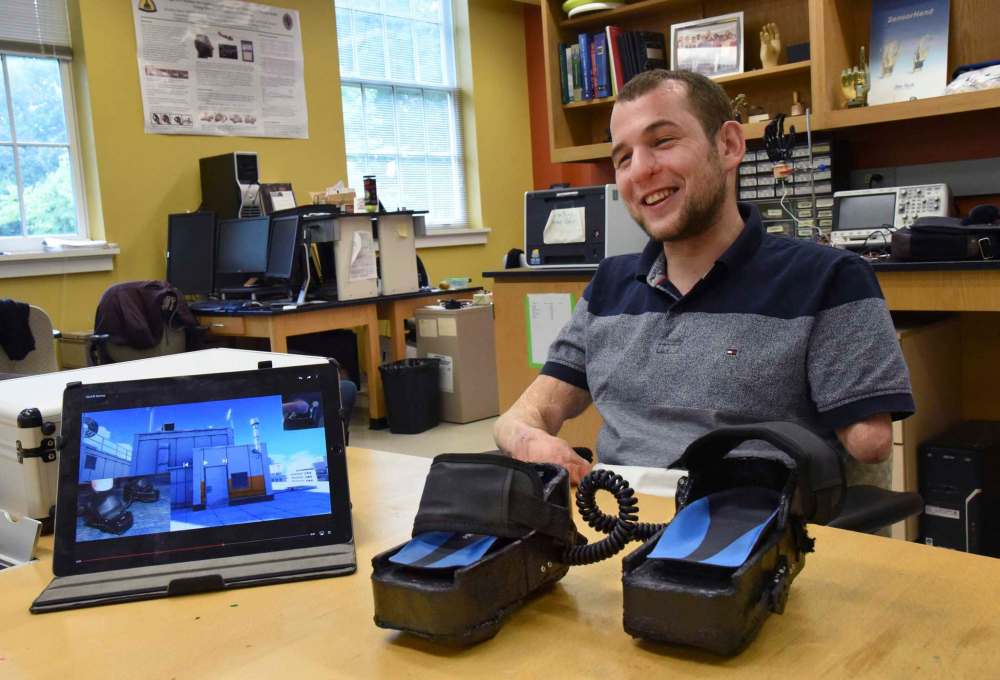
Levay, 28, a native of Hungary, is on a Fulbright scholarship to develop prosthetic devices at Johns Hopkins. He created his Game Enhancing Augmented Reality (GEAR) device in a biomedical instrumentation class and believes it could have broad appeal even for those who aren’t amputees.
“Right now, basically all control options on computers are for hands,” he said. His device “is not only useful for people who lost limbs, it’s useful for people who have limited control in their limbs, like people who suffered a stroke or suffered from carpal tunnel syndrome. They can benefit from a method where they use their feet instead of relying so heavily on their hands for the simple control of computers.”
This year, the clunky, sandal-like device won a US$7,500 grand prize in the 2016 Intel-Cornell Cup, in which student inventors are judged on applications of embedded technology, and was a finalist in the 2016 Johns Hopkins Healthcare Design Competition. Levay secured a provisional patent for the device through the university.
Users activates the device’s four sensors by pressing their feet into the foot bed in various ways. Those sensors, embedded in a silicon and 3D printed plastic exterior, can be customized to follow any programmed command, but his unit is set up to perform game functions such as crouching, moving forward and backward, and moving left or right.
Besides playing computer games, the device could be customized to work with a computer for any task.
Levay said he doesn’t want to create a startup to promote the device, a venture he called “pretty risky.” He hopes an established company will buy the device, refine it and put it on the market. He thinks it could appeal particularly to those developing virtual reality devices, which often require hands to simulate walking.
“It just gives a whole new layer of functionality to games,” he said. “We have our legs, and it’s not used when we’re interfacing with computers.”
The loss of upper limbs is rare. According to research published in the Archives of Physical Medicine and Rehabilitation in 2008, just 56,000 people are estimated to have lost a hand or an arm in the United States. Of the estimated two million people who have lost a limb, finger or toe, about two-thirds lost a lower extremity. A third, or 700,000, were classified as having lost an upper extremity, but most of those people have lost fingers.
The device could be useful for those with spinal cord injuries who have lost dexterity or function in their upper limbs, said Heather Weesner, an occupational therapist at the University of Maryland Rehabilitation and Orthopaedic Institute and a certified hand therapist. Many people who have lost their hands or the use of them are trying to use voice-activated technology to interact with computers, but that can be prohibitively expensive, she said.
Prosthetic limbs can cost as much as US$100,000, said Karen Lundquist, a spokeswoman for the Amputee Coalition. Upper-limb prosthetics are trickier to design and can be uncomfortable and difficult to manage, she said.
“There’s a huge gap in what’s available and what’s possible,” Lundquist said.
Some upper-limb amputees have “gotten very life-hack about it,” she said, developing unique solutions. A person might attach a cup holder to a prosthetic arm, for example, she said.
The ability to use the Internet is crucial for those who have lost limbs, Lundquist said.
“To be able to be socially connected to other people with disabilities, it could connect you to the world and give you a lot of work opportunities as well,” she said. “You’re more likely to not be depressed, you’re more likely to be employed.”
That loss of social connection via the Internet isn’t something that really affects lower-limb amputees, Weesner said. But for upper-limb amputees, being able to use a computer is often a top priority after figuring out how to dress and bathe.
“It really helps the patient’s psyche when they can have some of the activities that they used to have,” such as video games, she said.
“Especially when they’re fun.”
While testing the device, Levay and three non-amputees played the first-person action-adventure game Mirror’s Edge and posted video of the game play online, asking viewers to guess which player was using the device. More than 80 per cent of people who viewed the videos couldn’t identify which player was using the GEAR controller.
Such online anonymity could be good for those who have lost their upper limbs, Levay said, so they can temporarily avoid the odd glances from people who are surprised by their appearance.
“I walk down the street, and people think about what’s going on” with his appearance, Levay said.
“Without hearing it, you hear it in your mind. It doesn’t bother me necessarily, but it can get annoying after some time. There are people who would rather not go out and socialize… and all that goes away with computer games because no one sees you, so all they’re going judge you by is how well you play.”
Still, Levay said because he is focused on graduate school and building better prosthetics, he hasn’t had much time to use the device and enjoy his old hobby.
“The motivation was, of course, to allow me to play, but I haven’t had any time to play on this or anything else,” Levay said.
“I’m happy it’s there as a possibility. One day maybe I’ll have more time.”
— Baltimore Sun