‘Looking at the world around us:’ Canadian scientist wins Nobel Prize in physics

Advertisement

Advertise with us

James Peebles, a Manitoba-born scientist who won the Nobel Prize for physics on Tuesday, said his relatively quiet life isn't so quiet anymore.

Read this article for free:


or

Already have an account? Log in here »

To continue reading, please subscribe:

Subscribe and receive a limited-edition Free Press branded hat or tote.

Digital Subscription

One year of digital access for only $205*

  • Enjoy unlimited reading on winnipegfreepress.com
  • Read the E-Edition, our digital replica newspaper
  • Access News Break, our award-winning app
  • Play interactive puzzles

*First annual payment billed as $205.00 + GST for one year. This annual subscription will automatically renew at $233.00 + GST every 52 weeks (10% off the regular annual price of $259.35). Offer available to new and qualified returning subscribers only. Cancel any time.

To continue reading, please subscribe:

Add Free Press access to your Brandon Sun subscription for only an additional

$1 for the first 4 weeks*

  • Enjoy unlimited reading on winnipegfreepress.com
  • Read the E-Edition, our digital replica newspaper
  • Access News Break, our award-winning app
  • Play interactive puzzles
Start now

*Your next Brandon Sun subscription payment will increase by $1.00 and you will be charged $17.95 plus GST for four weeks. After four weeks, your payment will increase to $24.95 plus GST every four weeks.

Hey there, time traveller!
This article was published 08/10/2019 (2528 days ago), so information in it may no longer be current.

James Peebles, a Manitoba-born scientist who won the Nobel Prize for physics on Tuesday, said his relatively quiet life isn’t so quiet anymore.

Peebles, who was born in the francophone community of St. Boniface before it became part of Winnipeg, completed his undergraduate studies at the University of Manitoba before moving to Princeton University in New Jersey for graduate school.

A dual Canadian-U.S. citizen, he has taught at the Ivy League school for the last five decades.

In this 2016 photo provided by Princeton University, James Peebles speaks at the 43rd annual Donald R. Hamilton Lecture, at the university in Princeton, N.J. Peebles was among three scientists who won the 2019 Nobel Prize in Physics on Tuesday, Oct. 8, 2019, for their work in understanding how the universe has evolved, and the Earth's place in it. The prize was given to Peebles
In this 2016 photo provided by Princeton University, James Peebles speaks at the 43rd annual Donald R. Hamilton Lecture, at the university in Princeton, N.J. Peebles was among three scientists who won the 2019 Nobel Prize in Physics on Tuesday, Oct. 8, 2019, for their work in understanding how the universe has evolved, and the Earth's place in it. The prize was given to Peebles "for theoretical discoveries in physical cosmology" and the other half jointly to Michel Mayor and Didier Queloz "for the discovery of an exoplanet orbiting a solar-type star." (Mark Czajkowski/Princeton University via AP)

Peebles, 84, has been retired for 20 years, but he says he has continued to research and teach at a “relaxed rate” because he enjoys it.

“Life will go on,” he said in a phone interview between media events. “I suppose the aura of the Nobel is such that my life will change, but I don’t think I’m going to let it change much.

“You understand, I’m used to a quiet life.”

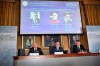
The Nobel committee said it gave Peebles the honour because his work is the basis of our contemporary ideas about the universe from the big bang to the present day.

“The field has exploded,” Peebles said. “It’s just a remarkable extension of well-tested natural science … so it should be recognized. And I’ve been working on it longer than anyone.”

He also told news conferences Tuesday that while awards are “very much appreciated,” that’s not why young people should study science.

“You should enter it for the love of the science,” he said. “You should enter science because you are fascinated by it. That’s what I did.”

Peebles said part of his childhood in Manitoba was spent building or taking apart thing such as the clocks in his family’s home.

“One of my earliest memories is throwing a tantrum because I wasn’t allowed to put together the coffee percolator,” he said.

“I simply liked looking at the world around us.”

Neil Turok, who worked with Peebles at Princeton and now serves as director of the Centre for the Universe at the Perimeter Institute in Waterloo, Ont., described his former colleague as an unsung hero, famous in the world of cosmology, but seldom recognized outside of it.

“Jim is one of the most modest people in the field. His contributions are frequently overlooked. The experts know you can’t oversee him,” Turok said.

Peebles has honorary doctorates from a string of Canadian universities and is a fellow of the Royal Society of Canada and the Order of Manitoba.

He is also the author or co-author of five books, including “Physical Cosmology” and “Finding the Big Bang.” He said he has a sixth book coming out next year, which maps the history of cosmology from Albert Einstein to today.

Peebles shares the Nobel Prize with Swiss scientists Michel Mayor and Didier Queloz, who won for the discovery of an exoplanet orbiting a solar-type star. Mayor and Queloz announced their discovery 24 years ago.

The three men will share a nine-million kronor (C$1.2 million) cash award, a gold medal and a diploma. The laureates are to receive them at a ceremony in Stockholm on Dec. 10.

Peebles said he plans to give some of his winnings to charity and his family. “I owe a lot to the University of Manitoba and a chunk will go to it.”

David Barnard, president of the University of Manitoba, said Peebles’s achievements have inspired new generations of scientists.

Prime Minister Justin Trudeau tweeted his congratulations and Manitoba Premier Brian Palliser issued a statement.

“As Manitobans, we know looking to the vast night sky is often a powerful experience,” Pallister wrote. “Dr. Peebles has reminded us that it can also be the beginning of a journey towards knowledge, achievement and academic excellence to be shared with the world.”

Peebles is the second Canadian in a row to win the physics prize. The University of Waterloo’s Donna Strickland was honoured last in 2018.

Arthur McDonald, a retired professor at Queen’s University, won physics prize in 2015.

This report by The Canadian Press was first published Oct. 8, 2019.

— With files from The Associated Press and Kelly Geraldine Malone in Winnipeg

Note to readers: This is a corrected story. An early version said Peebles took part in news conferences Friday.

Report Error Submit a Tip

More Stories

Manitoba-born scientist wins Nobel physics prize

Nicole Thompson, The Canadian Press 4 minute read Preview

Manitoba-born scientist wins Nobel physics prize

Nicole Thompson, The Canadian Press 4 minute read Tuesday, Oct. 8, 2019

James Peebles, a Manitoba-born scientist who won the Nobel Prize for physics on Tuesday, said his relatively quiet life isn't so quiet anymore.

Peebles, who was born in the francophone community of St. Boniface before it became part of Winnipeg, completed his undergraduate studies at the University of Manitoba before moving to Princeton University in New Jersey for graduate school.

A dual Canadian-U.S. citizen, he has taught at the Ivy League school for the last five decades.

Peebles, 84, has been retired for 20 years, but he says he has continued to research and teach at a "relaxed rate" because he enjoys it.

Read
Tuesday, Oct. 8, 2019

Labour board ruling halts Dynacare strike

Carol Sanders and Erik Pindera 6 minute read Preview

Labour board ruling halts Dynacare strike

Carol Sanders and Erik Pindera 6 minute read Updated: Yesterday at 5:58 PM CDT

The Manitoba Labour Board has cut short a strike by 350 lab workers employed by Dynacare who administer blood and urine tests for patients in Winnipeg, Brandon and surrounding communities.

The board ruled late Tuesday afternoon that the workers, who hit the picket line at 6 a.m., must return to work Wednesday.

Jason Linklater, president of their union, the Manitoba Association of Health Care Professionals, slammed the board’s decision.

“The Manitoba Labour Board is doing exactly what the government asked them to do: they are taking away our members’ right to fight for fairness,” he said in a statement.

Read
Updated: Yesterday at 5:58 PM CDT

South Winnipeg neighbourhood will be first to go geothermal

Chris Kitching 4 minute read Preview

South Winnipeg neighbourhood will be first to go geothermal

Chris Kitching 4 minute read 3:34 PM CDT

A new neighbourhood in south Winnipeg will be Manitoba’s first to use a shared, large-scale geothermal system to heat and cool hundreds of homes over coming decades.

The province is giving up to $4 million to the developers of Southwood Circle, just north of the University of Manitoba’s Fort Garry campus, for a district geothermal system as part of the NDP’s goal to reach net-zero greenhouse gas emissions by 2050.

“It means a whole neighbourhood can tap into geothermal, which means low-carbon heating and cooling for at least 1,000 homes,” Premier Wab Kinew said at a news conference Wednesday.

Geothermal systems, equipped with pumps and pipes, use underground temperatures to heat and cool one or more buildings. Proponents point to long-term energy and cost savings compared with conventional heating and cooling systems.

Read
3:34 PM CDT

Carney warns of tough times ahead in national address as retaliatory tariffs begin

Nick Murray, The Canadian Press 5 minute read Preview

Carney warns of tough times ahead in national address as retaliatory tariffs begin

Nick Murray, The Canadian Press 5 minute read Updated: Yesterday at 4:10 PM CDT

OTTAWA - Canada's pivot away from the United States will "come at a cost" but the alternative would be far worse, Prime Minister Mark Carney said Tuesday.

Carney made the remarks in a video released just hours after his government made good on a promise to implement retaliatory tariffs on the United States. Those tariffs respond to American duties imposed last month by U.S. President Donald Trump, after the two countries could not come to an agreement to settle some outstanding trade irritants.

Carney spent much of the video laying out Canada's response to Trump's protectionist trade policies, including expanding trade with other countries and building more capacity domestically.

But he said it "won't be easy."

Read
Updated: Yesterday at 4:10 PM CDT

‘Dynacare sucks:’ premier muses about bringing lab services back into public system after strike halted

Free Press staff 4 minute read Preview

‘Dynacare sucks:’ premier muses about bringing lab services back into public system after strike halted

Free Press staff 4 minute read Updated: 11:49 AM CDT

Manitoba’s premier said the province is looking at bringing diagnostic lab services back into the public system rather than continuing to contract Dynacare, declaring the for-profit company “sucks.”

“Maybe we’ll take over the whole system… we’re working on it, we’re looking at it, the situation is not great, this company’s making a mess — I think it’s pretty clear I’m not happy with them,” Premier Wab Kinew told CBC Radio Wednesday morning. “At the same time, nobody should be trying to use people’s health care as leverage.”

Kinew made the comments the day after the Manitoba Labour Board cut short a strike by 350 lab technicians and technologists employed by Dynacare, which administers blood, urine and other medical tests for patients in Winnipeg, Brandon and surrounding communities.

Dynacare, which is contracted by the provincial government, performs the majority of non-emergency blood and urine tests in the province.

Read
Updated: 11:49 AM CDT

Councillors say Main Street Project scuttles other agency’s efforts to house homeless

Scott Billeck 5 minute read Preview

Councillors say Main Street Project scuttles other agency’s efforts to house homeless

Scott Billeck 5 minute read Yesterday at 6:57 PM CDT

A Winnipeg outreach agency that’s been largely shut out of government funding says it has found housing for more people in the last five months than Manitoba’s homeless strategy that began last year.

Read
Yesterday at 6:57 PM CDT