Facebook CEO defends refusal to take down some content

Advertisement

Advertise with us

WASHINGTON - Facebook CEO Mark Zuckerberg on Thursday defended the social media platform's refusal to take down content it considers newsworthy "even if it goes against our standards." But while he promoted free expression, limitations were place on coverage of his remarks at Georgetown University.

Read this article for free:


or

Already have an account? Log in here »

To continue reading, please subscribe:

Subscribe and receive a limited-edition Free Press branded hat or tote.

Digital Subscription

One year of digital access for only $205*

  • Enjoy unlimited reading on winnipegfreepress.com
  • Read the E-Edition, our digital replica newspaper
  • Access News Break, our award-winning app
  • Play interactive puzzles

*First annual payment billed as $205.00 + GST for one year. This annual subscription will automatically renew at $233.00 + GST every 52 weeks (10% off the regular annual price of $259.35). Offer available to new and qualified returning subscribers only. Cancel any time.

To continue reading, please subscribe:

Add Free Press access to your Brandon Sun subscription for only an additional

$1 for the first 4 weeks*

  • Enjoy unlimited reading on winnipegfreepress.com
  • Read the E-Edition, our digital replica newspaper
  • Access News Break, our award-winning app
  • Play interactive puzzles
Start now

*Your next Brandon Sun subscription payment will increase by $1.00 and you will be charged $17.95 plus GST for four weeks. After four weeks, your payment will increase to $24.95 plus GST every four weeks.

Hey there, time traveller!
This article was published 17/10/2019 (2487 days ago), so information in it may no longer be current.

WASHINGTON – Facebook CEO Mark Zuckerberg on Thursday defended the social media platform’s refusal to take down content it considers newsworthy “even if it goes against our standards.” But while he promoted free expression, limitations were place on coverage of his remarks at Georgetown University.

Reporters were not allowed to ask questions — only students were given that chance, filtered by a moderator. Facebook and Georgetown barred news organizations from filming. Instead organizers provided a livestream on Georgetown’s social media site and made available video shot by Facebook.

“It’s quite ironic,” said Sally Hubbard, director of enforcement strategy at the Open Markets Institute and a former state prosecutor. More generally, she said of Facebook, “The key to free expression is to not have one company control the flow of speech to more than 2 billion people, using algorithms that amplify disinformation in order to maximize profits.”
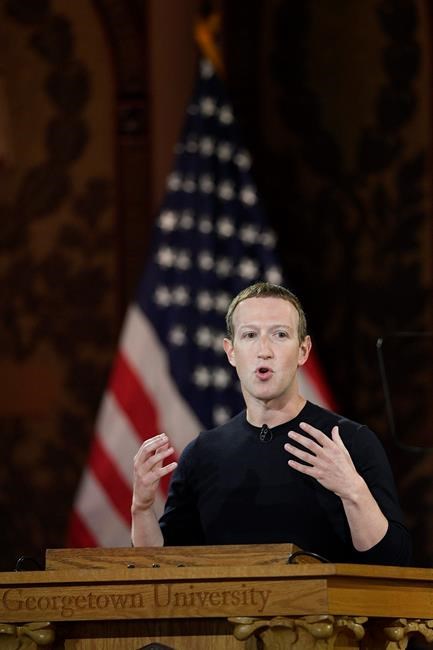
Facebook CEO Mark Zuckerberg speaks at Georgetown University, Thursday, Oct. 17, 2019, in Washington. (AP Photo/Nick Wass)

Facebook, Google, Twitter and other companies are trying to oversee internet content while also avoiding infringing on First Amendment rights. The pendulum has swung recently toward restricting hateful speech that could spawn violence. The shift follows mass shootings in which the suspects have posted racist screeds online or otherwise expressed hateful views or streamed images of attacks.

Facebook also has come under criticism for not doing enough to filter out phoney political ads.

“Right now, we’re doing a very good job at getting everyone mad at us,” Zuckerberg told the packed hall at Georgetown.

He said serious threats to expression are coming from places such as China, where social media platforms used by protesters are censored, and from court decisions restricting the location of internet users’ data in certain countries.

“I’m here today because I believe that we must continue to stand for free expression,” he said. People of varied political beliefs are trying to define expansive speech as dangerous because it could bring results they don’t accept, Zuckerberg said. “I personally believe this is more dangerous to democracy in the long term than almost any speech.”

Taking note of mounting criticism of the market dominance of Facebook and other tech giants, Zuckerberg acknowledged the companies’ centralized power but said it’s also “decentralized by putting it directly into people’s hands. … Giving people a voice and broader inclusion go hand in hand.”

John Stanton, a former fellow at Georgetown who heads a group called the “Save Journalism Project,” called the CEO’s appearance “a joke.”

Zuckerberg “is the antithesis of free expression,” Stanton said in a statement. “He’s thrown free speech, public education and democracy to the wayside in his thirst for power and profit.”

The social media giant, with nearly 2.5 billion users around the globe, is under heavy scrutiny from lawmakers and regulators following a series of data privacy scandals, including lapses in opening the personal data of millions of users to Trump’s 2016 campaign.

Facebook and other social media platforms have drawn accusations from President Donald Trump and his allies that their platforms are steeped in anti-conservative bias.

Zuckerberg recently fell into a tiff with Sen. Elizabeth Warren, a leading Democratic presidential candidate, who ran a fake political ad on Facebook taking aim at the CEO. Warren has proposed breaking up big tech companies. With the phoney ad, she was protesting Facebook’s policy of not fact-checking politicians’ speech or ads in the same way it enlists outside parties to fact-check news stories and other posts.

“We think people should be able to see for themselves,” Zuckerberg responded Thursday on the fact-checking issue. “If content is newsworthy, we don’t take it down even if it goes against our standards.”

The social media network also rebuffed requests that it remove a misleading video ad from Trump’s re-election campaign targeting Democrat Joe Biden.

A spokesman for Biden said Zuckerberg’s speech was an effort “to cloak Facebook’s policy in a feigned concern for free expression.”

“Facebook has chosen to sell Americans’ personal data to politicians looking to target them with disproven lies and conspiracy theories, crowding out the voices of working Americans,” campaign spokesman Bill Russo said in a statement.

Several of the students’ questions to Zuckerberg at Georgetown pointed up the conflict. One asked, if Facebook supports free speech, “why is conservative content disproportionately censored?” But another asserted that the policy of not fact-checking political ads is pro-conservative.

“I think it would be hard to be biased against both sides,” Zuckerberg replied, smiling.

Asked about the handling of questions, Facebook spokeswoman Ruchika Budhjara said, “They were submitted by students as they walked into the room. And they’re being picked at random by Georgetown.”

___

AP Technology Writer Barbara Ortutay in San Francisco contributed to this report.

Report Error Submit a Tip

More Stories

The view from here: Phyllis Green. Boob Tree, 1975

2 minute read Preview

The view from here: Phyllis Green. Boob Tree, 1975

2 minute read 2:01 AM CDT

Staycation: The Art of Being Here feautres more than 100 Manitoba-related artworks from the Winnipeg Art Gallery-Qaumajuq collection, spanning the past 50 years. These pieces reveal how the places around us are layered with memory, story and lived experience. Over the coming weeks, the Free Press will spotlight works from this eclectic exhibition, each one offering a new way of seeing home. Experience it in person and enjoy some staycation time at the gallery, on view until December.

Phyllis Green. Boob Tree, 1975

(Yarn, wood. Collection of the Winnipeg Art Gallery; Acquired with funds from the Estate of Mr. and Mrs. Bernard Naylor, funds administered by The Winnipeg Foundation, 2014-128. Photo: Ernest Mayer.)

The year 1975 was designated International Women’s Year by the United Nations, and in celebration, the WAG staged the show Images of Women, which explored how women had historically been depicted, an impressive selection but by mostly male artists. Amid pushback from the community, Sharron Zenith Corne and Marian Yeo organized a second exhibition, Woman as Viewer, which challenged those portrayals by only featuring works by women. It was called the first Canadian exhibition of feminist art. American artist Phyllis Green’s Boob Tree, a four-foot-tall crochet sculpture of a cluster of breasts, adorned the exhibit posters, which were so popular they were snatched by passersby! The sculpture is playful and unsettling, re-appropriating the objectification of women’s bodies.

Read
2:01 AM CDT

Gilbert Plains Country Club closes for remainder of season due to flood damage

Ken Wiebe 6 minute read Preview

Gilbert Plains Country Club closes for remainder of season due to flood damage

Ken Wiebe 6 minute read Thursday, Aug. 6, 2026

Scott McCallum has made the trek to the Gilbert Plains Country Club clubhouse countless times.

But this was the first time the golf professional and general manager of the course required hip waders to get to his office.

Walking hand in hand with his wife Lindsay, McCallum didn’t need much time to see the devastation caused by the flash flooding in the Parkland region in late June.

“We’re on a river and it’s a beautiful golf course, but anytime you’re on a body of water you know that you’re taking a chance of events like this happening,” McCallum said in a telephone interview. “To this magnitude, we’ve never seen anything like it before. So, this is new to us.

Read
Thursday, Aug. 6, 2026

Poilievre’s lips moving, but Canadians aren’t interested in what he’s saying

Tom Brodbeck 5 minute read Preview

Poilievre’s lips moving, but Canadians aren’t interested in what he’s saying

Tom Brodbeck 5 minute read Thursday, Aug. 6, 2026

Pierre Poilievre’s biggest political challenge right now isn’t Prime Minister Mark Carney’s popularity.

It’s the fact that he still seems to be campaigning against a political landscape that no longer exists.

More than a year after the 2025 federal election, the Conservative leader is still relying on the same message, the same themes and the same attacks that defined his party’s campaign before voters went to the polls.

And Canadians appear to be tuning it out.

Read
Thursday, Aug. 6, 2026

Letters, Aug. 8

7 minute read 2:01 AM CDT

Where is the love?Re: The true costs of your pet — for everyone (Think Tank, Aug. 7)

Before I put Jerry Storie’s mean-spirited diatribe at the bottom of the cage of my precious lovebirds, Harry and Sally, they need to tell him that not only do pet birds add joy and song to a household, they also represent love for all in the pet kingdom.

Yes, pets cost money but they’re still cheaper than kids. Pets earn their keep just by being the lovable creatures they are. Even those with behaviour problems deserve our care.

The animal-human bond has been scientifically proven to reduce stress, blood pressure and, most importantly, loneliness. Pets can help children learn social skills and are crucial to society as therapy agents. They get folks out walking and talking to each other. Many unsheltered people have comfort pets, often feeding their pets before themselves. Manitoba Harvest gives out pet food when donations allow, and Bear Clan has held pet food drives.

Family hopes police alert will bring missing woman home

Morgan Modjeski 3 minute read Preview

Family hopes police alert will bring missing woman home

Morgan Modjeski 3 minute read Thursday, Aug. 6, 2026

The family of Ashley Arason has made a desperate plea for her to come home.

The 41-year-old last had contact with her family on April 6, 2019, which was her 34th birthday.

“I’ve got a place for her,” said her older sister, Pamela Arason, through tears on Thursday. “She has a place to go, a home to come to.”

On Thursday, Winnipeg Police Service renewed the call for help from the public to solve the missing person case.

Read
Thursday, Aug. 6, 2026

Israel: the new political divide?

David McLaughlin 5 minute read Preview

Israel: the new political divide?

David McLaughlin 5 minute read 2:01 AM CDT

Abdul won and Avi is thrilled.

Federal NDP Leader Avi Lewis emerged from electoral hiding to tell us how it is “exhilarating to witness” a “wave of progressive populism” in the United States. He was referring to the upset winner of Tuesday’s heavily-watched Michigan Senate primary race, Abdul El-Sayed, who barely prevailed over his establishment opponent for the Democratic nomination.

Premier Wab Kinew’s favourite New Democrat (after himself) steadfastly hesitates to take a risk and run for a House of Commons seat in a byelection to kickstart Canada’s version of progressive populism. No hesitation, though, in Lewis immediately basking in the reflected glory of those international comrades and fellow travellers who do.

Writing about the state of Canada’s New Democrats feels like a hate crime — you hate wasting your time — and this is no exception. A better story is what’s driving this modest but undeniable political movement in U.S. politics and whether it might gain traction here in Canada.

Read
2:01 AM CDT