Grizzly bears move north in High Arctic as climate change expands range
Advertisement
Read this article for free:
or
Already have an account? Log in here »
To continue reading, please subscribe:
Digital Subscription
One year of digital access for only $1.44 a week*
- Enjoy unlimited reading on winnipegfreepress.com
- Read the E-Edition, our digital replica newspaper
- Access News Break, our award-winning app
- Play interactive puzzles
*Billed as $5.77 plus GST every four weeks. After 52 weeks, price increases to the regular rate of $19.95 plus GST every four weeks. Offer available to new and qualified returning subscribers only. Cancel any time.
To continue reading, please subscribe:
Add Free Press access to your Brandon Sun subscription for only an additional
$1 for the first 4 weeks*
- Enjoy unlimited reading on winnipegfreepress.com
- Read the E-Edition, our digital replica newspaper
- Access News Break, our award-winning app
- Play interactive puzzles
*Your next Brandon Sun subscription payment will increase by $1.00 and you will be charged $17.95 plus GST for four weeks. After four weeks, your payment will increase to $24.95 plus GST every four weeks.
Read unlimited articles for free today:
or
Already have an account? Log in here »
Hey there, time traveller!
This article was published 14/12/2019 (2502 days ago), so information in it may no longer be current.
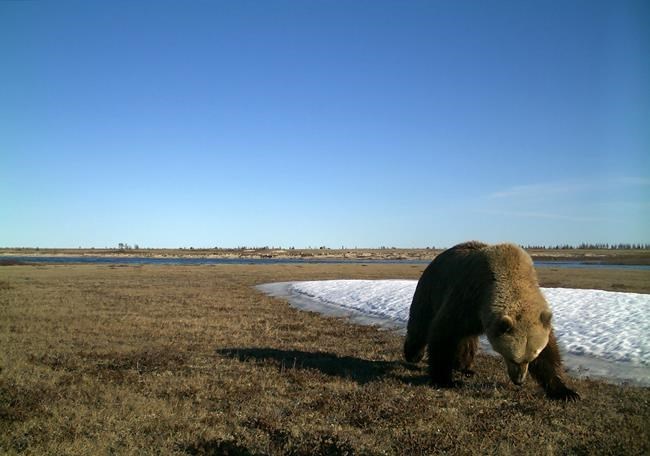
Some unlikely neighbours are moving in around the northernmost communities of the Northwest Territories, across the icy tundra of Canada’s High Arctic.
Inuvialuit hunters and trappers say grizzly bears are showing up in increasing numbers on islands of the Beaufort Sea and experts say climate change is likely a driving factor.
“The grizzly bears are moving into new areas,” said Vernon Amos, chairman of the Inuvialuit game council, in an interview from Inuvik, N.W.T.
At about 3,400 residents, Inuvik is the most populous community within the Inuvialuit Settlement Region that stretches across about 100,000 square kilometres of land.
Grizzlies have long roamed the four mainland Inuvialuit communities, including Inuvik, but there are more of them and they’re appearing for the first time around the two more northerly communities of Sachs Harbour and Ulukhaktok, he said.
Amos, 42, grew up in Sachs Harbour and says the ecosystem has changed significantly over his lifetime. While the seasonal freeze used to begin in August, this year it occurred toward the end of September or early October — an increasingly common occurrence, he said.
“There is a much longer melting and growing season. Areas that were tundra or barren for the most part are now grasslands and have other types of vegetation. Willow, for instance, are starting to establish themselves and grow higher or taller,” he said.
Doug Clark, a University of Saskatchewan associate professor in the school of environment and sustainability, is working with members of the community to document the bears.
During a layover in Calgary on his way back from the territory, Clark said in a phone interview that he has installed four remote cameras in areas where locals say they’ve spotted the massive animals, and distributed eight more cameras to local hunters and trappers to install.
The movement of the grizzlies in the North is significant because it’s part of a wide scale expansion, he said.
“That’s not the only part of Canada where grizzlies are expanding their range,” he said.
Grizzly bears have lost significant habitat to human settlement across North America and continue to struggle in some regions. But they have been expanding their range northward for several years, he said. One area seeing more grizzlies is the west coast of Hudson Bay, including Wapusk National Park near Churchill, Man., best known for its roaming polar bears.
With no southerly source population, it shows that grizzlies aren’t just moving north, they’re moving east and south as well.
“Something pretty big is going on and we don’t know why,” Clark said.
The most obvious question — why now and why not earlier? — suggests climate change is playing a role alongside other changes like resource development.
“They’re very much looking like one of the early winners in the climate change sweepstakes. But what that means in the long term, we don’t really know,” Clark said.
The bears are not the only species expanding their range and the High Arctic isn’t the only place with a changing climate.
Some of the biggest changes are happening in ocean environments and coastal areas, said Brian Starzomski, director of environmental studies at the University of Victoria. Melting glaciers are cooling the climate in northeastern North America, while an unusual warming event known as “The Blob” has brought some tropical species like the pufferfish to British Columbia’s waters.
Inland, wildfires are burning bigger, hotter and over wide areas. Mountains are also a hot spot for range changes, as species typically move both pole-ward and toward higher altitudes.
Species that can move easily — birds and insects — are expected to fare better than those that are stagnant, Starzomski said.

Of particular concern are species like the subalpine larch, a tree that lives at or near the tops of mountains in B.C. and Alberta. It can live for 1,000 years but it also takes almost 100 to 200 years to reproduce.
“It probably can’t reproduce fast enough or move its seeds long enough distances to respond quickly to climate change,” he said.
But blaming it all on climate change is too simple, he said. Humans have done a “great job” of introducing invasive species to new ecosystems through global trade, polluting the atmosphere and making land use decisions that destroy habitats or sever migration routes, he said.
“There’s a lot of pressure on nature at the moment. We talk a lot about climate change, but all of these things add up in the matter of human impact on the environment,” he said.
This report by The Canadian Press was first published Dec. 14, 2019.
Advertisement Advertise With Us
Advertisement Advertise With Us