

Lower tips, poor ratings: Gig economy workers face racism and sexism on the job
Advertisement
Read this article for free:
or
Already have an account? Log in here »
To continue reading, please subscribe:

Digital Subscription
One year of digital access for only $205*
- Enjoy unlimited reading on winnipegfreepress.com
- Read the E-Edition, our digital replica newspaper
- Access News Break, our award-winning app
- Play interactive puzzles
*First annual payment billed as $205.00 + GST for one year. This annual subscription will automatically renew at $233.00 + GST every 52 weeks (10% off the regular annual price of $259.35). Offer available to new and qualified returning subscribers only. Cancel any time.
To continue reading, please subscribe:
Add Free Press access to your Brandon Sun subscription for only an additional
$1 for the first 4 weeks*
- Enjoy unlimited reading on winnipegfreepress.com
- Read the E-Edition, our digital replica newspaper
- Access News Break, our award-winning app
- Play interactive puzzles
*Your next Brandon Sun subscription payment will increase by $1.00 and you will be charged $17.95 plus GST for four weeks. After four weeks, your payment will increase to $24.95 plus GST every four weeks.
Read unlimited articles for free today:
or
Already have an account? Log in here »
Hey there, time traveller!
This article was published 15/12/2020 (2130 days ago), so information in it may no longer be current.
TORONTO – When Phil Warner, Jordyn Samuels and Umar Asghar hit the road working for ride-hailing and delivery apps, they quickly found their experiences differed from those of their white male counterparts.
Warner was called by a derogatory slur in a work messaging app and has noticed that couriers from racialized groups wait longer at kitchens for their food deliveries to be ready.
Samuels has won awards for driver of the month and driver of the year, but says her tips don’t compare to those her male counterparts brag about. And Asghar said he’s grown used to riders bringing up his Pakistani roots in ways that make him uncomfortable.
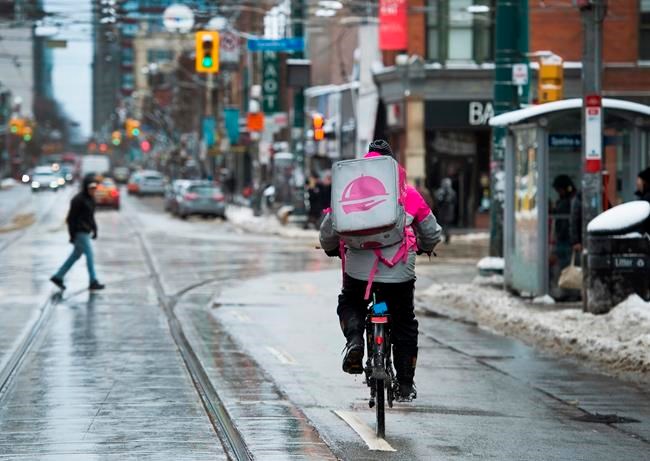
These experiences are not uncommon for those working in the gig economy — a growing industry centred around flexible but precarious work and popularized by companies including Uber, Lyft, SkipTheDishes, Fiverr, Airbnb and TaskRabbit.
Lower tips, worse ratings and a higher likelihood of harassment are all part of the job for women and Black, Indigenous or people of colour in the sector, say members of the industry and the experts who study it.
“What’s now called gig work is work that many racialized communities, women and folks who are dealing with racism in the labour market get pushed into more,” said Deena Ladd, the executive director of the Workers’ Action Centre, a Toronto-based advocacy organization.
Canada’s gig economy had upwards of 1.7 million workers in 2016, up 70 per cent from one million in 2005, according to Statistics Canada. Most of those jobs were held by women and immigrants.
The 2016 data shows 9.1 per cent of all female workers and 7.2 per cent of all male workers identified as gig workers. Almost 11 per cent of male immigrant workers who had been in Canada for less than five years were gig workers in 2016, compared with 6.1 per cent of male workers born in Canada.
Studies suggest women and racialized groups seek gig work because the jobs are flexible enough to accommodate raising children and getting started can be as straightforward as getting insurance, a background check and access to a bike or car. This makes gig work a prime option for new immigrants or people who recently lost their jobs.
Ladd worries COVID-19 will only exacerbate these patterns because financial losses, business closures and layoffs are making gig work more attractive to employers.
“We’re going to have millions of workers that will have no choice, and will be out there, competing for jobs, low wages, part-time hours, and will struggle to survive,” said Ladd.
Umar Asghar immigrated to Canada from Pakistan in 2016 and later signed up with Uber Eats on the advice of a friend, but has since worked for almost all the food delivery and ride-hailing apps in Toronto.
“Sometimes (riders) will dislike a driver who has a different cultural background and then they’ll bang the door,” Asghar said. “Sometimes they would give lower star ratings without any genuine reason or problem, but we have to focus on business.”
High ratings are important to gig workers because they often unlock incentives like a larger cut of the profit from each ride or discounts on gas and vehicle maintenance. If ratings slip below certain levels, drivers can be forced to look for work elsewhere.
A 2019 report from the University of Waterloo showed women also face harassment on the job.
Its authors found that female taxi and Uber drivers described unwanted sexual attention, including an incident where one was questioned about her dating life by a passenger who then intimidated her by saying he had a way to reach her through the app.
Another driver told researchers that “you just have to have 911 ready” because she has had passengers try to massage her neck and videotape her.
“It’s a dangerous job because they’re sitting there, they have their back to someone sitting behind them and they’re in a confined space away from other people, so they’re very vulnerable,” said Ellen MacEachen, a principal investigator forthe report and professor and interim director of the School of Public Health and Health Systems at the University of Waterloo.
“If you’re Black and someone doesn’t want to have a Black driver, … (the driver) could get rated lower.”
Samuels, a Black woman who runs an equity consultancy in Toronto and drives for Uber and Lyft on the side, said passengers sometimes get invasive with questions about her race.
While her five-star rating hasn’t suffered due to her gender or race, she says it likely affects her earnings.
“When I go to the Driver of the Year ceremonies, there are people who get high tips … and they’re usually all men,” she said. “It gets me thinking.”
While little Canadian research has been done on how tips on ride-hailing apps are affected by race or gender, several U.S. studies have showed female and Black Uber riders are subject to longer waits and more cancellations.
Other studies found these groups also receive lower tips compared with white servers and staff at restaurants and bars.
Some companies in the sector have pledged since the death of George Floyd in U.S. police custody to make changes in the face of pressure to eliminate discrimination at an institutional level.
For example, Uber promised to develop new anti-racism and unconscious bias training for drivers and riders, and to make it easier for anyone to report discrimination issues, said spokeswoman Kayla Whaling. The ride-share service said it would move toward pay equality and double Black representation in leadership roles by 2025.
The company was so committed to ridding its platform of racism that it even started running ads with a clear message: “If you tolerate racism, delete Uber.”
Meanwhile, Lyft partnered with more than 500 organizations — 20 of them in Canada — that have long supported communities of colour.
“We take any allegation of discrimination very seriously and investigate all incidents,” Lyft said in an email. “Lyft has a long-standing commitment to maintaining an inclusive and welcoming community, and discrimination against riders or drivers can and has led to (account) deactivation.”
Warner, a Black courier who has worked for Uber Eats and defunct delivery app Foodora, doesn’t think the efforts are enough because racialized groups in the gig economy are still treated differently and he has seen little action taken when they face discrimination on the job.
Many learn to ignore the racism and sexism because they fear speaking out will endanger their jobs, said Ladd from the Workers’ Action Centre. She pointed out that many of these positions lack stability, sick pay, paid leave or support in the event of a workplace injury.
Warner knows gig economy workers are often seen as “expendable,” but tries to speak out because he has the relative security of a part-time job outside the industry and wants to see change.
“The level of pervasive hostility that Black people face is a consistent everyday life experience,” he said. “If you don’t have someone saying, ‘hey, you need to take this seriously,’ then the CEOs who are white and often don’t experience any kind of racism are going to not understand how bad it is.”
This report by The Canadian Press was first published Dec. 15, 2020.



