Glaciers getting smaller, faster — especially in North America, study finds

Advertisement

Advertise with us

A new study has used millions of satellite images to generate the clearest picture yet of the world's glaciers and concludes they're getting smaller, faster.

Read this article for free:


or

Already have an account? Log in here »

To continue reading, please subscribe:

Subscribe and receive a limited-edition Free Press branded hat or tote.

Digital Subscription

One year of digital access for only $205*

  • Enjoy unlimited reading on winnipegfreepress.com
  • Read the E-Edition, our digital replica newspaper
  • Access News Break, our award-winning app
  • Play interactive puzzles

*First annual payment billed as $205.00 + GST for one year. This annual subscription will automatically renew at $233.00 + GST every 52 weeks (10% off the regular annual price of $259.35). Offer available to new and qualified returning subscribers only. Cancel any time.

To continue reading, please subscribe:

Add Free Press access to your Brandon Sun subscription for only an additional

$1 for the first 4 weeks*

  • Enjoy unlimited reading on winnipegfreepress.com
  • Read the E-Edition, our digital replica newspaper
  • Access News Break, our award-winning app
  • Play interactive puzzles
Start now

*Your next Brandon Sun subscription payment will increase by $1.00 and you will be charged $17.95 plus GST for four weeks. After four weeks, your payment will increase to $24.95 plus GST every four weeks.

Hey there, time traveller!
This article was published 28/04/2021 (1938 days ago), so information in it may no longer be current.

A new study has used millions of satellite images to generate the clearest picture yet of the world’s glaciers and concludes they’re getting smaller, faster.

And glaciers along the western edge of North America are thinning faster than almost anywhere else in the world, said co-author Brian Menounos of the University of Northern British Columbia, whose paper was published Wednesday in the journal Nature.

“I don’t think humans need more evidence the climate is changing,” Menounos said.
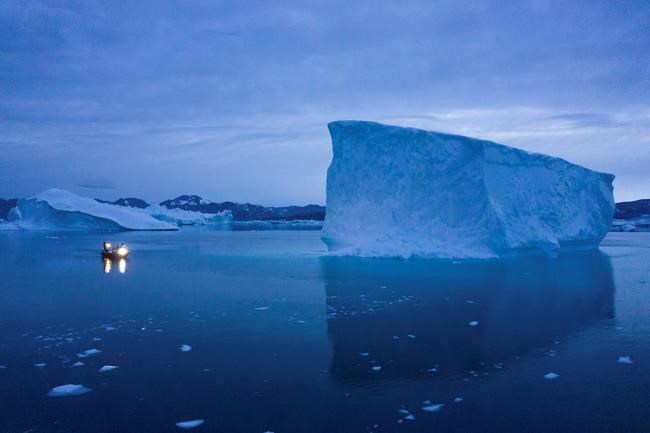
In this Aug. 15, 2019, photo, a boat navigates at night next to large icebergs in eastern Greenland. Greenland's ice has been melting for more than 20 years. THE CANADIAN PRESS/AP-Felipe Dana

“But I also think we can’t throw up our hands and say, ‘Oh, we can’t do anything.’ We have to understand the implications of climate change.”

Scientists have long known that the world’s 217,000 glaciers are in retreat.

That knowledge, however, was based on relatively infrequent satellite images and field monitoring that didn’t include all glaciers. Menounos and his colleagues turned to a previously unused trove of images that allowed them to estimate the falling elevation of precise spots with unprecedented accuracy.

“We had (a supercomputer) running for a solid year of compute time,” he said.

Once they knew how far the surface of the glaciers had fallen, they could calculate how much ice was lost. The results boggle the mind.

They found glaciers are now losing 267 billion tonnes of ice every year. Just one billion tonnes of ice — a gigatonne — is equal in mass to 10,000 fully loaded aircraft carriers.

Put another way, that’s enough ice melting every year to cover Canada’s entire land mass to a depth of 30 centimetres.

The pace is picking up. Between 2000 and 2004, when the study begins, glaciers “only” lost 227 gigatonnes per year.

But glaciers up the mountainous western spine of North America — including Canada — are melting even faster. Their thawing rate increased fourfold between 2000 and 2019.

Glaciers are now responsible for about 21 per cent of the roughly 22 centimetres that sea levels have risen since 1880.

That won’t stop. By the end of the century, about 200 million people will live on land likely to be submerged at high tide.

Glaciers are also a crucial source of fresh water, as they are in Western Canada. The paper quotes research suggesting more than one billion people could face water shortages by 2050.

That doesn’t include other benefits humans rely on glaciers for. They keep headwaters streams cool, for example.

“If you take that thermal buffering capacity of glaciers away, you’re left with a situation where these aquatic ecosystems are going to change,” Menounos said.

By far the biggest driver of glacial melt is rising temperatures caused by climate change, said Menounos. There are enough greenhouse gases in the air that some melting will continue even if the taps were turned off tomorrow.

But he said his study shows that while humans are causing the problem, they can also curb it.

“We just need the power and the gumption and the willpower to make some hard, difficult decisions,” Menounos said.

“You can’t really engineer your way out of this problem. You have to mitigate and reduce greenhouse gas emissions.”

This report by The Canadian Press was first published April 28, 2021.

— Follow Bob Weber on Twitter at @row1960

Report Error Submit a Tip

More Stories

Mayor Scott Gillingham, in one of his first re-election campaign pledges, has promised to create a level playing field for local businesses to compete with national and multinational bidders on city contracts for goods and services.

It’s not a bad pledge, per se. There are a lot of Winnipeggers who are keenly interested in seeing government do business with other Winnipeggers and Manitobans.

But Gillingham’s newest campaign policy fails to answer two key questions: what, exactly, is a “local” company? And it is beneficial to give government business to local companies over those headquartered elsewhere?

Two recent controversies illustrate the difficulty in obtaining definitive answers.

West Kildonan Industrial residents call for speed bumps after child hit by truck

Morgan Modjeski 3 minute read Preview

West Kildonan Industrial residents call for speed bumps after child hit by truck

Morgan Modjeski 3 minute read Saturday, Aug. 15, 2026

Residents in the West Kildonan Industrial neighbourhood are calling on the city to install speed bumps in their area after a child was hit and dragged by a vehicle Thursday.

Katelyn Bemister lives near the area where the child — who was hospitalized as a result of the incident and has been upgraded to stable condition — was struck. She says people frequently speed in the area.

“They’re going really fast, and they’re not really paying attention at all to the pedestrians in the area,” says Bemister.

In video supplied to the Free Press by a resident, the child can be seen riding a bike down a sidewalk along the 500 block of North Point Boulevard.

Read
Saturday, Aug. 15, 2026

Puzzles Palace

1 minute read Monday, Jul. 27, 2026

To solve our puzzles, please subscribe with this special offer: |

Sea Bears finish on top

Joshua Frey-Sam 6 minute read Preview

Sea Bears finish on top

Joshua Frey-Sam 6 minute read Saturday, Aug. 15, 2026

Beauty. Bliss. Ecstasy.

That is how Aug. 15, 2026 will be remembered in Winnipeg.

What was once a pipe dream in the city’s hoops community became an epic reality on Saturday, when Simon Hildebrandt, who grew up playing on the courts of this very town, made good on a three-pointer from the wing to crown the Winnipeg Sea Bears Canadian Elite Basketball League champions.

A storybook ending to a 98-84 victory over the Brampton Honey Badgers sent a CEBL attendance record of 12,519 fans into pandemonium at Canada Life Centre and capped a Finals run for the ages — one that was fraught with injury, impromptu player exits and unprecedented circumstances.

Read
Saturday, Aug. 15, 2026

Hayden Panettiere, who starred in ‘Heroes’ and ‘Nashville,’ dies at 36

Hannah Schoenbaum, The Associated Press 6 minute read Preview

Hayden Panettiere, who starred in ‘Heroes’ and ‘Nashville,’ dies at 36

Hannah Schoenbaum, The Associated Press 6 minute read Updated: 12:26 PM CDT

Hayden Panettiere, a onetime child star who soared to fame in the TV shows “Heroes” and “Nashville” while enduring struggles with alcohol addiction and depression, has died. She was 36.

Police said Panettiere was found unresponsive in an apartment in Greenville, South Carolina, shortly before 2 p.m. Sunday. Lifesaving measures were performed but she was pronounced dead at the scene.

No cause of death has been determined and Panettiere's death remains under investigation. An autopsy found no signs of trauma and police said officers saw no signs of foul play.

The television and film performer, who would have turned 37 on Friday, had been open about her private battles and wrote at length about them in the memoir, “This Is Me,” which came out in May. She described lifelong scars from her early fame, and acknowledged being addicted to alcohol and enduring postpartum depression after the birth of her daughter, Kaya, with Ukrainian boxer Wladimir Klitschko in 2014.

Read
Updated: 12:26 PM CDT

Best to fess up about grandkid-sitting fatigue

Maureen Scurfield 5 minute read 2:00 AM CDT

Dear Miss Lonelyhearts: We love our grandchildren, but now we’re sick of them. The two sets of parents — our adult children — have been parking their kids out here on the farm with us while they take back-to-back road trips to see their friends. We’ve had enough.

Grandma and I want them to come back and get the “brats” (just joking, they’re nice kids) so we can relax.

You have to be so careful with city kids around the farm who don’t know when they’re going to make a mistake and get hoofed by an animal or run over by a farm implement.

How do we tell our kids the party is over early, and they really need to come back before grandma and I give out?