Probe: Journalists, activists among firm’s spyware targets
Advertisement
Read this article for free:
or
Already have an account? Log in here »
To continue reading, please subscribe:

Digital Subscription
One year of digital access for only $205*
- Enjoy unlimited reading on winnipegfreepress.com
- Read the E-Edition, our digital replica newspaper
- Access News Break, our award-winning app
- Play interactive puzzles
*First annual payment billed as $205.00 + GST for one year. This annual subscription will automatically renew at $233.00 + GST every 52 weeks (10% off the regular annual price of $259.35). Offer available to new and qualified returning subscribers only. Cancel any time.
To continue reading, please subscribe:
Add Free Press access to your Brandon Sun subscription for only an additional
$1 for the first 4 weeks*
- Enjoy unlimited reading on winnipegfreepress.com
- Read the E-Edition, our digital replica newspaper
- Access News Break, our award-winning app
- Play interactive puzzles
*Your next Brandon Sun subscription payment will increase by $1.00 and you will be charged $17.95 plus GST for four weeks. After four weeks, your payment will increase to $24.95 plus GST every four weeks.
Read unlimited articles for free today:
or
Already have an account? Log in here »
Hey there, time traveller!
This article was published 18/07/2021 (1854 days ago), so information in it may no longer be current.
BOSTON (AP) — An investigation by a global media consortium based on leaked targeting data provides further evidence that military-grade malware from Israel-based NSO Group, the world’s most infamous hacker-for-hire outfit, is being used to spy on journalists, human rights activists and political dissidents.
From a list of more than 50,000 cellphone numbers obtained by the Paris-based journalism nonprofit Forbidden Stories and the human rights group Amnesty International and shared with 16 news organizations, journalists were able to identify more than 1,000 individuals in 50 countries who were allegedly selected by NSO clients for potential surveillance.
They include 189 journalists, more than 600 politicians and government officials, at least 65 business executives, 85 human rights activists and several heads of state, according to The Washington Post, a consortium member. The journalists work for organizations including The Associated Press, Reuters, CNN, The Wall Street Journal, Le Monde and The Financial Times.
NSO Group denied in an emailed response to AP questions that it has ever maintained “a list of potential, past or existing targets.” In a separate statement, it called the Forbidden Stories report “full of wrong assumptions and uncorroborated theories.”
The company reiterated its claims that it only sells to “vetted government agencies” for use against terrorists and major criminals and that it has no visibility into its customers’ data. Critics call those claims dishonest — and have provided evidence that NSO directly manages the high-tech spying. They say the repeated abuse of Pegasus spyware highlights the nearly complete lack of regulation of the private global surveillance industry.
The source of the leak — and how it was authenticated — was not disclosed. While a phone number’s presence in the data does not mean an attempt was made to hack a device, the consortium said it believed the data indicated potential targets of NSO’s government clients. The Post said it identified 37 hacked smartphones on the list. The Guardian, another consortium member, reported that Amnesty had found traces of Pegasus infections on the cellphones of 15 journalists who let their phones be examined after discovering their number was in the leaked data.
The most numbers on the list, 15,000, were for Mexican phones, with a large share in the Middle East. NSO Group’s spyware has been implicated in targeted surveillance chiefly in the Middle East and Mexico. Saudi Arabia is reported to be among NSO clients. Also on the lists were phones in countries including France, Hungary, India, Azerbaijan, Kazakhstan and Pakistan.
“The number of journalists identified as targets vividly illustrates how Pegasus is used as a tool to intimidate critical media. It is about controlling public narrative, resisting scrutiny, and suppressing any dissenting voice,” Amnesty quoted its secretary-general, Agnes Callamard, as saying.
In one case highlighted by the Guardian, Mexican reporter Cecilio Pineda Birto was assassinated in 2017 a few weeks after his cell phone number appeared on the leaked list.
AP’s director of media relations, Lauren Easton, said the company is “deeply troubled to learn that two AP journalists, along with journalists from many news organizations” are on the list of the 1,000 potential targets for Pegasus infection. She said the AP was investigating to try to determine if its two staffers’ devices were compromised by the spyware.
The consortium’s findings build on extensive work by cybersecurity researchers, primarily from the University of Toronto-based watchdog Citizen Lab. NSO targets identified by researchers beginning in 2016 include dozens of Al-Jazeera journalists and executives, New York Times Beirut bureau chief Ben Hubbard, Moroccan journalist and activist Omar Radi and prominent Mexican anti-corruption reporter Carmen Aristegui. Her phone number was on the list, the Post reported. The Times said Hubbard and its former Mexico City bureau chief, Azam Ahmed, were on the list.
Two Hungarian investigative journalists, Andras Szabo and Szabolcs Panyi, were among journalists on the list whose phones were successfully infected with Pegasus, the Guardian reported.
Among more than two dozen previously documented Mexican targets are proponents of a soda tax, opposition politicians, human rights activists investigating a mass disappearance and the widow of a slain journalist. In the Middle East, the victims have mostly been journalists and dissidents, allegedly targeted by the Saudi and United Arab Emirates governments.
The consortium’s “Pegasus Project” reporting bolsters accusations that not just autocratic regimes but democratic governments, including India and Mexico, have used NSO Group’s Pegasus spyware for political ends. Its members, who include Le Monde and Sueddeutsche Zeitung of Germany, are promising a series of stories based on the leak.
Pegasus infiltrates phones to vacuum up personal and location data and surreptitiously control the smartphone’s microphones and cameras. In the case of journalists, that lets hackers spy on reporters’ communications with sources.
The program is designed to bypass detection and mask its activity. NSO Group’s methods to infect its victims have grown so sophisticated that researchers say it can now do so without any user interaction, the so-called “zero-click” option.
In 2019, WhatsApp and its parent company Facebook sued NSO Group in U.S. federal court in San Francisco, accusing it of exploiting a flaw in the popular encrypted messaging service to target — with missed calls alone — some 1,400 users. NSO Group denies the accusations.
The Israeli company was sued the previous year in Israel and Cyprus, both countries from which it exports products. The plaintiffs include Al-Jazeera journalists, as well as other Qatari, Mexican and Saudi journalists and activists who say the company’s spyware was used to hack them.
Several of the suits draw heavily on leaked material provided to Abdullah Al-Athbah, editor of the Qatari newspaper Al-Arab and one of the alleged victims. The material appears to show officials in the United Arab Emirates discussing whether to hack into the phones of senior figures in Saudi Arabia and Qatar, including members of the Qatari royal family.
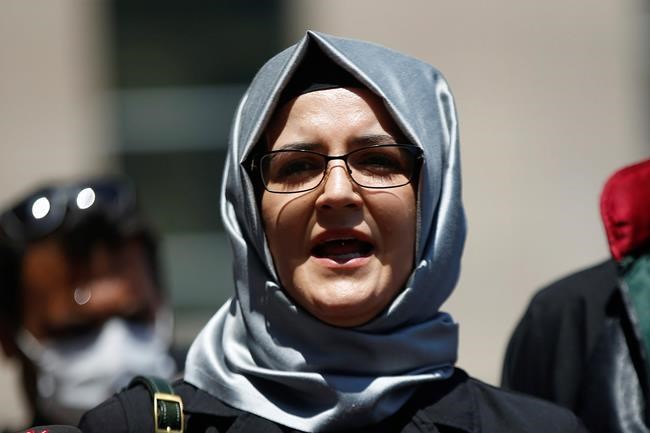
NSO Group does not disclose its clients and says it sells its technology to Israeli-approved governments to help them target terrorists and break up pedophile rings and sex- and drug-trafficking rings. It claims its software has helped save thousands of lives and denies its technology was in any way associated with Khashoggi’s murder.
NSO Group also denies involvement in elaborate undercover operations uncovered by The AP in 2019 in which shadowy operatives targeted NSO critics including a Citizen Lab researcher to try to discredit them.
Last year, an Israeli court dismissed an Amnesty International lawsuit seeking to strip NSO of its export license, citing insufficient evidence.
NSO Group is far from the only merchant of commercial spyware. But its behavior has drawn the most attention, and critics say that is with good reason.
Last month, it published its first transparency report, in which it says it has rejected “more than $300 million in sales opportunities as a result of its human rights review processes.” Eva Galperin, director of cybersecurity at the Electronic Frontier Foundation and a strident critic, tweeted: “If this report was printed, it would not be worth the paper it was printed on.”
A new, interactive online data platform created by the group Forensic Architecture with support from Citizen Lab and Amnesty International catalogs NSO Group’s activities by country and target. The group partnered with filmmaker Laura Poitras, best known for her 2014 documentary “Citzenfour” about NSA whistleblower Edward Snowden, who offers video narrations.
“Stop what you’re doing and read this,” Snowden tweeted Sunday, referencing the consortium’s findings. “This leak is going to be the story of the year.”
Since 2019, the U.K. private equity firm Novalpina Capital has controlled a majority stake in NSO Group. Earlier this year, Israeli media reported the company was considering an initial public offering, most likely on the Tel Aviv Stock Exchange.