Monster wildfire tests years of forest management efforts

Advertisement

Advertise with us

PORTLAND, Ore. (AP) — Ecologists in a vast region of wetlands and forest in remote Oregon have spent the past decade thinning young trees and using planned fires to try to restore the thick stands of ponderosa to a less fire-prone state.

Read this article for free:


or

Already have an account? Log in here »

To continue reading, please subscribe:

Subscribe and receive a limited-edition Free Press branded hat or tote.

Digital Subscription

One year of digital access for only $205*

  • Enjoy unlimited reading on winnipegfreepress.com
  • Read the E-Edition, our digital replica newspaper
  • Access News Break, our award-winning app
  • Play interactive puzzles

*First annual payment billed as $205.00 + GST for one year. This annual subscription will automatically renew at $233.00 + GST every 52 weeks (10% off the regular annual price of $259.35). Offer available to new and qualified returning subscribers only. Cancel any time.

To continue reading, please subscribe:

Add Free Press access to your Brandon Sun subscription for only an additional

$1 for the first 4 weeks*

  • Enjoy unlimited reading on winnipegfreepress.com
  • Read the E-Edition, our digital replica newspaper
  • Access News Break, our award-winning app
  • Play interactive puzzles
Start now

*Your next Brandon Sun subscription payment will increase by $1.00 and you will be charged $17.95 plus GST for four weeks. After four weeks, your payment will increase to $24.95 plus GST every four weeks.

Hey there, time traveller!
This article was published 20/07/2021 (1852 days ago), so information in it may no longer be current.

PORTLAND, Ore. (AP) — Ecologists in a vast region of wetlands and forest in remote Oregon have spent the past decade thinning young trees and using planned fires to try to restore the thick stands of ponderosa to a less fire-prone state.

This week, the nation’s biggest burning wildfire provided them with an unexpected, real-world experiment. As the massive inferno half the size of Rhode Island roared into the Sycan Marsh Preserve, firefighters said the flames jumped less from treetop to treetop and instead returned to the ground, where they were easier to fight, moved more slowly and did less damage to the overall forest.

The initial assessment suggests that the many years of forest treatments worked, said Pete Caligiuri, Oregon forest program director for The Nature Conservancy, which runs the research at the preserve.
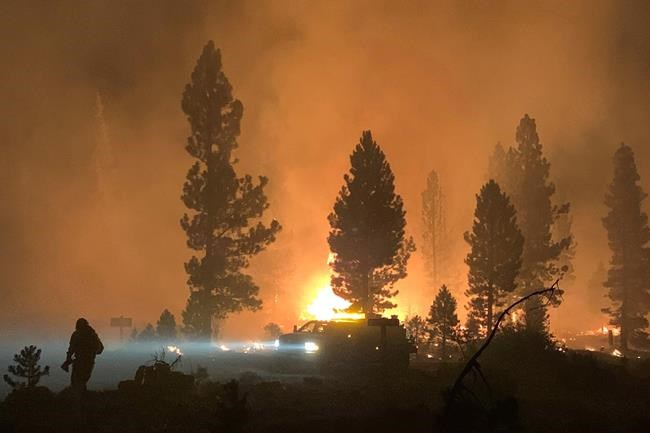
In this photo provided by the Bootleg Fire Incident Command, the Bootleg Fire burns at night in southern Oregon on Saturday, July 17, 2021. The destructive Bootleg Fire, one of the largest in modern Oregon history, has already burned more than 476 square miles (1,210 square kilometers), an area about the size of Los Angeles. The Bootleg Fire is among dozens burning in the parched West. (Bootleg Fire Incident Command via AP)

“Generally speaking, what firefighters were reporting on the ground is that when the fire came into those areas that had been thinned … it had significantly less impact.”

The reports were bittersweet for researchers, who still saw nearly 20 square miles of the preserve burn, but the findings add to a growing body of research about how to make wildfires less explosive by thinning undergrowth and allowing forests to burn periodically — as they naturally would do — instead of snuffing out every flame.

The Bootleg Fire, now 606 square miles (1,569 square kilometers) in size, has ravaged southern Oregon and is the fourth-largest fire in the state’s modern history. It’s been expanding by up to 4 miles (6 kilometers) a day, pushed by gusting winds and critically dry weather that’s turned trees and undergrowth into a tinderbox.

Fire crews have had to retreat from the flames for 10 consecutive days as fireballs jump from treetop to treetop, trees explode, embers fly ahead of the fire to start new blazes and, in some cases, the inferno’s heat creates its own weather of shifting winds and dry lightning. Monstrous clouds of smoke and ash have risen up to 6 miles into the sky and are visible for more than 100 air miles.

The fire in the Fremont-Winema National Forest merged with a smaller nearby blaze Tuesday, and it has repeatedly breached a perimeter of treeless dirt and fire retardant meant to stop its advance.

More evacuations were ordered Monday night, and a red flag weather warning signifying dangerous fire conditions was in effect through Tuesday. The fire is 30% contained.

“We’re in this for as long as it takes to safely confine this monster,” Incident Commander Rob Allen said Tuesday.

At least 2,000 homes have been evacuated at some point during the fire and another 5,000 threatened. At least 70 homes and more than 100 outbuildings have gone up in flames. Thick smoke chokes the area where residents and wildlife alike have already been dealing with months of drought and extreme heat. No one has died.

The Bootleg Fire was one of many fires burning in a dozen states, most of them in the West. Sixteen large uncontained fires burned in Oregon and Washington state alone on Monday.

On Tuesday, officials temporarily closed all recreational and public access to state-managed lands in eastern Washington due to fire danger, starting Friday.

Historically, wildfires in Oregon and elsewhere in the West burned an area as big or bigger than the current blaze more frequently but much less explosively. Periodic, naturally occurring fire cleared out the undergrowth and smaller trees that cause today’s fires to burn so dangerously.
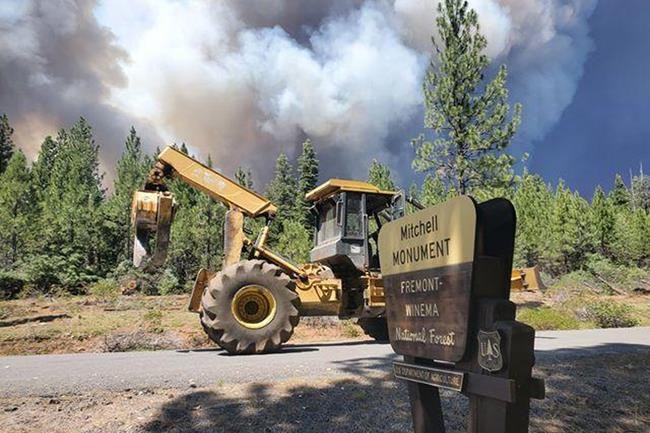
In this photo provided by the Bootleg Fire Incident Command, the Bootleg Fire burns behind heavy equipment at the Mitchell Monument in southern Oregon on Saturday, July 17, 2021. The 569-square-mile (1,474 square kilometers) Bootleg Fire is burning 300 miles (483 kilometers) southeast of Portland in and around the Fremont-Winema National Forest, a vast expanse of old-growth forest, lakes and wildlife refuges. (Bootleg Fire Incident Command via AP)

Those fires have not been allowed to burn for the past 120 years, said James Johnston, a researcher with Oregon State University’s College of Forestry who studies historical wildfires.

The area on the northeastern flank of the Bootleg Fire is in the ancestral homeland of the Klamath Tribes, which have used intentional, managed fire to keep the fuel load low and prevent such explosive blazes. Scientists at the Sycan Marsh research station now work with the tribe and draw on that knowledge.

Climate change is the catalyst for the worsening wildfire seasons in the West, Johnston said, but poor forest management and a policy of decades of fire suppression have made a bad situation even worse.

“My colleagues and I have been predicting a massive fire in that area for years. It’s an area that’s exceptionally prone to catastrophic fire,” said Johnston, who is not affiliated with Sycan Marsh. “It’s dry. It’s fire-prone and always has been. But what’s changed over the past 100 years is an extraordinary amount of fuel buildup.”

Elsewhere, fire crews were engaged in other daunting battles.

In Northern California, authorities expanded evacuations for the Tamarack Fire in Alpine County in the Sierra Nevada to include the mountain town of Mesa Vista late Monday. That fire, which exploded over the weekend was 61 square miles (158 square kilometers) with no containment.

Tony Galvez fled with his daughter at the last minute and found out the family’s home is gone.

“I lost my whole life, everything I’ve ever had. The kids are what’s going to matter,” he said as he fielded calls from relatives. “I got three teenagers. They’re going to go home to a moonscape.”

On the western side of the Sierra, the Dixie Fire has scorched more than 90 square miles (163 square kilometers), threatening tiny communities in the Feather River Valley region.

Meteorologist Julia Ruthford told a briefing that a surge of monsoonal moisture from the Southwest had created plumes topping 6 miles — so big that the fire generated a thunderstorm over itself with lightning and gusty winds.
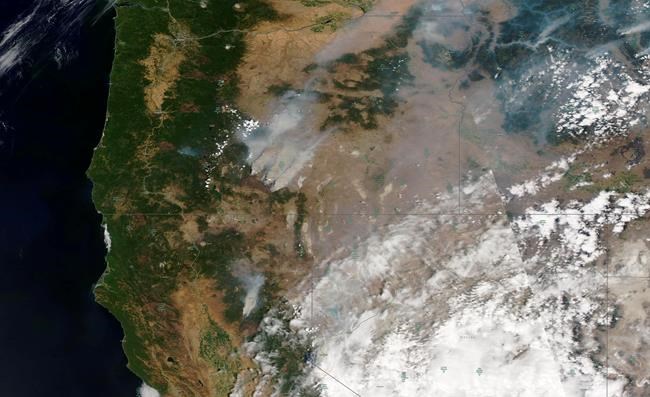
This satellite image provided by Satellite image ©2021 Maxar Technologies shows overview of wildfires from Oregon, Idaho, and Northern California on Sunday, July 18, 2021. Extremely dry conditions and heat waves tied to climate change have made wildfires harder to fight. Climate change has made the West much warmer and drier in the past 30 years and will continue to make weather more extreme and wildfires more frequent and destructive. (Satellite image ©2021 Maxar Technologies via AP)

For the past two days in Oregon, the fire has danced around Sycan Marsh, where researchers raced to protect buildings with sprinklers and fire lines. The 47-square-mile habitat attracts migrating and nesting birds and offers a unique location to research forest and fire ecology.

The nonprofit operates its own fire engines and now has three engines and seven firefighters on the blaze and more people are arriving.

“It’s an amazing place,” Caligiuri said. “It’s very hard to watch it all happening, and seeing all of that work being threatened by this fire is a lot to process.”

___

Associated Press Writer John Antczak in Los Angeles and AP Video Journalist Haven Daley in Alpine County, California, contributed to this report.

___

Follow Flaccus on Twitter at http://www.twitter.com/gflaccus

Report Error Submit a Tip

More Stories

Manitoba family finalist for cattle producers environmental award

Aaron Epp 4 minute read Preview

Manitoba family finalist for cattle producers environmental award

Aaron Epp 4 minute read 2:00 AM CDT

A family in western Manitoba is one of seven finalists for a national environmental award honouring beef cattle producers.

Connor and Kyla English, alongside Connor’s parents, Brian and Leanne English, are nominated for the Canadian Cattle Association’s Environmental Stewardship Award. The 30-year-old award is presented to beef farmers and ranchers who explore innovative ways to protect, preserve and enhance their operations and the environment simultaneously.

This year’s recipient will be announced on Wednesday during a banquet at the Canadian Beef Industry Conference in Winnipeg.

The English family’s roots near Bradwardine — about 265 kilometres west of Winnipeg — date back to 1898. Today, Connor, Kyla, Brian and Leanne manage a herd of about 320 breeding cows on nearly 445 hectares (1,100 acres) of owned and rented pasture and forage land.

Read
2:00 AM CDT

Nola chef earns national award

Eva Wasney 2 minute read Preview

Nola chef earns national award

Eva Wasney 2 minute read Yesterday at 2:01 AM CDT

Celebrated Winnipeg chef Emily Butcher has another feather to add to her toque. The executive chef and owner of Nola and Bar Accanto in St. Boniface has received the Culinary Award of Excellence from Restaurants Canada, a national foodservice advocacy organization.

Read
Yesterday at 2:01 AM CDT

City Lego seller continues to build up its business

Gabrielle Piché 5 minute read Preview

City Lego seller continues to build up its business

Gabrielle Piché 5 minute read Updated: Yesterday at 8:54 AM CDT

Brick by brick, a Winnipeg Lego seller is building its third expansion — in less than two years.

Read
Updated: Yesterday at 8:54 AM CDT

August in the kitchen garden

Colleen Zacharias 7 minute read Preview

August in the kitchen garden

Colleen Zacharias 7 minute read 3:00 AM CDT

Lynne Hermiston is passionate about growing her own food. Her backyard food garden in south Winnipeg is an amazing example of the abundance and diversity of food that can be grown in a relatively small space. But it’s also a prime example of how a zest for learning innovative methods can make food gardening more fun.

Hermiston’s backyard is approximately 10 metres wide and 15 metres deep. The growing area consisting of raised beds and a couple of in-ground beds between her deck and back fence is about nine metres deep. There is not a single blade of turf grass in sight. The design for this attractive and productive space was created by Classic Landscaping four years ago. A series of raised wooden beds mulched with straw are neatly arranged on a light grey, slate-like surface. An inviting centre arbor acts as a focal point and supports climbing plants. The square-shaped raised-bed area receives eight to nine hours of sun daily. It is flanked on one side by a long, linear-shaped bed, planted with flowering perennials that attract and support pollinators.

The food plants Hermiston is growing this summer include tomatoes, cucumbers, squash, beets, chickpeas, beans, onions, sweet potatoes, horseradish, garlic, peppers, carrots, pumpkin and cauliflower. She is growing Chinese Pink celery, an heirloom variety with bubblegum-pink stems, for the first time, as well as eggplant.

She also grows salad greens and herbs, which have made delicious additions to her summer recipes this year. Only a few harvests remain of the spinach she planted. But, compared to last year’s growing season, some food plants are taking their time, Hermiston says.

Read
3:00 AM CDT

Get out and about, have a sip at local beer, wine events

Ben Sigurdson 6 minute read Preview

Get out and about, have a sip at local beer, wine events

Ben Sigurdson 6 minute read 3:00 AM CDT

Beer and wine fans in Winnipeg can enjoy the dog days of summer and the first days of fall with a bumper crop of events coming in the next month that are sure to please most palates.

On Monday, the Manitoba chapter of the Canadian Association of Professional Sommeliers (CAPS) presents the Rosé the Night Away event on the rooftop of the Metropolitan Entertainment Centre (281 Donald St.) from 7-9 p.m.

A range of pink wines will be available to taste alongside small bites. Tickets are $42 for CAPS members and $55 for non-members and are available at wfp.to/iRV.

On Saturday, Aug. 22, the Winnipeg Beer Festival returns, with more than 20 producers pouring samples, including core pours and small-batch brews at Le Patio 340 (340 Provencher Blvd.).

Read
3:00 AM CDT

Development turning long-vacant gas station in Selkirk into commercial hub

By Tiago Resko 2 minute read Preview

Development turning long-vacant gas station in Selkirk into commercial hub

By Tiago Resko 2 minute read Thursday, Aug. 13, 2026

A plot of land that has sat vacant in Selkirk for 30 years is being redeveloped to host new businesses in the heart of the city.

The former gas station site on Main Street — between Rosser and Pacific avenues — will be turned into a commercial hub that will be home to six local businesses, and will be a big stepping stone for economic growth in Selkirk, Mayor Larry Johannson said Thursday.

“For decades this site has been a reminder of what once was. Today, it represents what is possible when investors see the potential of our community and choose to be a part of its future,” he said in a news release announcing the project and Thursday’s groundbreaking.

“This development reflects confidence in Selkirk, our economy and the direction we are heading.”

Read
Thursday, Aug. 13, 2026