Tokyo Olympic flame is the first powered by hydrogen

Advertisement

Advertise with us

TOKYO (AP) — Inspired by the sun, the Tokyo Olympic cauldron is designed to be better for the planet.

Read this article for free:

or

Already have an account? Log in here »

To continue reading, please subscribe:

Subscribe and receive a limited-edition Free Press branded hat or tote.

Digital Subscription

One year of digital access for only $205*

  • Enjoy unlimited reading on winnipegfreepress.com
  • Read the E-Edition, our digital replica newspaper
  • Access News Break, our award-winning app
  • Play interactive puzzles

*First annual payment billed as $205.00 + GST for one year. This annual subscription will automatically renew at $233.00 + GST every 52 weeks (10% off the regular annual price of $259.35). Offer available to new and qualified returning subscribers only. Cancel any time.

To continue reading, please subscribe:

Add Free Press access to your Brandon Sun subscription for only an additional

$1 for the first 4 weeks*

  • Enjoy unlimited reading on winnipegfreepress.com
  • Read the E-Edition, our digital replica newspaper
  • Access News Break, our award-winning app
  • Play interactive puzzles
Start now

*Your next Brandon Sun subscription payment will increase by $1.00 and you will be charged $17.95 plus GST for four weeks. After four weeks, your payment will increase to $24.95 plus GST every four weeks.

Hey there, time traveller!
This article was published 23/07/2021 (1826 days ago), so information in it may no longer be current.

TOKYO (AP) — Inspired by the sun, the Tokyo Olympic cauldron is designed to be better for the planet.

The flame at Tokyo’s National Stadium and another cauldron burning along the waterfront near Tokyo Bay throughout the games will be sustained in part by hydrogen, the first time the fuel source will be used to power an Olympic fire.

Previous flames have usually run on propane, although magnesium, gunpowder, resin and olive oil have also been used since the first modern cauldron was lit for the Amsterdam Games in 1928. The torch relay was introduced eight years later for Berlin.
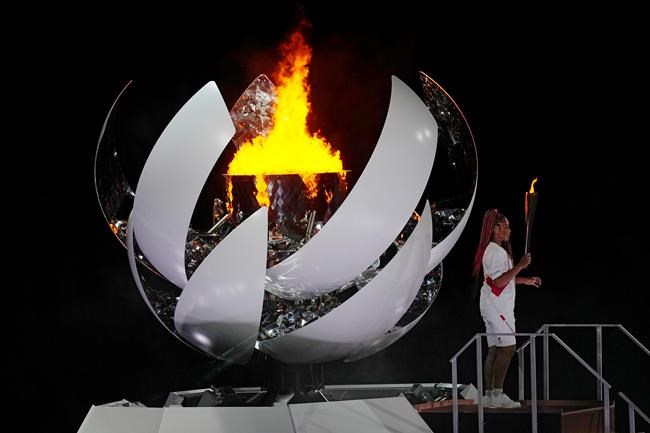
Naomi Osaka stands beside the Olympic flame after lighting it during the opening ceremony in the Olympic Stadium at the 2020 Summer Olympics, Friday, July 23, 2021, in Tokyo, Japan. (AP Photo/David J. Phillip)

Unlike propane, hydrogen does not produce carbon dioxide when combusted. The Tokyo cauldron is fueled by hydrogen produced by a factory in the Fukushima prefecture that runs on renewable energy. Propane and hydrogen were both used during the torch relay.

Organizers for the London Games in 2012 touted plans for a low-carbon torch but couldn’t get the design right in time. They instead used a mix of propane and butane. Brazilian officials commissioned a smaller cauldron for Rio in 2016 to reduce the amount of fuel needed.

The Tokyo cauldron was designed by Canadian architect Oki Sato. His sun-inspired orb unfolds like petals from a flower, which organizers say “embody vitality and hope.”

Tennis player Naomi Osaka lit the torch at 11:48 p.m., with performers from throughout the night’s ceremony holding sunflowers — famous for blooming toward the sun.

The first torch for these games was lit in Olympia, Greece, 16 months ago, but the relay was suspended for much of 2020 due to the pandemic. Officials put the torch on display at prefectures affected by the earthquake and tsunami that ravaged the region in 2011 until the relay was officially restarted in Fukushima on March 25, 2021.

Some stages of the relay were pulled off roads this month due to fears about spreading the coronavirus before the flame made its way to the National Stadium in Tokyo’s Shinjuku City.

___

More AP Olympics: https://apnews.com/hub/olympic-games and https://twitter.com/AP_Sports

Report Error Submit a Tip

More Stories

Spike in safety concerns doesn’t feel like harm reduction

Rebecca Chambers 4 minute read Preview

Spike in safety concerns doesn’t feel like harm reduction

Rebecca Chambers 4 minute read Yesterday at 5:39 PM CDT

It’s after dinner when a couple of young boys appear on my porch. I recognize them from the neighbourhood, but they’re not here to ask my kids to come out for a game of basketball. Instead, one asks, “Is it OK to come in for a little bit. There’s a guy out there and he’s scaring us.”

Read
Yesterday at 5:39 PM CDT

911 service restored after hours-long outage outside Winnipeg

Chris Kitching 6 minute read Preview

911 service restored after hours-long outage outside Winnipeg

Chris Kitching 6 minute read Updated: Yesterday at 6:25 PM CDT

Manitobans outside Winnipeg were unable to get through to 911 to request police, fire or ambulance service for hours Wednesday after a fibre optic line was severed.

Read
Updated: Yesterday at 6:25 PM CDT

Tokyo Olympic flame is the first powered by hydrogen

The Associated Press 2 minute read Preview

Tokyo Olympic flame is the first powered by hydrogen

The Associated Press 2 minute read Friday, Jul. 23, 2021

TOKYO (AP) — Inspired by the sun, the Tokyo Olympic cauldron is designed to be better for the planet.

The flame at Tokyo’s National Stadium and another cauldron burning along the waterfront near Tokyo Bay throughout the games will be sustained in part by hydrogen, the first time the fuel source will be used to power an Olympic fire.

Previous flames have usually run on propane, although magnesium, gunpowder, resin and olive oil have also been used since the first modern cauldron was lit for the Amsterdam Games in 1928. The torch relay was introduced eight years later for Berlin.

Unlike propane, hydrogen does not produce carbon dioxide when combusted. The Tokyo cauldron is fueled by hydrogen produced by a factory in the Fukushima prefecture that runs on renewable energy. Propane and hydrogen were both used during the torch relay.

Read
Friday, Jul. 23, 2021

Alberta-based UFA Co-op preps first cardlock, fuel hub in Manitoba

Gabrielle Piche 4 minute read Preview

Alberta-based UFA Co-op preps first cardlock, fuel hub in Manitoba

Gabrielle Piche 4 minute read Yesterday at 8:20 PM CDT

An Alberta-based co-op plans to open its first Manitoba gas station later this year.

UFA Co-operative Ltd. has circled Portage la Prairie for a cardlock and bulk petroleum site. Meanwhile, it’s analyzing the keystone province for future locations.

“There is more to come,” Fred Thun, UFA president, said Wednesday.

The co-op counts at least 121 petroleum stations across Alberta and Saskatchewan and 125,000 member-owners. It already ships fuel to bulk customers in Manitoba.

Read
Yesterday at 8:20 PM CDT

Puzzles Palace

1 minute read Monday, Jul. 13, 2026

To solve our puzzles, please subscribe with this special offer: |

Manitoba Mid-Amateur champ aided by seven-year-old son acting as caddy

Joshua Frey-Sam 5 minute read Preview

Manitoba Mid-Amateur champ aided by seven-year-old son acting as caddy

Joshua Frey-Sam 5 minute read Yesterday at 9:40 PM CDT

Doug Penner had the benefit of experience on his side, and yet it was his far less seasoned caddy whom he credited for helping him capture the Golf Manitoba Men’s Mid-Amateur Championship at Quarry Oaks on Wednesday.

The Steinbach local’s tournament-low seven-under 65 in the final round to win by a pair of strokes was aided by his seven-year-old son, Liam, whose young eyes helped his father read some tricky greens as they enjoyed a high-stakes day on the links together.

“Surprisingly, he calms me down, gets me into the zone and made some good reads,” said Penner, who grew up playing at Quarry Oaks and now golfs out of the Steinbach Fly-In. “He helped quite a bit. He’s only seven, but he’s into golf, and he knows the game, so very special having him on the bag.”

Penner began the day four strokes back of Evan Nachtigall, and that deficit quickly became five after he bogeyed the opening hole. That was the only blip in his round, as Penner poured in eight birdies on the ensuing 17 holes to finish the 54-hole tournament 12-under par (204), two shots clear of Nachtigall and David Spurr.

Read
Yesterday at 9:40 PM CDT