‘Cheering for the mammoth’: Scientists retrace the steps of 17,000 year-old animal
Advertisement
Read this article for free:
or
Already have an account? Log in here »
To continue reading, please subscribe:

Digital Subscription
One year of digital access for only $205*
- Enjoy unlimited reading on winnipegfreepress.com
- Read the E-Edition, our digital replica newspaper
- Access News Break, our award-winning app
- Play interactive puzzles
*First annual payment billed as $205.00 + GST for one year. This annual subscription will automatically renew at $233.00 + GST every 52 weeks (10% off the regular annual price of $259.35). Offer available to new and qualified returning subscribers only. Cancel any time.
To continue reading, please subscribe:
Add Free Press access to your Brandon Sun subscription for only an additional
$1 for the first 4 weeks*
- Enjoy unlimited reading on winnipegfreepress.com
- Read the E-Edition, our digital replica newspaper
- Access News Break, our award-winning app
- Play interactive puzzles
*Your next Brandon Sun subscription payment will increase by $1.00 and you will be charged $17.95 plus GST for four weeks. After four weeks, your payment will increase to $24.95 plus GST every four weeks.
Read unlimited articles for free today:
or
Already have an account? Log in here »
Hey there, time traveller!
This article was published 12/08/2021 (1887 days ago), so information in it may no longer be current.
More than 17,000 years ago, a woolly mammoth roamed enough of the Alaskan landscape to circle the Earth twice.
That’s according to a new paper from an international team of researchers who retraced the lifetime of one of the extinct ancient Arctic creatures.
The mammoth’s story is written in its tusk through tiny isotopes, which are tiny atoms, said Mat Wooller, a paleoecologist at the University of Alaska.
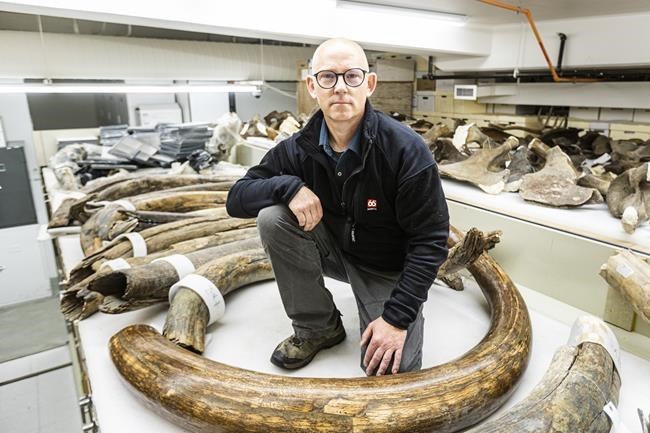
“Isotopes are like a little chemical GPS (global positioning system) recorder,” Wooller said.
Looking at the isotopes, researchers analyzed 400,000 microscopic data points in a two-metre long woolly mammoth tusk found in Alaska in 2018. They were able to determine the animal was a male who lived to be 28 years old, he said.
The way the tusk grows makes it easier to analyze, said Clement Bataille, a University of Ottawa researcher who also worked on the project.
Each year, new layers grow on the mammoth’s tusk, “as if we you were stacking a bunch of ice cream cones on top of each other,” he said.
The isotopes found in the mammoth’s tusk were matched with maps created by analyzing the teeth of hundreds of small rodents across Alaska. That data set was then used as a baseline to trace the mammoth’s movements across Alaska.
“It’s like a video game that helps us reconstruct the possible paths of the mammoth,” said Bataille.
“When the mammoth drinks water, the oxygen from this water is transmitted to its tissue and preserved because the tusk is constantly growing and reporting its diet and movements,” he added.
Bataille said his team was surprised to learn the mammoth’s movements shifted abruptly around the age of 15. Researchers think that’s likely when the animal was kicked out of its herd to head out on its own, the same way elephants treat their young.
During that time, the mammoth would sometimes travel 500 or more kilometres over a few months, Bataille said.
“There were some moments where he would just take off.”
The researchers learned that the mammoth had a much larger range than expected, covering most of Alaska in its lifetime. They also determined the mammoth had some favourite spots where he would stay put, such as river valleys and tundra plains where food was plentiful, said Bataille.
“At the end, you’re just staring at your computer, cheering for the mammoth,” he said. “It’s almost like being there with him on the landscape.”
The mammoth’s death at 28 is also a bit of a tragedy, Bataille said, because the animals were known to live into their 80s.
Battaille said its nitrogen isotopes spiked during the final winter of its life, which points to starvation.
Researchers still know very little about woolly mammoths, but the new data provides a baseline for the mammal to be studied more.
“We don’t know anything about mammoths. I had all this bias from my kids watching ‘Ice Age,'” Bataille said.
“Up until this point, we had very little information about how mammoths moved over the landscape,” added Wooller. “It’s a big technical leap forward.”
He said it’s only the beginning of the research into the life history of mammoths. He also wants to find out exactly why the creatures went extinct, a mystery that has puzzled scientists for a long time.
“That is a detective story that scientists have argued about for many years,” said Wooller.
The disappearance of mammoths in the past also raises questions about what other species are at risk of extinction now and in the future.
“The climate is changing very rapidly. The Arctic is changing. What in the ecology will influence extinction?” Bataille said.
This report by The Canadian Press was first published Aug. 12, 2021.
—
This story was produced with the financial assistance of the Facebook and Canadian Press News Fellowship.