EXPLAINER: How wildfire camps keep crews ready for battle
Advertisement
Read this article for free:
or
Already have an account? Log in here »
To continue reading, please subscribe:

Digital Subscription
One year of digital access for only $205*
- Enjoy unlimited reading on winnipegfreepress.com
- Read the E-Edition, our digital replica newspaper
- Access News Break, our award-winning app
- Play interactive puzzles
*First annual payment billed as $205.00 + GST for one year. This annual subscription will automatically renew at $233.00 + GST every 52 weeks (10% off the regular annual price of $259.35). Offer available to new and qualified returning subscribers only. Cancel any time.
To continue reading, please subscribe:
Add Free Press access to your Brandon Sun subscription for only an additional
$1 for the first 4 weeks*
- Enjoy unlimited reading on winnipegfreepress.com
- Read the E-Edition, our digital replica newspaper
- Access News Break, our award-winning app
- Play interactive puzzles
*Your next Brandon Sun subscription payment will increase by $1.00 and you will be charged $17.95 plus GST for four weeks. After four weeks, your payment will increase to $24.95 plus GST every four weeks.
Read unlimited articles for free today:
or
Already have an account? Log in here »
Hey there, time traveller!
This article was published 28/08/2021 (1844 days ago), so information in it may no longer be current.
BOISE, Idaho (AP) — Empty cow pastures on one day can be bustling with hundreds of firefighters the next as fire camps with colorful tent cities spring up.
More than 20,000 wildland firefighters are battling some 100 large wildfires in the U.S. West, and truckloads of supplies and equipment are needed to keep them effective at fighting flames for weeks on end.
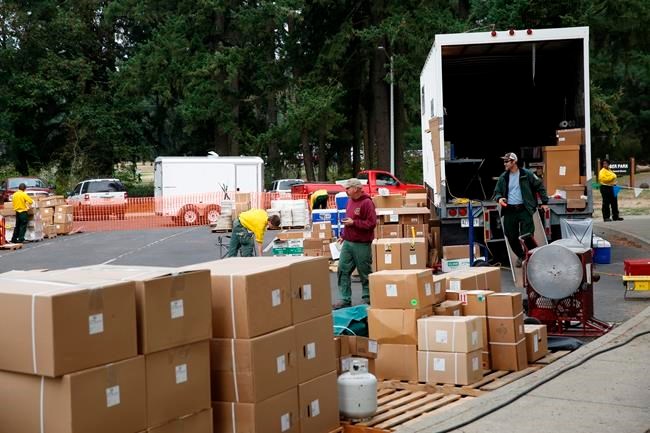
“We’ll set up a small village,” said Evans Kuo, a “Type 1” incident commander assigned to the nation’s biggest and most dangerous wildfires. His incident command team has 44 members. “The main idea of the camp is to not only house the incident command team, but also house the base camp that has food, water, sleeping and showers.”
___
HOW LARGE ARE FIRE CAMPS?
The size of each camp is determined by the size and complexity of the wildfire, with the largest blazes drawing more than 1,000 firefighters and support staff that are directed by Type 1 incident command teams.
U.S. Interior Department agencies, primarily the Bureau of Land Management, and the U.S. Forest Service supply firefighters, as do state agencies and tribes.
There also are Type 2 command teams on smaller and less complex blazes that draw from about 200 to 500 firefighters. Type 3 incidents may or may not have a fire camp.
More than 95% of all wildfires are put out quickly or within days by local firefighters, and are classified as Type 4 or 5. They typically don’t have fire camps.
Food caterers, semi-trailers with shower stalls and portable bathrooms are brought into large fire camps to make sure firefighters get enough food and a chance to wash off the dirt, ash and sweat.
“That’s a huge morale boost out on the line,” said Bubba Pugh, who has been fighting wildfires with the Idaho Department of Lands for about a decade. “Having the fire camp helps us get the job done.”
___
WHO’S IN CHARGE OF A FIRE CAMP?
An incident commander with decades of firefighting experience runs the show, plotting short-term and long-term strategy that’s recalibrated daily. Fire camp responsibilities are separated into divisions that include planning, logistics, communications, medical and even security.
Large fires will also have an air operations branch to coordinate fire retardant drops by jets or other aircraft, as well as water drops by helicopters. Some camps will also have a person in charge of night operations, when firefighters can make good progress.
Public information officers help inform area residents through social media and news outlets. They also work with law enforcement officials on evacuations and road closures.
While fire camps are hierarchical, the system includes an outlet for firefighters to anonymously report safety concerns to an employee relations person at a camp or online.
Camps also include someone tracking the overall cost of fighting the fire, which can run into the millions of dollars. The federal government spent $2.3 billion fighting wildfires last year, a number that’s expected to grow significantly this year.
___
WHERE ARE FIRE CAMPS LOCATED?
Kuo said schools make good fire camps because they have electricity and internet access, something that has become increasingly important in fighting fires. Information can be distributed to firefighters on smartphones using code scanners.
Firefighters bring their own tents, and can set up on athletic fields or, if in more remote areas, anywhere from meadows to cow pastures.
“Sometimes we don’t get the most luxurious fields to sleep in,” Pugh said. “But find a nice, flat piece of ground, and just expect to be there for the duration.”
Communication in remote locations is mainly done through handheld radios. Communications teams put repeaters — devices that receive radio signals and retransmit them — on ridgetops so commanders can communicate with firefighters in the field.
The National Interagency Fire Center in Boise has the largest store of handheld radios outside the U.S. Department of Defense. Center spokeswoman Jessica Gardetto said most of the center’s radios, about 23,000, are at large wildfires. All radios are not in use at the same time as they need to be charged.
Remote command posts are often operated from yurts, or office trailers, with different divisions having their own workspace.
Large fires also often have satellite camps to save time because it can take hours to drive from a command post to other areas of the fire.
___
HOW AND WHEN IS FOOD SERVED?
Firefighters get three calorie-heavy meals a day and snacks to keep them fueled for the physically intensive work.
Before the coronavirus pandemic, firefighters gathered in chow halls in the morning and evening, enjoying the camaraderie of the job while away from the fire line. Now, firefighters disperse to eat their meals, sometimes going back to their tents or finding a tree to sit under. Lunch is typically a bag lunch eaten in the field.
At satellite camps, pre-cooked food is flown to them.
___
WHAT’S THE PLAN?
Type 1 and Type 2 incident command teams each day produce an incident action plan that spells out goals and responsibilities, typically looking four days ahead. Each day the plan is recalibrated based on a variety of factors, chief among them weather. The plan is typically 12 to 20 pages long, and is made available as a PDF so it can be viewed on smartphones or other devices.
Kuo gets up at 5 a.m. to prepare for the 6 a.m. morning briefing, which is followed by other briefings and planning sessions during the day that lasts to 10 p.m.
“Somewhere in there you try to grab some food,” he said.
Most firefighters have been on the job for months, and will likely be needed for more than another month as some fires are expected to burn well into September.
“There is some burnout factor,” Kuo said, summing up the current atmosphere among firefighters. “But this is what we signed up for, so you dig deep and get through it.”