

‘Gasps all around:’ New Burgess Shale fossil sheds light on the evolution of bigness
Advertisement
Read this article for free:
or
Already have an account? Log in here »
To continue reading, please subscribe:
Monthly Digital Subscription
$0 for the first 4 weeks*
- Enjoy unlimited reading on winnipegfreepress.com
- Read the E-Edition, our digital replica newspaper
- Access News Break, our award-winning app
- Play interactive puzzles
*No charge for 4 weeks then price increases to the regular rate of $19.95 plus GST every four weeks. Offer available to new and qualified returning subscribers only. Cancel any time.
Monthly Digital Subscription
$4.99/week*
- Enjoy unlimited reading on winnipegfreepress.com
- Read the E-Edition, our digital replica newspaper
- Access News Break, our award-winning app
- Play interactive puzzles
*Billed as $19.95 plus GST every four weeks. Cancel any time.
To continue reading, please subscribe:
Add Free Press access to your Brandon Sun subscription for only an additional
$1 for the first 4 weeks*
*Your next subscription payment will increase by $1.00 and you will be charged $16.99 plus GST for four weeks. After four weeks, your payment will increase to $23.99 plus GST every four weeks.
Read unlimited articles for free today:
or
Already have an account? Log in here »
Hey there, time traveller!
This article was published 08/09/2021 (1578 days ago), so information in it may no longer be current.
It was getting late and the team of paleontologists excavating a previously unexplored outcrop of the Burgess Shale was ready to call it a day. A camera crew filming the dig in Kootenay National Park had already packed it in.
Then one of the team members split open a large plate of shale.
“I just remember the gasps all around,” said Joe Moysiuk of the Royal Ontario Museum.
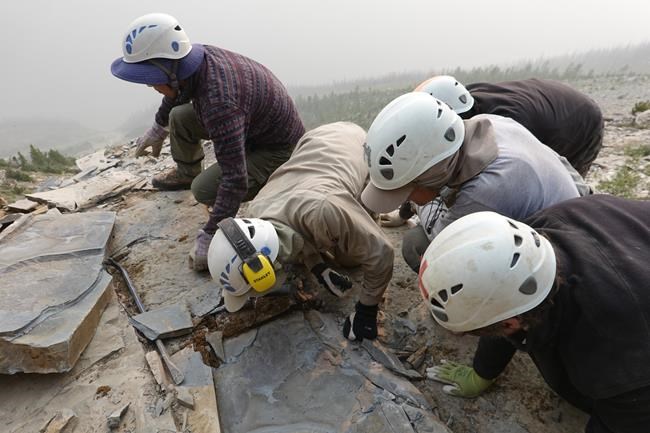
“Everyone was running to come and see what had been found. It was clearly a new animal.”
What that 2018 dig revealed was something that stood out even in the bizarre world of the Burgess Shale, an outcrop of 500-million-year-old rocks in the Canadian Rockies of British Columbia that is chock-a-block with fossils from the earliest days of complex life on Earth.
Most of those fossils are little-finger size. Not this one.
“We uncovered this huge carapace,” Moysiuk recalled.
“The whole animal must be at least 50 centimetres long. This is definitely one of the largest animals that we know of from the Cambrian period.”
Titanokorys gainesi hails from a time that predated life on land, when the seas were a giant laboratory for evolution to work out answers that plants and animals still use today. Spinal chords, eyes, exoskeletons — they all first appear in the Cambrian.
“All of the major animal body plans first evolved then,” Moysiuk said.
“We see the first representatives of things that looked like fish, things that looked like insects and crabs. Any other animal you might dream up, it most likely had some relative from the Cambrian period.”
Not that Titanokorys would look remotely familiar.
“These things are very alien-looking,” said Moysiuk.
The whole beastie was flattish and oblong, with gill slits toward the back, a horseshoe-shaped plate protecting its head and armoured plates underneath. Its eyes, halfway back along the body, would probably have been on stalks. It had claws out front with rake-like outgrowths.
A predator, it probably cruised the sea bottom looking for whatever tasty bits it could sweep into its mouth.
“The mouth itself is really cool,” Moysiuk said. “It looks like a pineapple slice that’s lined with these sharp, inward-pointing teeth.”
Burgess Shale fossils are renowned not only for their age, but for their preservation. Soft body parts such as eyes are often visible. A critter’s last meal is sometimes preserved in the rock.
Even for the Burgess, Titanokorys is well-preserved.
“We have relatively complete remains,” said Moysiuk. “These fossils are very rare.”

The fossil, he said, will allow paleontologists to study some of evolution’s most basic questions. Why, for example, do some animals get big and others don’t?
“It seems to be related to this evolutionary arms race that was happening during the Cambrian where you have bigger and bigger animals that are trying to outdo each other in size,” Moysiuk said. “As a predator, it benefits you to be pretty big.”
But whatever eventually comes from the study of Titanokorys, Moysiuk said nothing will match the thrill of seeing its fossil emerge after hundreds of millions of years from the dark shale of the Burgess.
“It was one of those moments I’ll never forget.”
This report by The Canadian Press was first published Sept. 8, 2021.