“Major cities really matter”: Mayors demand climate action

Advertisement

Advertise with us

GLASGOW, Scotland (AP) — On a train hurtling toward Glasgow, the mayors of Seattle and Freetown, Sierra Leone, greeted each other like long lost sisters, bonded by years of Zoom calls and collaboration in the fight against climate change.

Read this article for free:


or

Already have an account? Log in here »

To continue reading, please subscribe:

Subscribe and receive a limited-edition Free Press branded hat or tote.

Digital Subscription

One year of digital access for only $205*

  • Enjoy unlimited reading on winnipegfreepress.com
  • Read the E-Edition, our digital replica newspaper
  • Access News Break, our award-winning app
  • Play interactive puzzles

*First annual payment billed as $205.00 + GST for one year. This annual subscription will automatically renew at $233.00 + GST every 52 weeks (10% off the regular annual price of $259.35). Offer available to new and qualified returning subscribers only. Cancel any time.

To continue reading, please subscribe:

Add Free Press access to your Brandon Sun subscription for only an additional

$1 for the first 4 weeks*

  • Enjoy unlimited reading on winnipegfreepress.com
  • Read the E-Edition, our digital replica newspaper
  • Access News Break, our award-winning app
  • Play interactive puzzles
Start now

*Your next Brandon Sun subscription payment will increase by $1.00 and you will be charged $17.95 plus GST for four weeks. After four weeks, your payment will increase to $24.95 plus GST every four weeks.

Hey there, time traveller!
This article was published 02/11/2021 (1789 days ago), so information in it may no longer be current.

GLASGOW, Scotland (AP) — On a train hurtling toward Glasgow, the mayors of Seattle and Freetown, Sierra Leone, greeted each other like long lost sisters, bonded by years of Zoom calls and collaboration in the fight against climate change.

They lead cities on different sides of the economic and climate divide — one in the cool, northwestern corner of the one of the world’s richest nations; the other the capital of an impoverished country in the tropics of West Africa.

But Seattle Mayor Jenny Durkan and her Freetown counterpart, Yvonne Aki-Sawyerr, are both on the front lines of global warming, working to ensure their cities are prepared for rising sea levels, torrential rains and extreme heat.
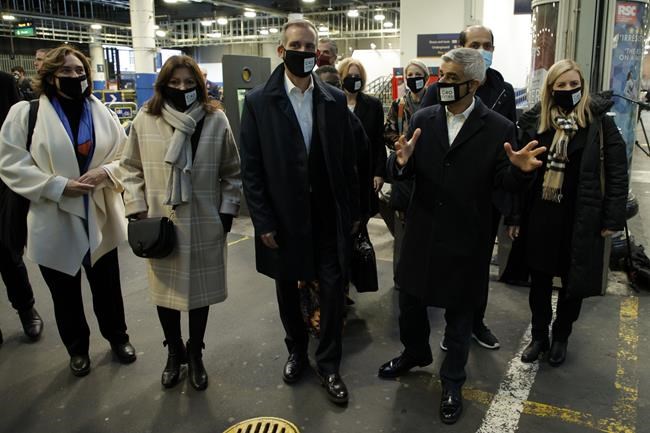
Mayor of London Sadiq Khan gestures leads a delegation of mayors, including Mayor of Paris Anne Hidalgo, second left, from the cities of Athens, Stockholm, North Dhaka, Phoenix, Los Angeles, Seattle, Paris, Freetown, Oslo, Rio de Janeiro and Barcelona onto a train taking them to the COP26 U.N. Climate Summit in Glasgow from Euston Station in London, Monday, Nov. 1, 2021. (AP Photo/David Cliff)

On Monday, they traveled to the U.N. climate conference in Scotland with a group of big city mayors to demand that world leaders follow the science and act now to head off a catastrophic increase in global temperatures.

Aki-Sawyerr describes herself and mayors as the captains of small boats trying to warn an ocean liner of the dangers ahead.

“I’m going to stand on top of the bow and I’ll be waving my hands furiously and I’m going to be saying, ‘Look over here, you’re hitting an iceberg and you need to stop now,’” she said. “And I’m hoping that there’ll be enough of us doing the same thing for it to make a difference.”

Aki-Sawyerr and Durkan are part of a delegation from the C40 group of big city mayors who are demanding that they be included in decisions about how to combat global warming and mitigate its effects. City leaders will be asked to implement many of the decisions made by presidents and prime ministers, so they should be consulted and receive funds to do the job, the group says.

The delegation also included the mayors of Los Angeles, Paris and London, as well as the Nordic cities of Oslo and Stockholm, and North Dhaka in Bangladesh.

The mayors sought to underscore their environmental credentials by making the 645-kilometer (400-mile) journey from London to Glasgow by rail. The electric train they traveled on generates about seven times less greenhouse gas emissions per passenger than flying.

Together, the C40 group’s 97 members are home to more than 700 million people, or almost 10% of the world’s population. Their organization also tries to help local communities, backing a program in which over 1,000 communities supported a campaign for a “net-zero” emissions future.

The mayors aren’t alone in saying that cities will play a big part in the fight against climate change.

More than half the world’s population now live in urban areas, and the trend is only going to continue. Despite the economic shock caused by COVID-19, cities are still seen as gateways to a better life because density and diversity lead to creativity and innovation, said Bernice Lee, director of futures at Chatham House think tank in London.

“Crucially, around 80% of emissions come from the planet’s cities, so they really have to be part of the solutions, and decisions made in major cities really matter,’’ Lee said. “They can be great environments for both testing and piloting the next generation of solutions.”

The U.N. climate conference, known as COP26, comes just two months after an international panel of climate scientists said time was running out to meet the goal of limiting global temperature increases to 1.5 degrees Celsius (2.7 degrees Fahrenheit) and avert catastrophic climate change. While organizers say Glasgow is the last best chance for an agreement to slash greenhouse gas emissions, some world leaders, including Presidents Xi Jinping of China and Vladimir Putin of Russia, have decided not to attend.

China is the world’s biggest emitter of greenhouse gas emissions, followed by the U.S., the European Union, India and Russia, according to the International Energy Agency.

Freetown is already seeing the impacts as a changing economy collides with global warming.

Increased migration from the countryside is forcing people to build informal settlements near coastal mangroves and on hillsides around the city, which destroys forests and worsens floods during heavy rains. More than 1,000 people were killed by a mudslide in 2017.

In response, the city is planting trees and working to improve sanitation and flood mitigation projects, Aki-Sawyerr told the U.N. Environment Program. One program gave tricycles to youth groups who collect household waste, which is then composted and returned to urban farmers.

“There are billions of people in the global south for whom climate change impacts are happening today. Now. Those livelihoods are being destroyed,’’ Aki-Sawyerr said. “These are the smaller, smaller emitters … and yet the consequences are dire.’’

But the fight against climate change is also taking place 6,700 miles (10,800 kilometers) away in Seattle.

Temperatures in Seattle, known for cloudy skies and drizzling rain, rose above 100 F (38 C) on three consecutive days in June as a mass of hot air sat over the western U.S. and Canada. On June 28, the temperature reached 108 degrees F (42 C), the highest in 151 years of detailed record-keeping.

The state of Washington recorded 138 heat-related deaths this summer compared with seven the previous year.

While scientists are hesitant to link any single weather event to global warming, Seattle officials are preparing for rising sea levels, higher tides and more frequent and longer-lasting heat waves.

Seattle maintained its commitment to the Paris Climate Accord after former U.S. President Donald Trump pulled out of the deal. The city promotes public transportation, cycling and walking as alternatives to solo car journeys and is working to increase energy efficiency in public and private buildings.

“Mayors are the front line in their cities for everything from who picked up the garbage or didn’t,” Durkan said. “Policy at the national level and central government level — their biggest challenge is how to implement it? What does that mean? Boots on the ground? Our first thought is, how do you implement and what does it mean to real people?”

___

Follow AP’s climate coverage at https://apnews.com/hub/climate

Report Error Submit a Tip

More Stories

Public versus private schooling

John R. Wiens 5 minute read 2:01 AM CDT

A Recent Maggie Macintosh piece (Enrolment up at alternative schools, Sept. 7) and several letters to the editor touted the benefits and values of private schooling. The executive director of the Manitoba Federation of Independent Schools, Andrew Micklefield, emphasized schools of choice and governmental cost-saving. A private, formerly public, schoolteacher emphasized finances, academics and parental support.

None are wrong in their arguments, but they are missing the main reasons for the existence of public schools, which has less to do with money and academics than with inclusion and equality. Nor do they adequately acknowledge the downsides of exclusion and elitism fostered by some aspects of choice and inequality. The increase in numbers of private schools and their attendees is a cause for some public concern.

Micklefield’s assertion is that private schools save the government money. Letter-writer Paulo Borges intimates he saves the province $52,500 ($15,000 each for three home-schooled children and $7500 for one private-school tuition), further suggesting that the savings are not used wisely by governments in supporting public schools.

In the front-page article, Micklefield and others go further to suggest that the main reason parents choose private schools is to receive an education in a Christian setting. That is a very limited rationale and certainly does not include the much larger variety of reasons why people choose private schooling or an even more restricted version of schools of choice, home schooling.

Time for the PUB to review Winnipeg water rates

Editorial 4 minute read Preview

Time for the PUB to review Winnipeg water rates

Editorial 4 minute read 2:01 AM CDT

We take you now to just over a month ago, to the Public Utilities Board and its decision about water and sewer rates for Russell, Binscarth, Angusville, Rossburn and Gambler First Nation.

Why? Just wait.

The area is supplied with water and sewage services by the Russell-Binscarth Water and Wastewater Utility, which has a total of 1,014 customers.

As the PUB noted in an Aug. 27, 2026 order on the utility’s rates, “The [water treatment plant] gets water from two groundwater wells that were upgraded in 2016 and the raw water main was installed in 1984. The water distribution system is primarily cast iron pipe. The raw water line will need to be upgraded in the near future to keep up with demand.”

Read
2:01 AM CDT

How confusing; seems there’s more than one candidate in Hanover named Shayne Barkman

Dan Lett 5 minute read Preview

How confusing; seems there’s more than one candidate in Hanover named Shayne Barkman

Dan Lett 5 minute read Thursday, Sep. 24, 2026

It’s not entirely clear when or why Hanover trustee Shayne Barkman became one of Manitoba’s best-known anti-LGBTTQ+ crusaders.

Back in 2022, when he ran as a candidate for Hanover school board for the first time, there was nary a hint that socially conservative culture wars were going to be a large part of his identity as an elected official.

In a Steinbach Online profile published before the 2022 municipal elections, Barkman highlighted his background as a successful farmer. He said he was entering politics to be a “listening ear” who could promote understanding.

“I would love to kind of just be a voice of reason amongst all the problems coming down the pipe,” Barkman said

Read
Thursday, Sep. 24, 2026

Husband of rival sex club owner accused in attempted bathhouse bombing

Morgan Modjeski 4 minute read Preview

Husband of rival sex club owner accused in attempted bathhouse bombing

Morgan Modjeski 4 minute read Thursday, Sep. 24, 2026

A Winnipeg bathhouse owner says he was shocked to learn the man accused of planting a pipe bomb outside his business is married to the owner of a competing sex and lifestyle club.

Christopher Gregoire, who recently took ownership of AQ Sauna, said a live pipe bomb was found by a “heroic patron” outside the club, formerly known as Aquarius Bath House, in the early morning hours of Sept. 11.

On Thursday, the Winnipeg Police Service announced Erik Lymen Olson, 59, was facing multiple charges in the incident. Olson is the husband of Adonis Men’s Spa owner Doug Pomanski.

“This is wild,” Gregoire said after learning of the charges.

Read
Thursday, Sep. 24, 2026

WSO kicks off season pairing Beethoven, Tchaikovsky

Conrad Sweatman 5 minute read Preview

WSO kicks off season pairing Beethoven, Tchaikovsky

Conrad Sweatman 5 minute read 2:01 AM CDT

French fries and milkshake, watermelon and feta cheese … Beethoven’s Fifth and Tchaikovsky’s Fifth?

Few events mark the beginning of the classical concert season like the Winnipeg Symphony Orchestra’s season-opener and this year they kick things off with an unusual but satisfying pairing.

“I think that for me, the combination of these two pieces is, first of all, a celebration of great masterworks that have withstood 100 years of being probed by time for their relevancy,” says conductor Daniel Raiskin, the WSO’s music director. “It’s the quality of music, it’s the quality of narrative that attracts us to these masterworks again and again.”

Both symphonies are so hefty and canonical, one might have expected half of the concert would be devoted to a concerto, tone poem or something smaller or lesser known.

Read
2:01 AM CDT

New series terrific addition to RWB repertoire

Holly Harris 5 minute read Preview

New series terrific addition to RWB repertoire

Holly Harris 5 minute read 2:01 AM CDT

‘See the music, hear the dance,” is a famous quote from quintessential ballet influencer George Balanchine, whose pithy bons mots have defined much of American classical dance since the legendary Russian-born choreographer first blazed a trail with the New York City Ballet.

Local balletomanes were given a golden opportunity to experience both up-close-and-personal Thursday when the Royal Winnipeg Ballet officially kicked off its 87th season with its newly minted Studio Series, which runs until Sunday.

The brainchild of the company’s artistic director, Christopher Stowell, the series features an abridged “concert version” of Balanchine’s seminal Who Cares?, set to a playlist of catchy George Gershwin tunes that make up the backbone of the Great American Songbook.

The Studio Series is the latest initiative taken by Stowell as he settles into his arguably still new position. Some of those endeavours will invariably stumble; others will hit their mark. This venture belongs in the latter category, bringing a 500-plus-year-old art form, often perceived as rarified, to audience members who may be hesitant, shy or just plain intimidated to visit the cavernous Centennial Concert Hall.

Read
2:01 AM CDT