Elon Musk, an erratic visionary, revels in contradiction
Advertisement
Read this article for free:
or
Already have an account? Log in here »
To continue reading, please subscribe:

Digital Subscription
One year of digital access for only $205*
- Enjoy unlimited reading on winnipegfreepress.com
- Read the E-Edition, our digital replica newspaper
- Access News Break, our award-winning app
- Play interactive puzzles
*First annual payment billed as $205.00 + GST for one year. This annual subscription will automatically renew at $233.00 + GST every 52 weeks (10% off the regular annual price of $259.35). Offer available to new and qualified returning subscribers only. Cancel any time.
To continue reading, please subscribe:
Add Free Press access to your Brandon Sun subscription for only an additional
$1 for the first 4 weeks*
- Enjoy unlimited reading on winnipegfreepress.com
- Read the E-Edition, our digital replica newspaper
- Access News Break, our award-winning app
- Play interactive puzzles
*Your next Brandon Sun subscription payment will increase by $1.00 and you will be charged $17.95 plus GST for four weeks. After four weeks, your payment will increase to $24.95 plus GST every four weeks.
Read unlimited articles for free today:
or
Already have an account? Log in here »
Hey there, time traveller!
This article was published 11/05/2022 (1582 days ago), so information in it may no longer be current.
As the uproar over Elon Musk’s $44 billion buyout of Twitter reaches a crescendo, another Musk drama, still chaotic four years after it began, has been back in court.
Ironically, that spectacle started with a Musk tweet about doing an audacious deal. Then, with Wall Street awaiting his next move, the Tesla CEO changed directions, admitting that his plan to buy all the electric car maker’s stock might be too much trouble. As regulators prepared to sue the billionaire for defrauding investors, he pondered his position in the corporate universe in a livestreamed interview while puffing on pot.
The episode made for a confounding, but now familiar, study in both Musk’s manic ambition and his delight in contradiction.
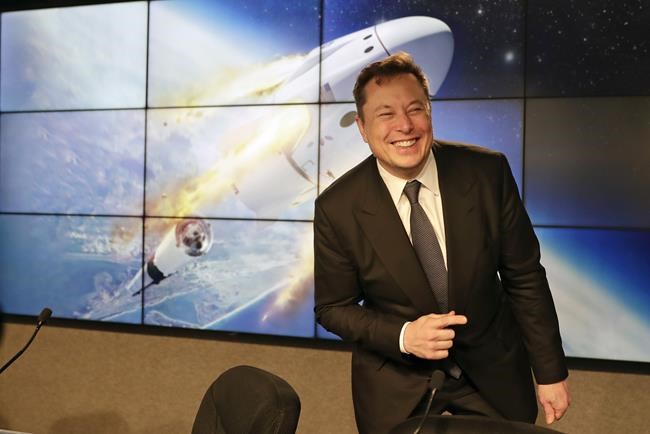
It’s no wonder then that, as the world’s richest man pursues a Twitter takeover described by one investment firm as veering “from comical to surreal,” even those who’ve watched him for years remain flummoxed about what he has up his sleeve.
“This is a guy who’s more transparent than 99.99 percent of other CEOs and yet he’s harder to predict because he has the confidence to be able to publicly change his mind,” said Erik Gordon, a University of Michigan business and law professor.
“Would Musk be more successful if he toned it down? I think the answer is no, because he wouldn’t be Musk.”
This week Musk is again keeping people guessing. First he embraced a European measure to keep hate speech and misinformation off social media. Less than 24 hours later, he announced that he’d reverse Twitter’s ban of former President Donald Trump, who was kicked off the platform for inciting violence.
Meanwhile, doubt remains about whether Musk will even go through with the deal. He could still walk away by paying Twitter a $1 billion termination fee, a huge figure yet a fraction of his total fortune.
But if the 50-year-old Musk’s gambit has made anything clear it’s that he thrives on contradiction.
Musk boasts that he’s acquiring Twitter to defend freedom of speech. But he has long used the platform to attack perceived foes who dare to disagree with him.
He is supremely confident in his own judgment and abilities. But he has openly acknowledged vulnerabilities, disclosing his angst over a breakup in a 2017 interview with Rolling Stone and telling a Saturday Night Live audience last year that he was the show’s first host with Asperger’s syndrome.
He’s a brilliant visionary, widely admired for reimagining what a car can be, not to mention his ventures in rocket travel, solar energy, computerized brain implants and constructing a network of underground tunnels.
But his apparent joy in trashing the conventions of corporate behavior has alienated analysts, regulators, employees and others unsure what to make of him.
Even Musk seems to get that many people don’t get him.
“I don’t think you’d necessarily want to be me,” he told podcaster Joe Rogan in the 2018 interview during which the CEO, wearing an “Occupy Mars” T-shirt, took a drag on a blunt stuffed with tobacco and marijuana.
“I think people wouldn’t like it that much. It’s very hard to turn it off.”
That combination of intellect, will and the power of enormous wealth thrill some and scare others. Either way, Musk — whose 92 million followers on Twitter rivals uber celebrities like Taylor Swift and Lady Gaga — is impossible to ignore.
“He’s the poster child for disruption,” said Benjamin Breier, the former CEO of Kindred Health Care and author of a book about unconventional corporate leadership.
Born in South Africa, Musk has been something of an outlier since childhood, teaching himself computer programming at 10, according to a 2015 biography by journalist Ashlee Vance. Two years later he pocketed $500 from the sale of a video game he created that had users shoot down alien spacecraft.
He left Pretoria at 16 for his mother’s native Canada before moving to the U.S. on a student visa. At 24 he dropped out of Stanford after two days in its Ph.D. physics program to try his luck in the 1990s dot-com boom.
Together with brother Kimbal, he launched Zip2, an online business directory. Short on cash, Musk did all the coding, squatting in a small office whose landlord was out of the country. The brothers slept on a futon in turn, showering at a YMCA and living on food from a 24-hour Jack-in-the-Box, they told a group of admirers during a 2020 discussion available on YouTube.
A year later, a venture capital firm agreed to back the business and eventually Zip2 was sold to Compaq for $307 million.
Musk used his share of the profits to found what would become the PayPal online payment business. That sold to eBay in 2002 for $1.5 billion.
“After that, he thought, well, should he do space research or solar energy or electric cars?” his mother, Maye Musk, recalled during a 2021 appearance on CBS This Morning. “I said just choose one, and of course he didn’t listen to me.”
Musk, fascinated by rockets since childhood, founded Space Exploration Technologies, better known as SpaceX, to develop cost-effective reusable rockets. Two years later he was courted to invest in a startup called Tesla.
But he soon clashed with co-founder Martin Eberhard, who recalls Musk as craving attention and anxious to claim credit as a visionary.
“Every time there was an article that didn’t feature him, he blew a gasket,” Eberhard, who sued Musk and Tesla after he was ousted from the CEO’s post, said during a 2018 interview with the AP. “As you can see from his personality right now, he’s very interested in the limelight.”
On Twitter, Musk recently called Eberhard a “liar.”
As Tesla’s chairman, Musk could be incredibly demanding, pushing employees to meet goals many considered impossible, said Gene Berdichevsky, the battery engineer on the company’s first production vehicle. Some ideas failed despite exhaustive efforts. But those that proved correct ended up “changing the world,” he said.
Musk is likely to be just as unrelenting at Twitter, said Berdichevsky, who now leads a company developing new types of battery chemistry.
“There will be immense pressure on the management team,” he said. “They will be asked to do things that they don’t necessarily think are reasonable. Some of them will not be reasonable and others will completely transform things.”
Keith Rabois, a venture capitalist who worked with Musk at PayPal, said such idiosyncrasies are not unusual among people whose ideas upend the status quo.
“Elon on his worst day is probably 100 times more effective than anybody else in America,” Rabois said in a 2018 interview with AP.
Musk’s creative energy, though, is intertwined with a penchant for erratic behavior.
That was spotlighted in 2018, as Tesla struggled to ramp up production of its Model 3 sedan. Inside its California factory, Musk berated engineers for delays and defects before acknowledging that his overreliance on automation was the source of many of the problems.
Meanwhile, he scolded analysts for asking “boring, bonehead questions” about Tesla’s ability to deliver.

Then Musk tweeted out of the blue that he was considering taking Tesla private and had secured the financing.
Tesla’s stock soared before he backtracked and the Securities and Exchange Commission sued him for defrauding investors. Musk and Tesla ended up paying fines of $20 million each and agreeing that any tweets potentially affecting the stock price be reviewed by a Tesla lawyer.
Musk dismisses the fine, but bridles at the restriction. Late last month a federal judge rejected his contention that the settlement violates his right to free speech.
The prolonged battle with the SEC reflects Musk’s disdain for public officials who challenge him.
In 2020 he tangled with health officials who limited staffing at the California factory to prevent the spread of COVID, calling stay-at-home orders “fascist.” This year he clashed with the National Highway Traffic Safety Administration over a recall of so-called “Full Self-Driving” vehicles programmed to roll through stop signs at low speed if there was no crossing traffic.
Lawyers answering to Musk have lashed out at California officials, painting them as bullies for a lawsuit accusing Tesla of rampant racial discrimination at its plant.
Musk seems to relish taunting regulators, calling the SEC the “Shortseller Enrichment Commission” — and worse.
“You have a guy who probably has an unmeasurable IQ and who also is a little bit of a fifth grader who says something in class that he knows will get him sent to the principal’s office,” and delights in doing so, said Gordon, the Michigan professor.
But the pushback against the SEC is about more than ego. It also spotlights the way Musk has latched on to Twitter to express his personal and corporate identity.
Musk, whose account has the sixth-highest number of followers, has posted more than 17,000 times, according to Socialtracker, often long after the workday is over. He’s suggested that some of those tweets are composed under the influence of red wine, vintage records and the sleeping pill Ambien.
“Some people use their hair to express themselves,” he’s said. “I use Twitter.”
Musk and his fans, though, also use the platform to go after those seen as adversaries. Days before agreeing to buy Twitter, Musk tweeted a photo of Microsoft co-founder Bill Gates, using a crude sexual term to make fun of his belly. That was relatively mild.
A San Francisco short seller who questioned Musk’s leadership of Tesla has alleged that the CEO and one of his acolytes, Omar Qazi, were responsible for a series of tweets insulting him and falsely asserting he had been arrested for child abduction. The diatribes were part of a campaign of 80,000 coordinated tweets “praising Tesla and attacking its critics,” according to the lawsuit filed by investor Aaron Greenspan, who runs a legal document website.
Qazi called the allegations “absurd,” in an email. In court papers, Tesla lawyers have dismissed the charges of a Musk-led Twitter mob as conspiracy theories. But a recent Musk tweet critical of a top Twitter executive was followed by a flood of racist and misogynistic attacks by trolls backing the CEO.
Musk did not respond to an interview request for this story. But speaking briefly with AP at New York’s Met Gala, he reiterated his pledge to rid Twitter of spam bots and trolls spreading junk messages online.
“That’s obviously diminishing the user experience,” Musk said. “I’m on the warpath, so if somebody is operating a bot and troll army, then I’m definitely their enemy.”
But a University of Maryland researcher recently concluded that such bots have been used to generate hundreds of thousands of positive tweets about Tesla, potentially buoying its stock in years when it was under pressure.
Neither the company nor its supporters has taken responsibility for those bots. But Musk has said that for real people who use Twitter, most anything is fair game.
“Twitter’s a war zone,” he said in a 2018 interview with 60 Minutes. “If somebody’s gonna jump in the warzone, it’s like, “Okay, you’re in the arena. Let’s go.”
Statements like that raise numerous questions about how Twitter would change with him in charge.
Musk, worth about $240 billion, appears to believe that pressure to produce profits is responsible for Twitter’s efforts to curb hateful speech and misinformation that alienate advertisers.
As a private company, Twitter would answer only to Musk and the targets he sets, focusing less on profit and instead on opening itself to more voices, said Eric Talley, a Columbia Law School professor specializing in corporate finance.
That sounds to many like a worthy idea. But Twitter’s reliance on advertising was the impetus for its efforts to detect and cap extremism and misinformation, said Angelo Carusone of Media Matters, a watchdog group.
Without that pressure, Musk seems set on reshaping a platform he says has shifted too far left after banishing Trump and others.
But for all Musk’s confidence, he risks running afoul of Apple and Google, which power most of the world’s smartphones. Both have stringent policies against misinformation, hate speech and other misconduct, previously enforced to boot apps like the social media platform Parler from their devices.

“This could turn into one of those moments where you have an unstoppable force coming up against two immovable objects,” said Carusone, who admitted concern about how the tech giants might apply their standards.
Musk, who waxes about preserving Twitter as the public square of the internet, hasn’t addressed what he’d do if his efforts to open it to more voices wind up jeopardizing its accessibility.
Then again, the billionaire has never been one to shy away from a contradiction.
___
AP writer Barbara Ortutay contributed to this report from San Francisco. Krisher reported from Detroit; Liedtke from San Francisco.