No reported damage in Philippines from Chinese rocket debris
Advertisement
Read this article for free:
or
Already have an account? Log in here »
To continue reading, please subscribe:
Digital Subscription
One year of digital access for only $1.44 a week*
- Enjoy unlimited reading on winnipegfreepress.com
- Read the E-Edition, our digital replica newspaper
- Access News Break, our award-winning app
- Play interactive puzzles
*Billed as $5.77 plus GST every four weeks. After 52 weeks, price increases to the regular rate of $19.95 plus GST every four weeks. Offer available to new and qualified returning subscribers only. Cancel any time.
To continue reading, please subscribe:
Add Free Press access to your Brandon Sun subscription for only an additional
$1 for the first 4 weeks*
- Enjoy unlimited reading on winnipegfreepress.com
- Read the E-Edition, our digital replica newspaper
- Access News Break, our award-winning app
- Play interactive puzzles
*Your next Brandon Sun subscription payment will increase by $1.00 and you will be charged $17.95 plus GST for four weeks. After four weeks, your payment will increase to $24.95 plus GST every four weeks.
Read unlimited articles for free today:
or
Already have an account? Log in here »
Hey there, time traveller!
This article was published 31/07/2022 (1540 days ago), so information in it may no longer be current.
MANILA, Philippines (AP) — There was no reported damage in a western Philippine region where debris from a rocket that boosted part of China’s new space station reportedly fell, a Filipino official said Monday.
Philippine Space Agency official Marc Talampas said authorities have been advised to be on the lookout for the rocket debris, which may have splashed down into seawaters off Palawan province.
“We are monitoring the situation and have also issued an advisory to the public to be vigilant, avoid contact with any suspected floating debris and to report to local authorities immediately,” Talampas told The Associated Press.
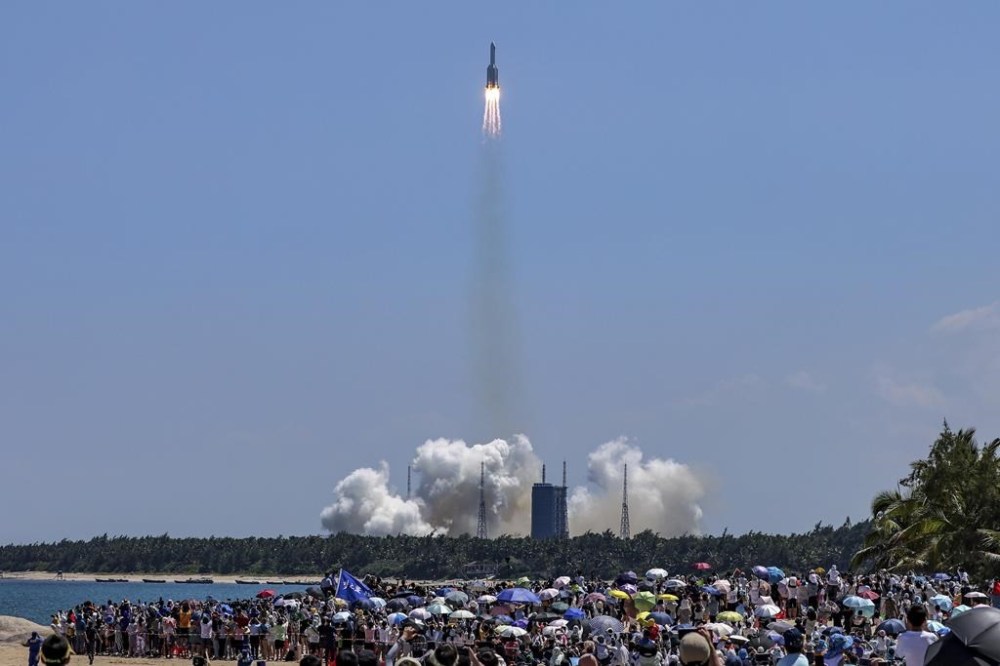
The China Manned Space Agency reported Sunday that most of the final stage of the Long March-5B rocket burned up after entering the atmosphere. It said the booster would be allowed to fall unguided.
The Chinese agency announcement gave no details of whether remaining debris fell on land or sea but said the “landing area” was at 119 degrees east longitude and 9.1 degrees north latitude. That is in waters southeast of Palawan’s capital city of Puerto Princesa.
The Philippine Space Agency did not receive any notifications from its Chinese counterpart about the rocket debris.
China has faced criticism for allowing rocket stages to fall to Earth uncontrolled twice before. NASA accused Beijing last year of “failing to meet responsible standards regarding their space debris” after parts of a Chinese rocket landed in the Indian Ocean.
The country’s first space station, Tiangong-1, crashed into the Pacific Ocean in 2016 after Beijing confirmed it lost control. An 18-ton rocket fell uncontrolled in May 2020.
China also faced criticism after using a missile to destroy one of its defunct weather satellites in 2007, creating a field of debris that other governments said might jeopardize other satellites.
The July 24 launch of the Long March-5B, China’s most-powerful rocket, carried the Wentian laboratory into orbit. It was attached to the Tianhe main module, where three astronauts live.
The remains of a separate cargo spacecraft that serviced the station fell into a predetermined area of the South Pacific after most of it burned up on reentry, the Chinese government announced earlier.