Israeli archaeologists dig up large tusk of ancient elephant
Advertisement
Read this article for free:
or
Already have an account? Log in here »
To continue reading, please subscribe:

Digital Subscription
One year of digital access for only $205*
- Enjoy unlimited reading on winnipegfreepress.com
- Read the E-Edition, our digital replica newspaper
- Access News Break, our award-winning app
- Play interactive puzzles
*First annual payment billed as $205.00 + GST for one year. This annual subscription will automatically renew at $233.00 + GST every 52 weeks (10% off the regular annual price of $259.35). Offer available to new and qualified returning subscribers only. Cancel any time.
To continue reading, please subscribe:
Add Free Press access to your Brandon Sun subscription for only an additional
$1 for the first 4 weeks*
- Enjoy unlimited reading on winnipegfreepress.com
- Read the E-Edition, our digital replica newspaper
- Access News Break, our award-winning app
- Play interactive puzzles
*Your next Brandon Sun subscription payment will increase by $1.00 and you will be charged $17.95 plus GST for four weeks. After four weeks, your payment will increase to $24.95 plus GST every four weeks.
Read unlimited articles for free today:
or
Already have an account? Log in here »
Hey there, time traveller!
This article was published 31/08/2022 (1481 days ago), so information in it may no longer be current.
KIBBUTZ REVADIM, Israel (AP) — Israeli archaeologists recently unearthed the titanic tusk of a prehistoric elephant near a kibbutz in southern Israel, a remnant of a behemoth once hunted by early people around half a million years ago.
The Israel Antiquities Authority announced Wednesday that the 2.5-meter (yard) long fossil belonging to the long-extinct straight-tusked elephant was found during a joint excavation with researchers from Tel Aviv University and Ben-Gurion University.
Israel Antiquities Authority prehistorian Avi Levy, who headed the dig, said it was “the largest complete fossil tusk ever found at a prehistoric site in Israel or the Near East.”
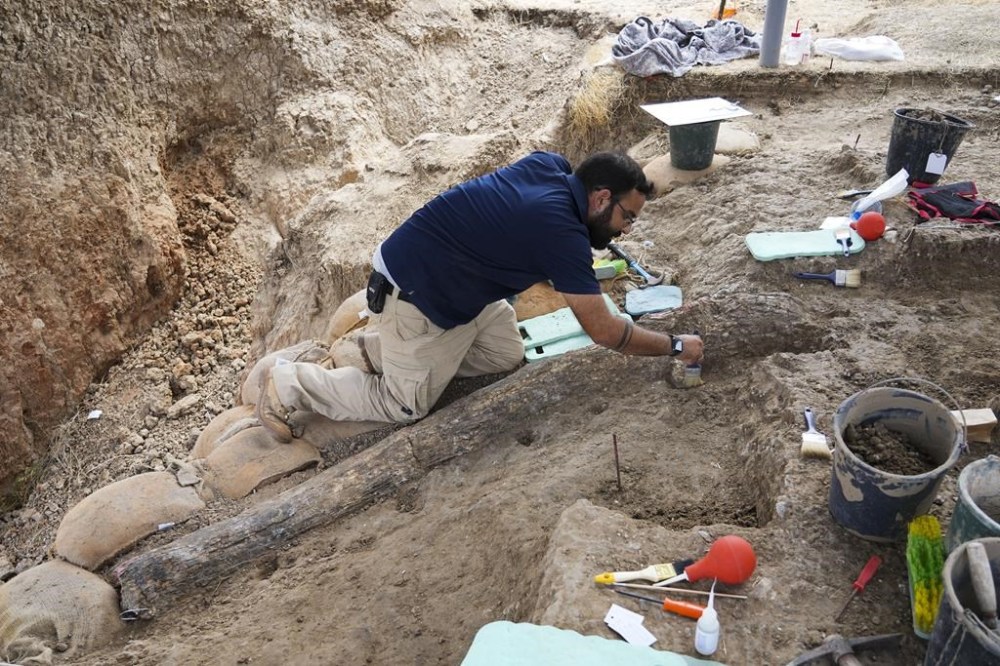
The site was dated to the late lower paleolithic period, around 500,000 years ago, based on stone tools found in the vicinity, the antiquities authority said.
Omry Barzilai, an IAA archaeologist, said the find was “very puzzling, very enigmatic” because it was not clear whether ancient people hunted the behemoth on the spot or whether they brought the felled animal’s tusk to this spot.
The tusk was found near a kibbutz on the central plain running parallel to Israel’s Mediterranean coast. But half a million years ago, when the ancient elephant died, the now-arid terrain was likely a swamp or shallow lake, an ideal habitat for ancient hominids.