A look at how some historic Canadian hurricanes compare with Fiona

Advertisement

Advertise with us

As people in Atlantic Canada prepared Friday for the imminent arrival of Fiona, some weather experts were studying past hurricanes and storms to gain insight on what could be coming.

Read this article for free:


or

Already have an account? Log in here »

To continue reading, please subscribe:

Subscribe and receive a limited-edition Free Press branded hat or tote.

Digital Subscription

One year of digital access for only $205*

  • Enjoy unlimited reading on winnipegfreepress.com
  • Read the E-Edition, our digital replica newspaper
  • Access News Break, our award-winning app
  • Play interactive puzzles

*First annual payment billed as $205.00 + GST for one year. This annual subscription will automatically renew at $233.00 + GST every 52 weeks (10% off the regular annual price of $259.35). Offer available to new and qualified returning subscribers only. Cancel any time.

To continue reading, please subscribe:

Add Free Press access to your Brandon Sun subscription for only an additional

$1 for the first 4 weeks*

  • Enjoy unlimited reading on winnipegfreepress.com
  • Read the E-Edition, our digital replica newspaper
  • Access News Break, our award-winning app
  • Play interactive puzzles
Start now

*Your next Brandon Sun subscription payment will increase by $1.00 and you will be charged $17.95 plus GST for four weeks. After four weeks, your payment will increase to $24.95 plus GST every four weeks.

Hey there, time traveller!
This article was published 24/09/2022 (1456 days ago), so information in it may no longer be current.

As people in Atlantic Canada prepared Friday for the imminent arrival of Fiona, some weather experts were studying past hurricanes and storms to gain insight on what could be coming.

Chris Fogarty, lead meteorologist and program manager at the Canadian Hurricane Centre, said meteorologists often like to look back at historical events when preparing forecasts.

“We want to see if we can compare (an incoming hurricane) with past events to give people an idea of what we’re going to see,” said Fogarty.
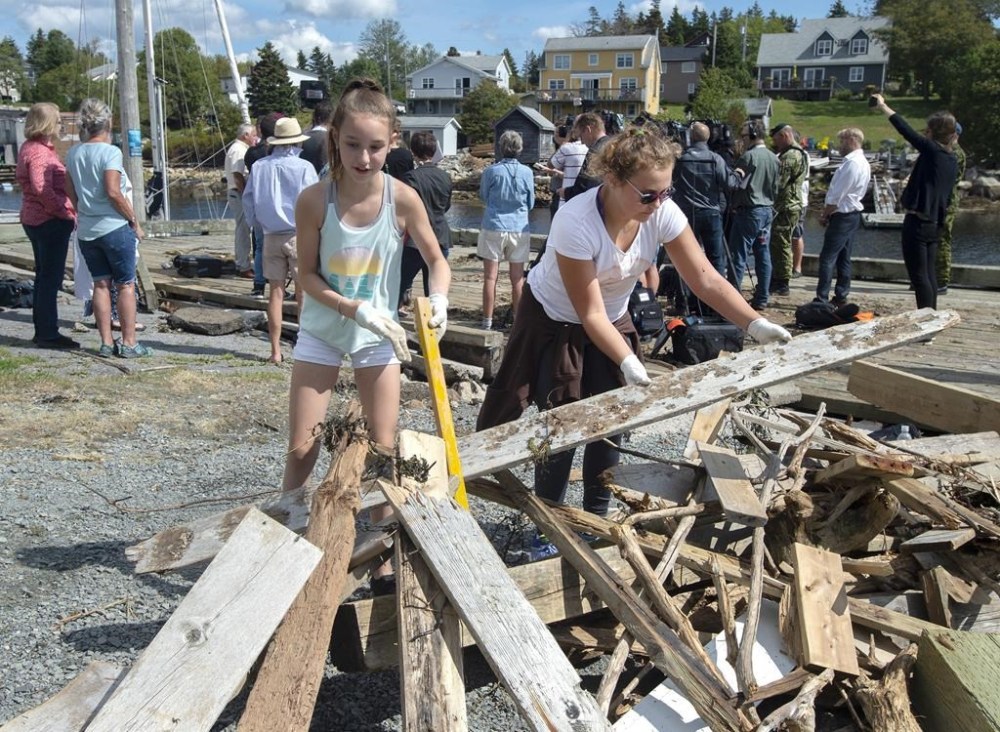
Madelyn Watts, left, and Angelina Taylor clean up debris on the government wharf as Ralph Goodale, minister of Public Safety and Emergency Preparedness and Harjit Sajjan, minister of National Defence, hold a news conference in the background in Herring Cove, N.S. on Tuesday, Sept. 10, 2019. Hurricane Dorian brought wind, rain and heavy seas that knocked out power across the region. THE CANADIAN PRESS/Andrew Vaughan

Fogarty offered thoughts on some of the notable hurricanes and post-tropical storms that have made landfall in Canada and what impact they had.

2019 — Dorian

Hurricane Dorian, a storm that made landfall in Atlantic Canada on Sept. 7, 2019, was “similar in a sense” to Fiona, said Fogarty, in that it was a hurricane that transformed into a nor’easter. The impacts of Dorian were made worse by soaking rains and powerful winds from tropical storm Erin a week earlier, according to Environment Canada records.

Dorian was not as intense as hurricane Juan in 2003, but the winds, rain and waves it brought destroyed more physical infrastructure in Nova Scotia than any storm had in the past. It was the single most damaging storm in Nova Scotia Power’s history, according to Environment Canada records, with 80 per cent of customers affected. Dorian was still much weaker than what Fiona is expected to be, said Fogarty.

2010 — Igor

Environment Canada archives list this storm as the worst of tropical origin to hit Newfoundland in 75 years. It brought excessive rainfall and winds reaching up to 172 km/h that toppled trees, caused power outages and structural damage to buildings, and brought widespread flooding.

Hurricane Fiona is likely to be similar to Igor, said Fogarty, which was a “very powerful storm.”

“(It had) a lot of rain, strong winds, ” he said. “But (meteorologists are) not seeing the numbers, some of the computer model numbers with Fiona, that we saw with Igor in 2010. That’s to say that (Fiona) does look like it’s going to be worse than even (Igor).”

2003 — Juan

This “storm of the century” hit Halifax directly on Sept. 29, 2003, according to Environment Canada. A paramedic in Halifax was killed when a tree was blown onto his ambulance. An estimated 50 to 100 million trees came down in Nova Scotia in a two-hour period. Environment Canada says hurricane Juan was “the most damaging storm in modern history for Halifax,” when measured by the widespread tree blowdowns, power outages and damaged homes.

“The wind speeds in Juan, they were right around what we’re predicting with Fiona,” said Fogarty. “But with Fiona, a larger area will be impacted .… Juan was probably a tenth the size of what Fiona is.”

1954 — Edna

Hurricane Edna formed southeast of Barbados on the afternoon of Sept. 2, 1954, and made landfall in New Brunswick as a Category 1 on Sept. 11, according to Environment Canada. It weakened to tropical storm strength over southern Quebec and Labrador before heading out to sea. With wind speeds of up to 160 km/h, it killed one person in Nova Scotia and injured numerous others.

“I would say that we probably have to go back to at least 1954 to envision some of the impacts that we’ll likely see (with Fiona),” said Fogarty. “Hurricane Edna was in 1954 and it produced wide swaths of forest blowdown in Nova Scotia and Prince Edward Island.”

1873 — The Great Nova Scotia Hurricane

Also referred to as the Great Nova Scotia Cyclone, this storm swept across Cape Breton Island on Aug. 25, 1873, and killed as many as 500 people, mostly sailors, according to Historica Canada. Environment Canada says some historical records indicate 100 more died in Newfoundland, and as many as 1,200 boats and 900 homes were also lost.

“It had properties and a track that might be similar to Fiona,” said Fogarty. “There was incredible surge in the Gulf of St. Lawrence, P.E.I. was (also) devastated, which is likely what we’re going to see with Fiona. To be honest, this 1873 storm, the Great Nova Scotia Cyclone, is the one that stands out in my head as (having) perhaps a similar track and impact.”

1775 — The Independence Hurricane

More than 4,000 mariners were lost, mostly off the coast, in the Independence Hurricane of 1775, according to Environment Canada. The storm hit the then-British colony of Newfoundland. Department archives say it’s been speculated the storm was a turning point in the American Revolution because most of the lives lost were British sailors.

It was “a terrible storm,” said Fogarty, that “may have” had all the same features as Fiona, though there is little data reaching that far back, and information mainly comes from ship reports and early records.

“It was thousands of fatalities because there were no warnings back then,” he said. “But some of the reports from that storm (showed) immense storm surge in eastern Newfoundland.”

This report by The Canadian Press was first published Sept. 24, 2022.

Report Error Submit a Tip

More Stories

A look at how some historic Canadian hurricanes compare with Fiona

Jessica Smith, The Canadian Press 5 minute read Preview

A look at how some historic Canadian hurricanes compare with Fiona

Jessica Smith, The Canadian Press 5 minute read Saturday, Sep. 24, 2022

As people in Atlantic Canada prepared Friday for the imminent arrival of Fiona, some weather experts were studying past hurricanes and storms to gain insight on what could be coming.

Chris Fogarty, lead meteorologist and program manager at the Canadian Hurricane Centre, said meteorologists often like to look back at historical events when preparing forecasts.

"We want to see if we can compare (an incoming hurricane) with past events to give people an idea of what we're going to see," said Fogarty.

Fogarty offered thoughts on some of the notable hurricanes and post-tropical storms that have made landfall in Canada and what impact they had.

Read
Saturday, Sep. 24, 2022

Manitoba abandoning spring, fall clock changes

Carol Sanders 8 minute read Preview

Manitoba abandoning spring, fall clock changes

Carol Sanders 8 minute read Updated: Yesterday at 8:48 AM CDT

Time’s up for the time change in Manitoba.

Manitobans won’t be setting their clocks back an hour in November. The province has decided to permanently stay on daylight time after surveying residents on the twice annual clock adjustment.

“We heard from Manitobans loud and clear — no more changing the clocks in Manitoba,” Premier Wab Kinew said in a news release Thursday.

Most of the 72,000 votes submitted in an online EngageMB survey — 92 per cent — said they would like to see the practice end. The survey asked if they preferred earlier sunrises in winter with standard time or the later sunsets in summer with daylight time. More than half of survey participants (58 per cent) indicated a preference to stay on permanent daylight time; 34 per cent voted to eliminate the time change but stay on standard time.

Read
Updated: Yesterday at 8:48 AM CDT

Cabernet Sauvignon star of wine festival

Ben Sigurdson 5 minute read Preview

Cabernet Sauvignon star of wine festival

Ben Sigurdson 5 minute read 3:00 AM CDT

The Winnipeg Wine Festival will celebrate the king of red wine grapes next weekend — the theme of this year’s festival, which takes place Sept. 25 and 26 at the RBC Convention Centre, is Cabernet Sauvignon.

Cab Sauv, as it’s also known, is the world’s most widely planted wine grape of any colour, first coming to prominence in the 1800s in France’s Bordeaux region, where the grape is still popular. Rather than single-variety wines, Bordeaux reds tend to be blends, with those coming from the left bank of the Gironde estuary being Cabernet-dominant, while right-bank wines are Merlot-dominant, with Cabernet Sauvignon playing a supporting role. Cabernet and Merlot work well together and many other countries have followed suit in blending the two.

A team at University of California Davis put Cabernet Sauvignon through a DNA test in 1996 and discovered its parent grapes are Cabernet Franc and Sauvignon Blanc — it’s likely that at some point the two varieties, planted next to each other in some vineyard, crossed and mutated and became the grape we know today. (Someone growing grapes in the 19th century must have had an inkling of what was up, as the grape has been called Cabernet Sauvignon since long before the DNA test.)

Flavour-wise, most Cabernet Sauvignon wines are big and bold, with a core of deep dark berry flavours, some graphite and spice notes and relatively bright acidity. It’s a grape that is well-suited to barrel aging, with most examples seeing at least some time in wood.

Read
3:00 AM CDT

Canada-U.S. trade relationship is broken, but the damage can — and will — be repaired

Tom Brodbeck 5 minute read Preview

Canada-U.S. trade relationship is broken, but the damage can — and will — be repaired

Tom Brodbeck 5 minute read Thursday, Sep. 17, 2026

Canada needs to get serious about diversifying its trade beyond the United States. But at the same time, Canadians should expect relations with the U.S. to normalize after Donald Trump is no longer in the White House.

For generations, Canada-U.S. trade was considered almost a fact of geography. The two countries share the world’s longest undefended border, deeply integrated supply chains and a century of commercial relationships.

Canadian manufacturers depend on American customers. American manufacturers depend on Canadian suppliers. Energy, agriculture, automotive production and countless other industries operate across the border as though it barely exists.

That isn’t going to change dramatically, even in the midst of a bitter trade war unleashed by the U.S. president.

Read
Thursday, Sep. 17, 2026

Jets GM insists club’s not working under any deadline in netminder’s trade request

Mike McIntyre 7 minute read Preview

Jets GM insists club’s not working under any deadline in netminder’s trade request

Mike McIntyre 7 minute read Thursday, Sep. 17, 2026

Connor Hellebuyck and his family were subject to so much post-Olympic vitriol that both the Winnipeg Jets security team and even police had to get involved.

Read
Thursday, Sep. 17, 2026

Today’s horoscope

Georgia Nicols 4 minute read Preview

Today’s horoscope

Georgia Nicols 4 minute read 2:01 AM CDT

MOON ALERT: After 12:15 a.m., there are no restrictions to shopping or important decisions today. The moon is in Capricorn.

ARIES (March 21-April 19)

This is a tricky day. Don’t be too ambitious. It’s totally OK to kick back and relax. But be aware that communications with parents and authority figures might be confused, vague or subject to misunderstandings. Nevertheless, romance is sweet and cosy!

TAURUS (April 20-May 20)

Read
2:01 AM CDT