
Stone Age discovery fuels mystery of who made early tools

Advertisement

Advertise with us

NEW YORK (AP) — Archaeologists in Kenya have dug up some of the oldest stone tools ever found, but who used them is a mystery.

Read this article for free:


or

Already have an account? Log in here »

To continue reading, please subscribe:

Subscribe and receive a limited-edition Free Press branded hat or tote.

Digital Subscription

One year of digital access for only $205*

  • Enjoy unlimited reading on winnipegfreepress.com
  • Read the E-Edition, our digital replica newspaper
  • Access News Break, our award-winning app
  • Play interactive puzzles

*First annual payment billed as $205.00 + GST for one year. This annual subscription will automatically renew at $233.00 + GST every 52 weeks (10% off the regular annual price of $259.35). Offer available to new and qualified returning subscribers only. Cancel any time.

To continue reading, please subscribe:

Add Free Press access to your Brandon Sun subscription for only an additional

$1 for the first 4 weeks*

  • Enjoy unlimited reading on winnipegfreepress.com
  • Read the E-Edition, our digital replica newspaper
  • Access News Break, our award-winning app
  • Play interactive puzzles
Start now

*Your next Brandon Sun subscription payment will increase by $1.00 and you will be charged $17.95 plus GST for four weeks. After four weeks, your payment will increase to $24.95 plus GST every four weeks.

Hey there, time traveller!
This article was published 09/02/2023 (1309 days ago), so information in it may no longer be current.

NEW YORK (AP) — Archaeologists in Kenya have dug up some of the oldest stone tools ever found, but who used them is a mystery.

In the past, scientists assumed that our direct ancestors were the only toolmakers. But two big fossil teeth found along with the tools at the Kenyan site belong to an extinct human cousin known as Paranthropus, according to a study published Thursday in the journal Science.

This adds to the evidence that our direct relatives in the Homo lineage may not have been the only tech-savvy creatures during the Stone Age, said study author Rick Potts, director of the Smithsonian’s Human Origins Program.
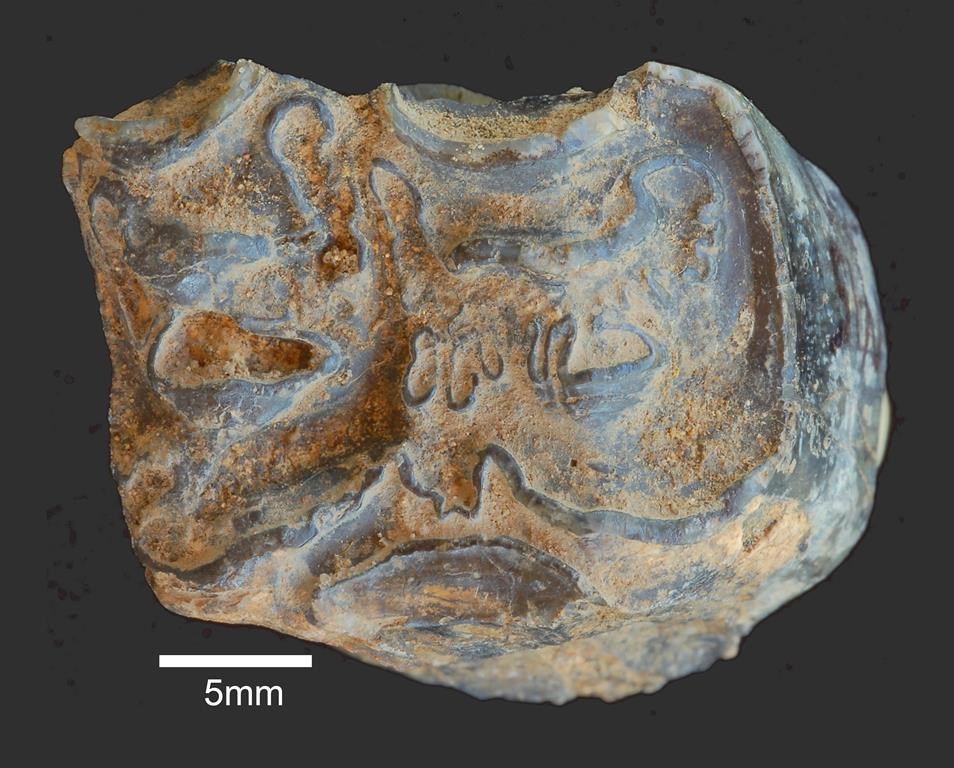
This photo provided by the Homa Peninsula Paleoanthropology Project shows the fossilized upper molar of a horse (Eurygnathohippus) found eroding from the Nyayanga site in southwestern Kenya. Archaeologists in Kenya have dug up some of the oldest stone tools ever found, dating back to around 2.9 million years ago, but who used them is a mystery, according to a study published Thursday, Feb. 9, 2023, in the journal Science. (J.S. Oliver/Homa Peninsula Paleoanthropology Project via AP)

“Those teeth open up an amazing whodunit — a real question of, well, who were these earliest toolmakers?” Potts said.

The tools date back to around 2.9 million years ago, when early humans used them to butcher hippos for their meat, the researchers report.

Older stone tools have been found in Kenya, dating back to around 3.3 million years ago, long before our own Homo ancestors appeared. Those tools were a bit simpler and so far have only been found in one spot, said Shannon McPherron, an archaeologist at Germany’s Max Planck Institute for Evolutionary Anthropology who was not involved with the study.

The latest discovery matches up with a much bigger tradition known as the Oldowan toolkit. These same kinds of tools show up across Africa and beyond during more than a million years of prehistory, Potts said, showing they really caught on among early humans.

They held a rock in one hand and hit it with another stone, chipping off thin, razor-sharp flakes, explained anthropologist Kathy Schick of the Stone Age Institute in Indiana, who wasn’t involved in the research.

With the rocks and flakes, early humans could slice and crush a wide range of materials, said lead author Thomas Plummer, an anthropologist at Queens College of the City University of New York. And the tools from the Kenya site — likely the most ancient Oldowan tools found to date — suggest this gave them an advantage in a key area: eating.

The site, known as Nyayanga, is a lush, hilly landscape on the shores of Lake Victoria. Since starting excavations there in 2015, researchers have found a trove of artifacts and animal bones, along with the two Paranthropus teeth.

Slice marks on several hippo bones show they were cut up for their meat, which would have been eaten raw as a hippo steak tartare, Plummer said. The early humans also likely used their tools to break open antelope bones for their fatty marrow inside, and to peel the outer rinds of tough plant roots, the authors concluded.

“Stone tools are allowing them, even at this really early date, to extract a lot of resources from the environment,” Plummer said. “If you can butcher a hippo, you can butcher pretty much anything.”

In the past, it was easy to assume that our direct ancestors were the ones using these tools, Plummer said. But the teeth make it hard to rule out that other early humans were picking up tools of their own, researchers said — even extinct cousins like Paranthropus, with their big teeth and small brains.

The mystery will be a tough one to solve.

After all, we can’t say for sure whether Paranthropus was using these tools, or just happened to die in the same place, Schick said: “When we find hominin fossils with stone tools, you always have to ask, is this the dinner or the diner?”

___

The Associated Press Health and Science Department receives support from the Howard Hughes Medical Institute’s Science and Educational Media Group. The AP is solely responsible for all content.


Report Error Submit a Tip

More Stories

Labour board ruling halts Dynacare strike

Carol Sanders and Erik Pindera 6 minute read Preview

Labour board ruling halts Dynacare strike

Carol Sanders and Erik Pindera 6 minute read Tuesday, Sep. 8, 2026

The Manitoba Labour Board has cut short a strike by 350 lab workers employed by Dynacare who administer blood and urine tests for patients in Winnipeg, Brandon and surrounding communities.

The board ruled late Tuesday afternoon that the workers, who hit the picket line at 6 a.m., must return to work Wednesday.

Jason Linklater, president of their union, the Manitoba Association of Health Care Professionals, slammed the board’s decision.

“The Manitoba Labour Board is doing exactly what the government asked them to do: they are taking away our members’ right to fight for fairness,” he said in a statement.

Read
Tuesday, Sep. 8, 2026

South Winnipeg neighbourhood will be first to go geothermal

Chris Kitching 4 minute read Preview

South Winnipeg neighbourhood will be first to go geothermal

Chris Kitching 4 minute read Updated: Yesterday at 7:28 PM CDT

A new neighbourhood in south Winnipeg will be Manitoba’s first to use a shared, large-scale geothermal system to heat and cool hundreds of homes over coming decades.

The province is giving up to $4 million to the developers of Southwood Circle, just north of the University of Manitoba’s Fort Garry campus, for a district geothermal system as part of the NDP’s goal to reach net-zero greenhouse gas emissions by 2050.

“It means a whole neighbourhood can tap into geothermal, which means low-carbon heating and cooling for at least 1,000 homes,” Premier Wab Kinew said at a news conference Wednesday.

Geothermal systems, equipped with pumps and pipes, use underground temperatures to heat and cool one or more buildings. Proponents point to long-term energy and cost savings compared with conventional heating and cooling systems.

Read
Updated: Yesterday at 7:28 PM CDT

Weekender festivities to take over downtown

Sheldon Birnie 3 minute read Preview

Weekender festivities to take over downtown

Sheldon Birnie 3 minute read Yesterday at 6:00 AM CDT

Come one, come all, to Graham Avenue this weekend.

Organizers of the Weekender hope to welcome thousands of Winnipeggers to the streets and parking lots in and around the Graham Avenue pedestrian mall in what they are billing as “Downtown’s Biggest Street Party.”

Starting Friday evening and running through Sunday, the free festival boasts a plethora of ways by which visitors can enjoy themselves. From food trucks to markets, games to live music, classic cars and free bike repairs, the festival aims to provide a little something for everyone.

“The Weekender is truly about bringing people together, to have fun, to experience all that downtown has to offer,” says Olivia Billson, director of communications and public relations for Downtown Winnipeg BIZ, which is putting on the festival in conjunction with Smith Events and Arch Events.

Read
Yesterday at 6:00 AM CDT

Stone Age discovery fuels mystery of who made early tools

Maddie Burakoff, The Associated Press 4 minute read Preview

Stone Age discovery fuels mystery of who made early tools

Maddie Burakoff, The Associated Press 4 minute read Thursday, Feb. 9, 2023

NEW YORK (AP) — Archaeologists in Kenya have dug up some of the oldest stone tools ever found, but who used them is a mystery.

In the past, scientists assumed that our direct ancestors were the only toolmakers. But two big fossil teeth found along with the tools at the Kenyan site belong to an extinct human cousin known as Paranthropus, according to a study published Thursday in the journal Science.

This adds to the evidence that our direct relatives in the Homo lineage may not have been the only tech-savvy creatures during the Stone Age, said study author Rick Potts, director of the Smithsonian’s Human Origins Program.

“Those teeth open up an amazing whodunit — a real question of, well, who were these earliest toolmakers?” Potts said.

Read
Thursday, Feb. 9, 2023

Grieving families, local leaders want review of Interlake intersection after teens die in crash

Chris Kitching 8 minute read Preview

Grieving families, local leaders want review of Interlake intersection after teens die in crash

Chris Kitching 8 minute read Tuesday, Sep. 8, 2026

A two-vehicle crash that killed four teenage friends in the Interlake Sunday night prompted outpourings of grief in several communities and calls for safety improvements at the intersection, which was also the site of a death in July.

Recent high school graduates Maya Borsa and Chloe Vermette, both 18, were identified by their families as victims of the collision at Highway 8 and Provincial Road 229, just west of Winnipeg Beach.

“(Chloe) was a very bubbly, loving personality. Always giving, always caring. Her friends meant the world to her,” said her mother, Veronique Vermette, who struggled to comprehend the tragedy when she went to the scene Monday. “We sat in the rain for hours, and it blew my mind that four lives were taken.”

The teens’ parents are waiting for RCMP to provide more information about the cause of the crash. Chloe, who graduated from Windsor Park Collegiate in Winnipeg in July, was driving one of the vehicles, her mother said.

Read
Tuesday, Sep. 8, 2026

Supportive housing operator sued after man with dementia walks away

Erik Pindera 4 minute read Preview

Supportive housing operator sued after man with dementia walks away

Erik Pindera 4 minute read 6:00 AM CDT

The Public Guardian and Trustee of Manitoba is suing a health services company after a man with dementia under its care allegedly wandered away from an apartment it operates for vulnerable people and was later found face down in a puddle — unresponsive, hypothermic and severely injured.

The public trustee — a provincial government agency that, among other duties, makes financial and personal care decisions for vulnerable adults who cannot do so themselves — filed the lawsuit against Cambridge Health Inc. and a related numbered company in the Court of King’s Bench earlier this month.

The agency did so on behalf of a now-38-year-old man, who has been under its care since 2018, as a result of his frontotemporal dementia. The disease often starts in mid-life, rather than old age, as is the case with most other forms of dementia.

The lawsuit alleges the man, who resided at a Henderson Highway apartment complex where Cambridge Health operated a supportive residence for people with complex behavioural health issues, was in a common area of the home at about 4:30 p.m. on April 3 last year.

Read
6:00 AM CDT