For man behind gene-edited babies, a rocky return to science
Advertisement
Read this article for free:
or
Already have an account? Log in here »
To continue reading, please subscribe:

Digital Subscription
One year of digital access for only $205*
- Enjoy unlimited reading on winnipegfreepress.com
- Read the E-Edition, our digital replica newspaper
- Access News Break, our award-winning app
- Play interactive puzzles
*First annual payment billed as $205.00 + GST for one year. This annual subscription will automatically renew at $233.00 + GST every 52 weeks (10% off the regular annual price of $259.35). Offer available to new and qualified returning subscribers only. Cancel any time.
To continue reading, please subscribe:
Add Free Press access to your Brandon Sun subscription for only an additional
$1 for the first 4 weeks*
- Enjoy unlimited reading on winnipegfreepress.com
- Read the E-Edition, our digital replica newspaper
- Access News Break, our award-winning app
- Play interactive puzzles
*Your next Brandon Sun subscription payment will increase by $1.00 and you will be charged $17.95 plus GST for four weeks. After four weeks, your payment will increase to $24.95 plus GST every four weeks.
Read unlimited articles for free today:
or
Already have an account? Log in here »
Hey there, time traveller!
This article was published 27/02/2023 (1300 days ago), so information in it may no longer be current.
Five years ago, scientist He Jiankui shocked his peers and the world with claims that he created the first genetically edited babies. Now, after serving three years in a Chinese prison for practicing medicine without a license, he faces obstacles and critics as he tries to re-enter science.
For months he’s been touting plans to develop affordable gene therapies for rare diseases, starting with the muscle-wasting condition Duchenne muscular dystrophy. He announced on social media last fall that he had opened a lab in Beijing. He spoke remotely about this new endeavor at an event in early February hosted by the University of Kent in the United Kingdom.
And last week, he announced to the press that he’d received a Hong Kong visa and might want to work in the financial hub. But Hong Kong officials revoked that visa hours later, saying false statements had been made and a criminal investigation would be launched.
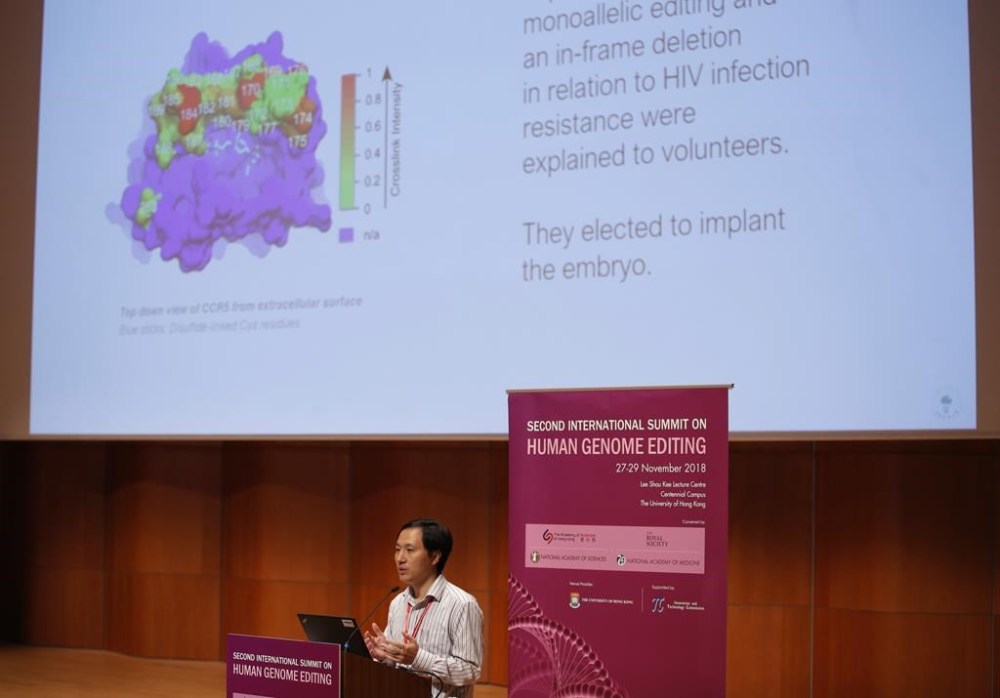
The Associated Press has reached out to He several times by phone and email, but he has not agreed to an interview. He said on Twitter over the weekend that he will pause posting there to focus on his research. Others in the scientific world, meanwhile, are divided about his efforts at a comeback — with some expressing serious doubts.
“We have to be clear: He has no expertise in gene editing” and his previous experiment was “a total, total disaster,” said Kiran Musunuru, a University of Pennsylvania gene editing expert who wrote a book on the case. “I understand maybe some of this is a play to rehabilitate his reputation … But how can anyone think this is a good idea?”
Some scientists worry he may return to the sort of work he did before, which involved using a tool called CRISPR-Cas9 to genetically edit embryos, disabling a gene that allows HIV to enter cells. The idea was to try to make the children resistant to AIDS.
The gene editing tool is a powerful one that may lead to treatments for many diseases. The scientists who discovered it were awarded the Nobel Prize in 2020. But He’s work was criticized across the globe because, by making edits to embryos, he was attempting changes that could be passed to future generations — potentially altering the course of human evolution. The work was also medically unnecessary and carried the risks of changing other genes.
It’s unclear how the three children who grew from the embryos — twins known as Lulu and Nana and a third child known as Amy — are doing.
Given He’s ambition,“I wouldn’t be surprised that a few years down the line if the opportunity arises, that he would go back” to that sort of work, said Dr. Samira Kiani, a genetic engineer and researcher at the University of Pittsburgh who produced a documentary on He’s story called “Make People Better.”
But Benjamin Hurlbut, an expert in bioethics and biomedicine at Arizona State University who is in touch with He off and on, said “there’s absolutely no reason” to believe he will do anything similar, and that He has the know-how and connections to build respectable projects in biotech.
“He’s done his time and he’s trying to start over,” Hurlbut said.
A REVEALING TALK
Kent sociologist Joy Zhang, an organizer of the U.K. event where He spoke, said most participants were scientists and academics based in China, and many arrived with open minds about him and his latest project.
“It was really shocking how shameless he was boasting about his gene therapy when he had very little substance to show, either scientifically or ethically,” Zhang said. “He proved that he’s not a misunderstood genius. He’s just a very egotistic opportunist.”
During his 25-minute presentation, He spent most of the time explaining basic science, discussing his Duchenne research for less than two minutes, according to a scathing report published by event organizers. That included sharing his goal to raise 50 million Chinese yuan through charity (about $7.3 million) and start clinical trials by March 2025.
“We’ve exposed that there is little substance” behind He’s ambitious Duchenne gene therapy plans, the report said. “We were concerned that he might endanger another vulnerable population if his new venture remains unchecked.”
Organizers said they invited He because China hadn’t had an open discussion about CRISPR technology and ethics since his stunning announcement in 2018. They were disappointed He wouldn’t talk about his recent past. A day earlier, he had pulled out of a planned talk at Oxford University, saying on Twitter he wasn’t ready to do that.
Kiani said inviting He to speak at such events is a good idea because the scientific community can communicate what’s right and wrong – and hear about his plans. “It would be very naive of us to think that if we don’t engage him in any conversation, he will just go away,” she said.
After He’s presentation, a fellow scientist pressed him about whether he thought so-called “heritable human genome editing” should be banned. The question has become especially timely, experts say, as the U.K. fertility watchdog agency pushes for an overhaul of fertility laws that some worry could eventually lead to the legalization of the practice.
He wouldn’t answer.
SCIENCE’S COMPETITIVE CULTURE
Cultural anthropologist Eben Kirksey, a fellow of St. Cross College at the University of Oxford, who wrote the book “The Mutant Project,” said he’s concerned about what He’s past actions might portend about the future. For example, Kirksey said He misled the public about the health of the twin girls in the gene-editing experiment; Kirksey revealed in his book that they were born at 31 weeks gestation by emergency C-section.
Kirksey said, He’s pursuit of fame and potentially-profitable breakthroughs again threaten to get in the way of “good, stable, well-thought-out science.”
Besides the Duchenne research, He said last year on the social media platform Weibo that he was seeking funds from the Chinese government to develop an advanced type of machine that creates synthetic DNA that could be used for information storage. A tiny piece of synthetic DNA can store vast amounts of data.
His proposal for that project listed J. William Efcavitch, a scientific officer at a life sciences company in California, as a scientific adviser. Efcavitch, who did not respond to requests for comment, previously served on the scientific advisory board of Direct Genomics, a sequencing company He co-founded before the gene editing scandal.
Hurlbut said those plans wouldn’t attract much attention if not for the scandal.

“There’s something off about the singular preoccupation about the one individual – the sort of ‘mad scientist’ narrative – when what he did was embedded in a much larger network,” Hurlbut said soon after the Weibo posting.
Something similar is bound to happen again, experts said, unless the global scientific community changes the competitive culture that pushes many into a race to be first, and unless people ask: Should we rush forward just because we can?
Saying He went rogue points the finger elsewhere, Hurlbut said, “rather than asking: What did this grow out of? Do we have anything to do with this?”
___
The Associated Press Health and Science Department receives support from the Howard Hughes Medical Institute’s Science and Educational Media Group. The AP is solely responsible for all content.