Oldest reference to Norse god Odin found in Danish treasure
Advertisement
Read this article for free:
or
Already have an account? Log in here »
To continue reading, please subscribe:

Digital Subscription
One year of digital access for only $205*
- Enjoy unlimited reading on winnipegfreepress.com
- Read the E-Edition, our digital replica newspaper
- Access News Break, our award-winning app
- Play interactive puzzles
*First annual payment billed as $205.00 + GST for one year. This annual subscription will automatically renew at $233.00 + GST every 52 weeks (10% off the regular annual price of $259.35). Offer available to new and qualified returning subscribers only. Cancel any time.
To continue reading, please subscribe:
Add Free Press access to your Brandon Sun subscription for only an additional
$1 for the first 4 weeks*
- Enjoy unlimited reading on winnipegfreepress.com
- Read the E-Edition, our digital replica newspaper
- Access News Break, our award-winning app
- Play interactive puzzles
*Your next Brandon Sun subscription payment will increase by $1.00 and you will be charged $17.95 plus GST for four weeks. After four weeks, your payment will increase to $24.95 plus GST every four weeks.
Read unlimited articles for free today:
or
Already have an account? Log in here »
Hey there, time traveller!
This article was published 08/03/2023 (1263 days ago), so information in it may no longer be current.
COPENHAGEN, Denmark (AP) — Scandinavian scientists said Wednesday that they have identified the oldest-known inscription referencing the Norse god Odin on part of a gold disc unearthed in western Denmark in 2020.
Lisbeth Imer, a runologist with the National Museum in Copenhagen, said the inscription represented the first solid evidence of Odin being worshipped as early as the 5th century — at least 150 years earlier than the previous oldest known reference, which was on a brooch found in southern Germany and dated to the second half of the 6th century.
The disc discovered in Denmark was part of a trove containing about a kilogram (2.2 pounds) of gold, including large medallions the size of saucers and Roman coins made into jewelry. It was unearthed in the village of Vindelev, central Jutland, and dubbed the Vindelev Hoard.
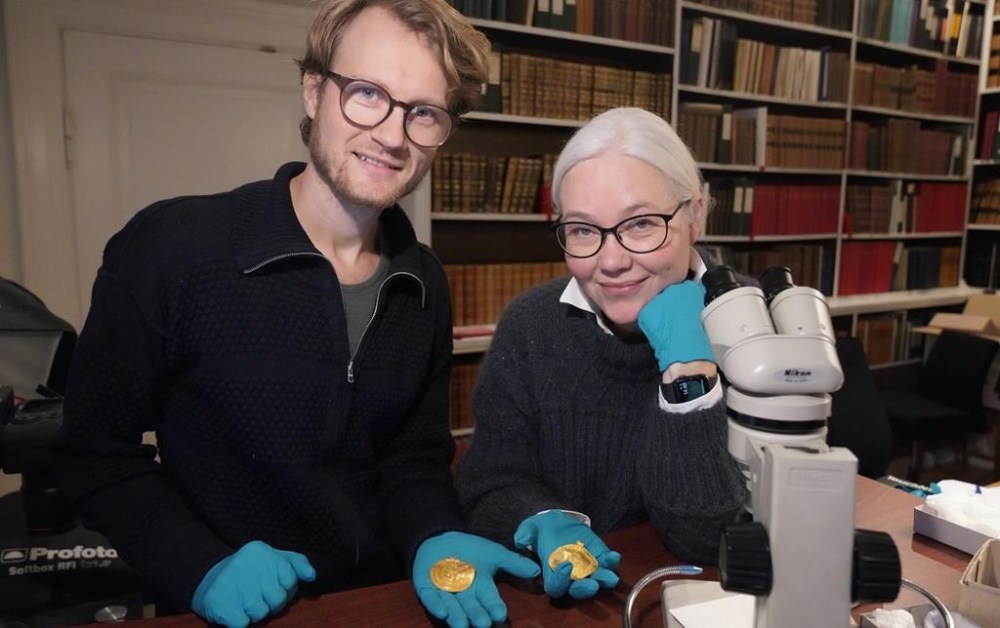
Experts think the cache was buried 1,500 years ago, either to hide it from enemies or as a tribute to appease the gods. A golden bracteate — a kind of thin, ornamental pendant — carried an inscription that read, “He is Odin’s man,” likely referring to an unknown king or overlord.
“It’s one of the best executed runic inscriptions that I have ever seen,” Imer said. Runes are symbols that early tribes in northern Europe used to communicate in writing.
Odin was one of the main gods in Norse mythology and was frequently associated with war as well as poetry.
More than 1,000 bracteates have been found in northern Europe, according to the National Museum in Copenhagen, where the trove discovered in 2020 is on display.

Krister Vasshus, an ancient language specialist, said that because runic inscriptions are rare, “every runic inscription (is) vital to how we understand the past.”
“When an inscription of this length appears, that in itself is amazing,” Vasshus said. “It gives us some quite interesting information about religion in the past, which also tells us something about society in the past.”
During the Viking Age, considered to be from 793 to 1066, Norsemen known as Vikings undertook large-scale raiding, colonizing, conquest and trading throughout Europe. They also reached North America.
The Norsemen worshipped many gods and each of them had various characteristics, weaknesses and attributes. Based on sagas and some rune stones, details have emerged that the gods possessed many human traits and could behave like humans.
“That kind of mythology can take us further and have us reinvestigate all the other 200 bracteate inscriptions that we know,” Imer said.