

Has T. rex lost its bite? Menacing snarl may be wrong
Advertisement
Read this article for free:
or
Already have an account? Log in here »
To continue reading, please subscribe:
Monthly Digital Subscription
$0 for the first 4 weeks*
- Enjoy unlimited reading on winnipegfreepress.com
- Read the E-Edition, our digital replica newspaper
- Access News Break, our award-winning app
- Play interactive puzzles
*No charge for 4 weeks then price increases to the regular rate of $19.00 plus GST every four weeks. Offer available to new and qualified returning subscribers only. Cancel any time.
Monthly Digital Subscription
$4.75/week*
- Enjoy unlimited reading on winnipegfreepress.com
- Read the E-Edition, our digital replica newspaper
- Access News Break, our award-winning app
- Play interactive puzzles
*Billed as $19 plus GST every four weeks. Cancel any time.
To continue reading, please subscribe:
Add Free Press access to your Brandon Sun subscription for only an additional
$1 for the first 4 weeks*
*Your next subscription payment will increase by $1.00 and you will be charged $16.99 plus GST for four weeks. After four weeks, your payment will increase to $23.99 plus GST every four weeks.
Read unlimited articles for free today:
or
Already have an account? Log in here »
Hey there, time traveller!
This article was published 30/03/2023 (992 days ago), so information in it may no longer be current.
NEW YORK (AP) — The Tyrannosaurus rex is often shown baring massive, sharp teeth, like the ferocious creature in “Jurassic Park.” But new research suggests that this classic image might be wrong.
The teeth on T. rex and other big theropods were likely covered by scaly lips, concludes a study published Thursday in the journal Science. The dinosaur’s teeth didn’t stick out when its mouth was closed, and even in a wide open bite, you might just see the tips, the scientists found.
The research is the latest in a long back-and-forth over how dinosaur mouths really looked.
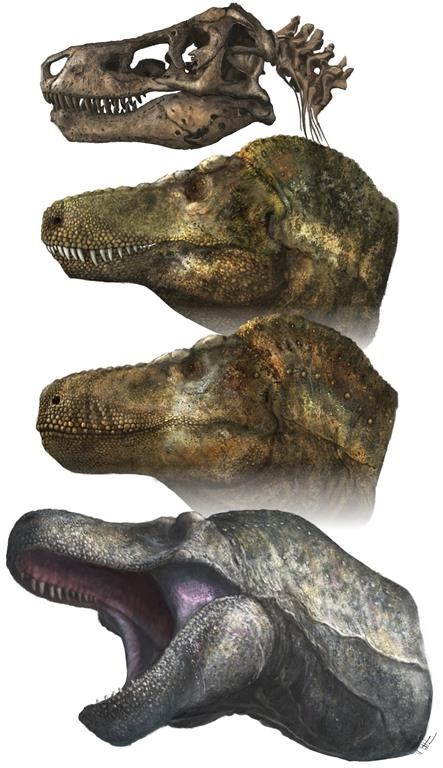
Recent depictions show big teeth jutting out of the dinosaurs’ jaws, even when closed. Some thought the predators’ teeth were just too big to fit in their mouths, said study author Thomas Cullen, a paleontologist at Auburn University in Alabama.
When researchers compared skulls from dinosaurs and living reptiles, though, they found this wasn’t the case. Some large monitor lizards actually have bigger teeth than T. rex compared to their skull size, and can still fit them under a set of scaly lips, Cullen said.
The scientists also found clues in the pattern of wear and tear on tooth surfaces.
For a creature like a crocodile, whose teeth stick out of its mouth, the exposed part gets worn down quickly — “like someone’s taken a sander to the side of the tooth,” said another study author Mark Witton, a paleoartist at England’s University of Portsmouth.
But when researchers analyzed a tooth from a Daspletosaurus, a T. rex relative, they found it was in good condition and it didn’t show that uneven damage pattern.
With this evidence and other clues from the dinosaurs’ anatomy, the study makes a good case for lipped tyrannosaurs, said University of Maryland paleontologist Thomas Holtz, who was not involved with the study. Still, “we’re not talking kissy lips,” he pointed out — they’d be thin and scaly like those of the Komodo dragon, a large lizard.

It’s not the first time our depictions of dinosaurs have been called into question: Other research has shown that T. rex was more hunched over than we used to think, and that fierce velociraptors probably sported feathers. Most of what we know about dinosaurs comes from their bones, but it can be harder to get clear answers about soft tissues like skin, which usually aren’t preserved as fossils.
Adding lips may make dinosaurs look a little less ferocious, but it also makes them feel more realistic, Witton said.
“You don’t really see a monster,” he said. “You see an animal.”
___
The Associated Press Health and Science Department receives support from the Howard Hughes Medical Institute’s Science and Educational Media Group. The AP is solely responsible for all content.