

Japan’s Honda outlines global strategy for electric cars
Advertisement
Read this article for free:
or
Already have an account? Log in here »
To continue reading, please subscribe:
Monthly Digital Subscription
$0 for the first 4 weeks*
- Enjoy unlimited reading on winnipegfreepress.com
- Read the E-Edition, our digital replica newspaper
- Access News Break, our award-winning app
- Play interactive puzzles
*No charge for 4 weeks then price increases to the regular rate of $19.00 plus GST every four weeks. Offer available to new and qualified returning subscribers only. Cancel any time.
Monthly Digital Subscription
$4.75/week*
- Enjoy unlimited reading on winnipegfreepress.com
- Read the E-Edition, our digital replica newspaper
- Access News Break, our award-winning app
- Play interactive puzzles
*Billed as $19 plus GST every four weeks. Cancel any time.
To continue reading, please subscribe:
Add Free Press access to your Brandon Sun subscription for only an additional
$1 for the first 4 weeks*
*Your next subscription payment will increase by $1.00 and you will be charged $16.99 plus GST for four weeks. After four weeks, your payment will increase to $23.99 plus GST every four weeks.
Read unlimited articles for free today:
or
Already have an account? Log in here »
Hey there, time traveller!
This article was published 25/04/2023 (962 days ago), so information in it may no longer be current.
TOKYO (AP) — Honda is gearing up for an electrification shift in North America with two models developed with General Motors going on sale next year and a bigger EV with a new platform in 2025, a year earlier than initially announced.
“We believe that the value society places on being kind to the environment will only build in momentum,” President Toshihiro Mibe said Wednesday in announcing a sprawling set of initiatives intended to put Honda on the global EV map.
Mibe told reporters Tokyo-based Honda will forge ahead on investments and partnerships to realize such goals.
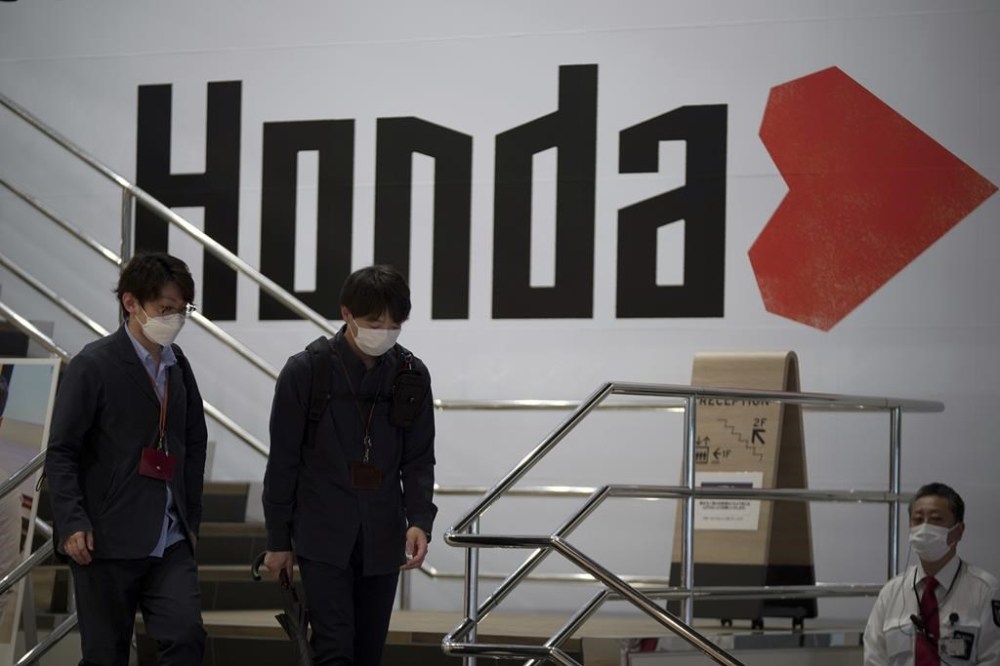
Honda has set a goal to have all its models around the world electric or fuel cell, which runs on hydrogen and is emissions-free, by 2040. It aims to make more than 2 million EVs a year by 2030.
In Japan, where EV demand is picking up gradually, an EV based on the tiny N-ONE model goes on sale in 2025. Two more EV models are planned for the following year.
In China, the world’s biggest EV market, Honda Motor Co. has three EV models going on sale next year, e:NS2, e:NP2 and a concept unveiled at the recent Shanghai auto show.
By 2027, Honda will introduce seven more EV models in China. By 2035, Honda aims for 100% electric for its China sales, ahead of other regions.
All the world’s automakers are getting serious about electric vehicles, now dominated by Tesla and China’s BYD. With governments moving to curb emissions and climate change, even previously skeptical consumers are starting to buy EVs, especially in the U.S. and China, but also in parts of Europe and in Australia.
The big question is whether Japanese manufacturers, like Honda and Toyota Motor Corp., will be able to dominate the market as they have historically with gas-guzzlers.
Some analysts say a car is still a car, and the wealth of know-how that comes with auto manufacturing still holds with the new electric era. Others claim it’s a totally new ballgame, with opportunities galore for new players.
Toyota’s EV bZ4X, which went on sale last year, was recalled shortly afterward for a flaw with the wheel hub bolts that could cause the wheels to detach, risking an accident. About 2,700 vehicles were recalled globally. No crashes were reported and the model is back on sale.
But it served as a painful reminder of such pitfalls, when venturing into new ground with a flagship model. Toyota previously banked on hybrids, which switch back and forth between a gas engine and electric motor, as well as fuel cells that run on hydrogen.
Toyota President Koji Sato, who took office this month, has acknowledged Toyota fell behind in selling EVs around the world.
The main drawback for the proliferation of EVs is the battery, which is heavy, a challenge in auto development. The components needed to make batteries, such as rare earths, are expensive.
Honda plans to leverage its strategic partnership with Hanwa Co., a Japanese trading company, to ensure stable procurement of nickel, cobalt and lithium for the batteries, according to Mibe.
In North America, Honda will use batteries from General Motors and a joint venture with South Korea’s LG Energy Solution. Honda will make electric models in the U.S. at its three plants in Ohio, including the Marysville plant.
Under the U.S. Inflation Reduction Act, signed by President Joe Biden last year, to qualify for full tax credits EVs must be assembled in North America, and a certain percentage of their battery parts and minerals have to come from North America or a U.S. free trade partner.

Honda is also working on developing solid-state batteries for EVs Mibe said. EVs now run mostly on lithium-ion batteries.
Honda’s 2025 platform is called “E&E architecture,” for “electric and electronic,” referring to the software, connectivity and services that work while driving and are updated over time. Automakers will be competing in this area.
Mibe said Honda has dealt with the recent shortage of computer chips that have hit all automakers, partly due to restrictions related to the coronavirus pandemic. Honda has reached a basic agreement with TSMC of Taiwan, the world’s largest semiconductor maker, to guard against such shortages in the future.
“We hope to lead the world in ecological manufacturing,” Mibe said. ___ AP journalist Tom Krisher in Detroit contributed.
Krisher is on Twitter https://twitter.com/tkrisher Yuri Kageyama is on Twitter https://twitter.com/yurikageyama