Halifax ocean tech hub buoys firms tackling everything from climate change to defence

Advertisement

Advertise with us

HALIFAX - It started as a Coast Guard facility, two aging brick buildings on the Dartmouth side of Halifax Harbour.

Read this article for free:


or

Already have an account? Log in here »

To continue reading, please subscribe:

Subscribe and receive a limited-edition Free Press branded hat or tote.

Digital Subscription

One year of digital access for only $205*

  • Enjoy unlimited reading on winnipegfreepress.com
  • Read the E-Edition, our digital replica newspaper
  • Access News Break, our award-winning app
  • Play interactive puzzles

*First annual payment billed as $205.00 + GST for one year. This annual subscription will automatically renew at $233.00 + GST every 52 weeks (10% off the regular annual price of $259.35). Offer available to new and qualified returning subscribers only. Cancel any time.

To continue reading, please subscribe:

Add Free Press access to your Brandon Sun subscription for only an additional

$1 for the first 4 weeks*

  • Enjoy unlimited reading on winnipegfreepress.com
  • Read the E-Edition, our digital replica newspaper
  • Access News Break, our award-winning app
  • Play interactive puzzles
Start now

*Your next Brandon Sun subscription payment will increase by $1.00 and you will be charged $17.95 plus GST for four weeks. After four weeks, your payment will increase to $24.95 plus GST every four weeks.

Hey there, time traveller!
This article was published 07/05/2023 (1252 days ago), so information in it may no longer be current.

HALIFAX – It started as a Coast Guard facility, two aging brick buildings on the Dartmouth side of Halifax Harbour.

Today, they’ve been updated with modern steel-grey siding, a nod to the nearby sea and the site’s new purpose as the Centre for Ocean Ventures and Entrepreneurship, or COVE.

Along a wharf that once moored federal patrol ships, research vessels with ocean monitoring equipment now rent berths.
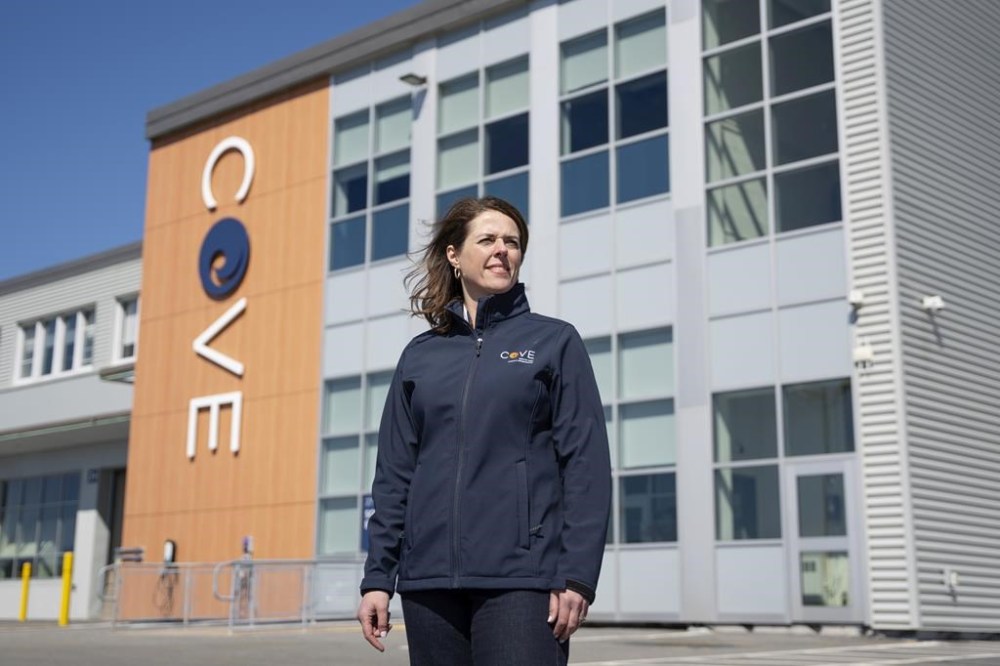
Melanie Nadeau, CEO of the Centre for Ocean Ventures and Entrepreneurship (COVE), poses at the company's headquarters in Dartmouth, N.S. on Thursday, April 13, 2023. THE CANADIAN PRESS/Darren Calabrese

The inside is also unrecognizable from its Coast Guard origins: machine shops whir with the sound of high-tech equipment, engineers tweak the latest prototypes, entrepreneurs work in a startup yard, and office and meeting spaces are filled with some of the greatest minds in the field of ocean technology.

“People from the Coast Guard come here and say, ‘I worked here 15 years ago, and I never imagined this is what it could be,'” said COVE chief executive Melanie Nadeau during a wide-ranging interview.

“It shows how we’ve repurposed this site to create a cluster of innovators around marine technologies.”

After an extensive renovation, the former federal facility reopened in 2018 as a hub for Canada’s marine technology sector. In five short years — much of it in the depths of a global pandemic — COVE has landed on the international stage as one of the most cutting-edge marine innovation ecosystems in the world.

It’s now home to 65 local and international businesses — with a waiting list for its workshops and office space.

The companies are involved in research ranging from sea level rise and ocean floor mapping to offshore energy and ocean shipping sustainability.

“There’s a big misconception this is just a Nova Scotia thing,” Nadeau said. “The research being done at COVE on climate change and defence and security affect our entire country.”

She added: “These aren’t regional issues — these are national issues. It’s a Canadian imperative.”

One of the resident businesses, Kraken Robotics, has developed unmanned underwater vehicles with subsea sonar and laser sensors.

Precise Design, which also operates out of COVE, engineers and manufactures custom casings that enable scientific equipment to withstand some of the ocean’s deepest depths.

Merinov does applied research in fisheries, aquaculture and food processing sector.

“We’re creating and testing tools to improve the sustainability of the fisheries and shellfish and seaweed farming sectors,” said Flora Salvo, a project manager with Merinov. “At COVE, we have access to everything we need for research and development. It’s the centre of the blue economy in Canada.”

The innovation happening at COVE has helped attract the attention of leaders in the marine technology and defence sectors.

“Now we’re global. Our brand is known all over the world,” Nadeau said. “In a span of six weeks, we had 22 VIP visits from places like the Middle East, the U.K., France and Europe.”

Nova Scotia Premier Tim Houston has also been met with broad interest in COVE when overseas.

“We have many gems in Nova Scotia and COVE is certainly an exciting one,” he said. “More and more, the world is realizing Nova Scotia’s potential.”

It’s that reputation and innovative capabilities that has spurred NATO’s interest in Halifax as it rolls out a new program.

The Nova Scotia capital is in the running to be the North American home for the Defence Innovation Accelerator for the North Atlantic, or DIANA. Halifax would complement the European office in London, England.

The DIANA program would come with dozens of new NATO jobs, funding for research and the chance for local companies to commercialize so-called dual-use technology for both civilian and military purposes.

“The DIANA program taps into the expertise of our resident companies and gives them access to 30-plus countries looking for a solution to answer a problem that they have,” Nadeau said.

“It can be anything from quantum computing and surveillance to clean technologies, artificial intelligence and biotech.”

The program dovetails with COVE’s focus on commercialization — one of the tech hub’s key goals.

“We’re really good at creating (intellectual property), and then the IP either gets sold to the U.S. or other places,” she said. “We’re not well versed on commercialization. It’s a big gap in the market and that’s where the value is.”

COVE is also focused on sustainability, climate change and the decarbonization of marine-based industries.

“We’re transforming legacy industries,” Nadeau said. “We’re really pushing forward on what the world will look like in 20 years.”

While COVE works with researchers and government and has an incubation facility, its primary focus is industry.

One of the major issues for the marine technology industry is finding workers, Nadeau said.

“There’s a big labour gap,” she said. “It’s not a two-year labour challenge, it’s a decade long labour challenge.”

The shortage of workers spans multiple disciplines — not just ocean science, Nadeau said.

“People think of the ocean and they think about ocean science, but we need people in commerce, engineering, computer science, marketing … it’s quite multi-disciplinary,” she said.

There are also efforts to diversify the sector as well as improve retention, Nadeau said.

Meanwhile, one of COVE’s main areas of expertise is robotics and the use of marine observation tools to collect ocean data.

“We want to improve existing data but then also automate the collection of data and create real time data,” she said. “Under 10 per cent of the ocean has actually been explored.”

This report by The Canadian Press was first published May 7, 2023.

Report Error Submit a Tip

More Stories

Nurses disciplined for botched IV infusion

Nicole Buffie 3 minute read Preview

Nurses disciplined for botched IV infusion

Nicole Buffie 3 minute read Thursday, Oct. 8, 2026

Two nurses working at the Grace Hospital have been reprimanded and fined $2,500 each for an IV infusion gone bad and an attempted coverup.

The incident happened on November 23, 2023 when a nurse asked a colleague to set up an IV infusion on him in an unused operating room.

During the attempted IV start, the nurse lost consciousness. The nurse who attempted the IV drip and another who was in the room called for help and several staff responded.

The nurse regained consciousness and vomited, but recovered and continued to work his shift, a March 18 decision by the College of Registered Nurses of Manitoba says.

Read
Thursday, Oct. 8, 2026

Nature doesn’t waste its time

Russell Wangersky 7 minute read Preview

Nature doesn’t waste its time

Russell Wangersky 7 minute read 2:01 AM CDT

Sixteen months in and the black burn from a forest fire somehow transitions from the foreground to the background. I’m not sure if it actually softens, if it really changes, or if is just that your eyes, now used to the background, start seeing less of it.

One thing’s for certain: nature doesn’t waste any time taking its opportunities. In the sheltered ground behind where the shed over our Newfoundland root cellar used to be, a forest of sorrel has arisen, its dark-green leaves with their distinctive double horns at their base crowding in tight amongst each other.

It’s no surprise: sorrel is new beginnings, often the first plant I see recultivating abandoned gardens or disturbed ground and I’m happy to have it around always. Its distinctive lemony bite is a fine addition to salads, though we’re not likely to choose it from that particular root cellar patch. Not with the way the asphalt roof shingles burned right around there. I shovelled up the heavy pats of congealed black tar last spring, right after the fire, bringing them up from inside the cellar in big plastic buckets to send to safe disposal. But there’s probably plenty of tar still in the ground and out of sight — hardly an appetizing thought.

From other areas, maybe we will eventually sample sorrel: it depends on how close they were to the house or shed or anything else that burned. And so very much burned. The province has said gardens are safe from contamination by fire-retardant chemicals as nothing has shown up in tests. But we know what way the wind was blowing — what burned, and where, is always part of the equation. It’s a strange calculation to make: I’m just glad our house wasn’t heated with fuel oil, was too old to contain asbestos, and didn’t have indoor plumbing for decades.

Read
2:01 AM CDT

Landlords will face fines for breaching confidentiality

Carol Sanders 4 minute read Preview

Landlords will face fines for breaching confidentiality

Carol Sanders 4 minute read Yesterday at 5:04 PM CDT

The province is amending legislation to allow landlords to be penalized if they breach the confidentiality of tenants who break their lease by obtaining a domestic violence certificate.

“Hopefully, now there’s going to be measures in place so that if this happens again, and God forbid it happens again to anyone else, that there would be penalties imposed on landlords who do that,” said one victim whose concerns were published on the front page of the Free Press last month.

Under current legislation, landlords must ensure that any information received from those tenants regarding the termination of the tenancy is kept confidential, but there are no penalties for landlords who violate that section of the act. After hearing from victims put at risk when landlords broke the law by violating their confidentiality, the government announced Monday that it is amending the Residential Tenancies Act to allow for penalties.

The young woman who spoke to the Free Press showed that her landlord copied her alleged abuser in email correspondence that included her personal email address and the domestic violence certificate she obtained in 2025 to end a tenancy agreement early and leave an abusive relationship.

Read
Yesterday at 5:04 PM CDT

Get to know your Jet: Mario Ferraro

Mike McIntyre 8 minute read Preview

Get to know your Jet: Mario Ferraro

Mike McIntyre 8 minute read Thursday, Oct. 8, 2026

A one-on-one conversation with a Winnipeg Jet about the stuff you don't always hear in the media scrum

Read
Thursday, Oct. 8, 2026

Yielding attraction

Joel Schlesinger 6 minute read Preview

Yielding attraction

Joel Schlesinger 6 minute read 2:01 AM CDT

Yield is a Rorschach test for investors. Where one see opportunity in high payouts from an investment, another sees high risk.

Consider bonds: yields are moving higher, which implies higher risk in the market, but to an investor considering buying a bond, higher yields represent higher income.

For most of the past 18 years, bond yields have been near historical lows and investors have sought alternatives.

“Canada’s population is aging, with a growing number of investors approaching or entering retirement and looking for more income,” says Pat Sommerville, co-chief executive officer of Hamilton ETFs in Toronto.

Read
2:01 AM CDT

Phoneless concert a beautiful chance to bask in moment

Jen Zoratti 5 minute read Preview

Phoneless concert a beautiful chance to bask in moment

Jen Zoratti 5 minute read 2:01 AM CDT

Outside the Scotiabank Arena in Toronto, digital billboards flashed fans their singular photo op for the night: “I took this photo before I saw Phoebe Bridgers: The Lost Tour 2026.”

It is, as it is for so many other people, my only documentation of a concert by one of my favourite artists. The American singer-songwriter — who I discovered at the Winnipeg Folk Festival in 2018 — has had a meteoric rise in the past few years, winning three Grammys in 2024 as one third of Boygenius, the indie-rock supergroup rounded out by Lucy Dacus and Julien Baker, and opening for Taylor Swift on select dates of her titanic Eras Tour.

Now, Bridgers is touring in support of Lost Weekend, her third album and first since 2020’s Punisher. It’s a feat of a record, a richly textured meditation on loss and grief, written in the aftermath of the death of her dad, with whom she had a complicated relationship.

So she is in a position to not only play multiple sold-out arena shows, but also insist that those shows be phone-free.

Read
2:01 AM CDT